15 Minutes
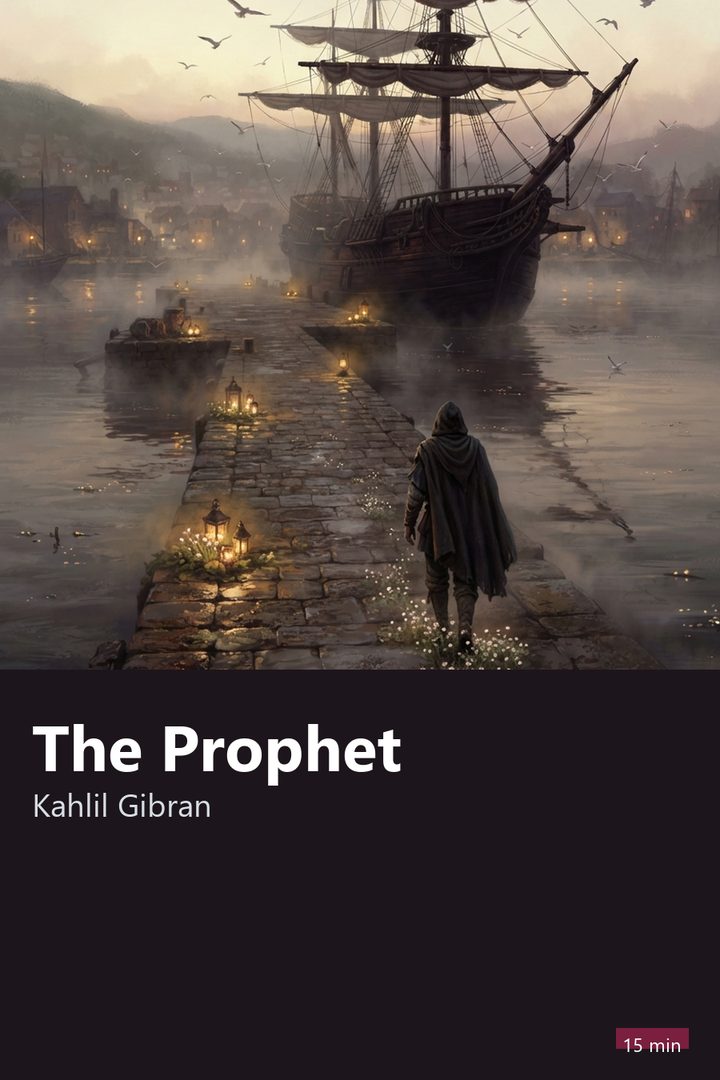
Cover of The Prophet

Spirituality · 16 min

The Prophet

Kahlil Gibran · 1923

Who it's for

For anyone who likes to stop and think about the big passages of life, such as love, work, and grief, without depending on a particular religion to do it. It also works for people who have heard a passage from The Prophet at a wedding or a funeral and want to understand the whole book behind that stray line.

Read it in the app

⚡ Free to download • 🎁 One full book free every day

🎧 Audio coming soon in the app

Narration for the English summaries is on its way. Meanwhile you can read the full summary in the app.

3 ideas to take with you

1

For the author, raising a child to fulfill the dream you never fulfilled is mistaking a parent's love for a personal project you put off.

2

According to Gibran, work that carries some real usefulness for another person keeps its meaning even when the task itself doesn't excite you.

3

In the book, Almustafa suggests that much of what we call a lack of freedom is a chain the person forged for themselves.

“
For Gibran, a marriage that demands total fusion all the time weighs more than accepting, without guilt, each person's space within the relationship.
An idea from The Prophet, in the words of 15 Minutes

Preview

Start reading now

The prophet who waited for the ship

The Prophet tells the story of Almustafa, a man who lived twelve years in the fictional city of Orphalese, far from where he was born. He arrived as a stranger and came to be heard as a kind of sage of the city. At the start of the story, he spots on the horizon the ship that has come to take him back home.

Before he boards, Almitra, described as a seeress, who was the first person in the city to recognize something different in him when he arrived twelve years earlier, asks Almustafa to speak to the people before leaving, and that request opens the structure of the book: the crowd gathers, and each person asks about a theme of life.

This simple frame gives unity to a book that, in practice, is a sequence of poetic answers that are almost independent of one another. The farewell scene lends urgency to the whole: a man about to leave tries to condense everything he has learned about living into a single afternoon.


Love: the sickle that also prunes

About love, Almustafa makes it clear that it is not a calm choice: when it beckons, you follow, even if the path is steep. Gibran describes love as a force that threshes you like wheat on the threshing floor, that beats and sifts you until it separates husk from grain.

Love, besides welcoming, also exposes: it crowns, but it also crucifies. It brings joy and the pain of opening up to another person without the disguises of everyday life. Whoever seeks only the comfortable side of love should look for something else, because complete love charges for both faces.

In the end, Almustafa says love asks for nothing but itself to be complete. In everyday terms, it would be loving someone not because it solves your loneliness, but because the person alone is the whole reason.

Marriage: two pillars, one roof

Almustafa's answer about marriage is still read at ceremonies all over the country: the two should stay together, but leave space between them, like the pillars of a temple that hold up the same roof without touching.

The image repeats: fill each other's cup, but do not drink from the same cup; give each other bread, but do not eat from the same piece; dance together, but let each have moments alone, like the strings of an instrument that play together without touching.

The practical message is direct: love that becomes total fusion suffocates over time. It is the same argument behind a couple who keep their own circle of friends or their own gym schedule even while married: closeness that lasts respects some distance.

13 more sections and the quiz

Continue in the app

Read the whole summary, finish with the The Prophet quiz and follow the guided Journeys. No ads in the app.

About Kahlil Gibran

Kahlil Gibran was born in 1883 in the village of Bsharri, in Lebanon, and emigrated to the United States as a child, growing up in Boston's Lebanese neighborhood. Besides being a writer, he was a painter and illustrator, and he spent much of his adult life in New York, tied to a circle of Arab-American writers who published in both Arabic and English. The Prophet, released in 1923, became his best-selling book and one of the most reprinted of the twentieth century. Gibran died in 1931, at age 48, in New York, from liver problems.

Explore

Category:
Spirituality