15 Minutes
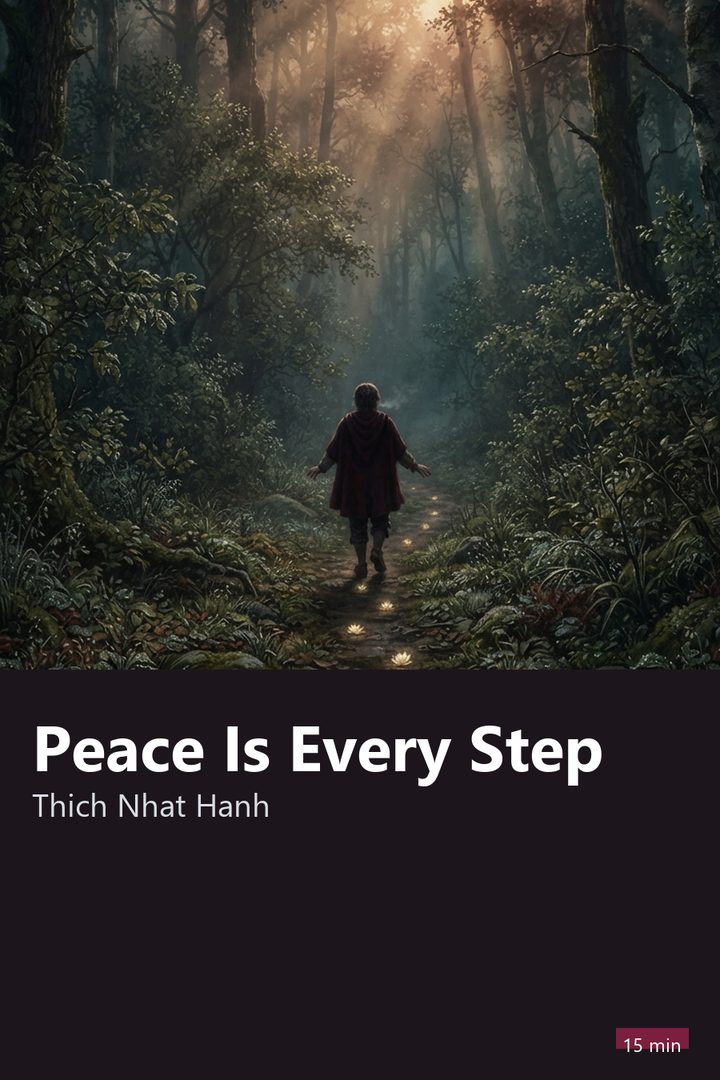
Cover of Peace Is Every Step

Spirituality · 15 min

Peace Is Every Step

Thich Nhat Hanh · 1991

Who it's for

For you if you live on autopilot, run over by your calendar, traffic, and notifications, and feel the day slipping by without you ever truly being present in it. Peace Is Every Step is for people who want to test, in practice, small ways of coming back to mindfulness without having to become a monk or find a free hour every day.

Read it in the app

⚡ Free to download • 🎁 One full book free every day

🎧 Audio coming soon in the app

Narration for the English summaries is on its way. Meanwhile you can read the full summary in the app.

3 ideas to take with you

1

Treating your own anger like a crying baby in your arms, instead of swallowing it or taking it out on someone else, is the path the book proposes so anger doesn't get to choose your next words.

2

For the author, a person at war with their own mind tends to feed more conflict around them than a person who has already made peace with themselves.

3

For the author, the mind works like a garden: paying repeated attention to a feeling is watering that seed and making it grow stronger inside you.

“
For Thich Nhat Hanh, a red light in traffic can work as a bell of mindfulness: instead of feeding the rush, it opens a pause to breathe before reacting.
An idea from Peace Is Every Step, in the words of 15 Minutes

Preview

Start reading now

The red light is a bell of mindfulness

Think about traffic in any big city: you're late, the light turns red, and the automatic reaction is irritation. According to the monk, any interruption of autopilot, a red light, the ring of a bell, a car horn, can become an invitation to come back to your own body, instead of staying in your head planning the next appointment.

The idea is to turn everyday annoyance into a reminder, not into fuel for more irritation. For a lot of us that might be the traffic light at the corner, the line at the bank, the packed bus that runs late. Instead of resisting, the book's invitation is to use that forced pause to breathe three times with attention before going back to autopilot.

It's not about liking traffic, it's about not letting every obstacle become one more dose of accumulated stress, which by late afternoon turns into unexplained exhaustion. The bell of mindfulness, whatever it is in your routine, is free and always available.

Breathe on purpose, not out of habit

Everybody breathes all day long without thinking about it, and that's exactly why breathing becomes, in the book, the most accessible tool of mindfulness: it's already happening, you just have to notice it. Stopping for a minute to feel the air going in and out is enough to pull the mind back to the present, taking it out of the autopilot of worry.

The suggested practice is short on purpose: notice the in-breath as an in-breath and the out-breath as an out-breath, without controlling the rhythm, just observing. It doesn't require any special posture; you can do it sitting at work, in the checkout line, or between one call and the next.

The payoff isn't instant, magical relaxation, it's the habit of coming back to your body several times a day, instead of spending the whole day only in your head. Over time, that return reduces the feeling of always running after your own life.

Smile before you feel like it

One of the most repeated pieces of advice in the book seems silly at first: smile on purpose, even with no apparent reason, because of the effect your facial expression has on your inner state. It's not a request for a forced smile to impress anyone; it's a physical reminder that you can choose how to inhabit your face in a tense moment.

In practice it can be a small smile when you wake up, before you pick up your phone, or a second before a difficult meeting. The idea is that body and mind talk to each other in both directions: if a tense mind tightens the face, a face relaxed on purpose also calms the mind, even if only a little.

It's not a solution to a real problem, like an overdue bill or a serious fight at home. It's a small adjustment of inner posture that costs nothing and fits in thirty seconds, whether you're in the bus line or waiting for your boss to pick up the phone.

11 more sections and the quiz

Continue in the app

Read the whole summary, finish with the Peace Is Every Step quiz and follow the guided Journeys. No ads in the app.

About Thich Nhat Hanh

Thich Nhat Hanh was a Vietnamese Buddhist monk, born in 1926 and died in 2022, exiled from Vietnam in 1966 for his activism against the war and for reconciliation between the sides of the conflict. In 1967, Martin Luther King Jr. nominated the monk for the Nobel Peace Prize, recognizing his peace work during the Vietnam War. In 1982, he founded Plum Village, a monastery and practice center in the south of France that became the worldwide base of what is called engaged Buddhism. He wrote more than a hundred books over his lifetime, and Peace Is Every Step, originally published in 1991, is one of the most widely read outside Buddhist circles.

Explore

Category:
Spirituality
Part of the Journeys:
Unhurried Spirituality