15 Minutes
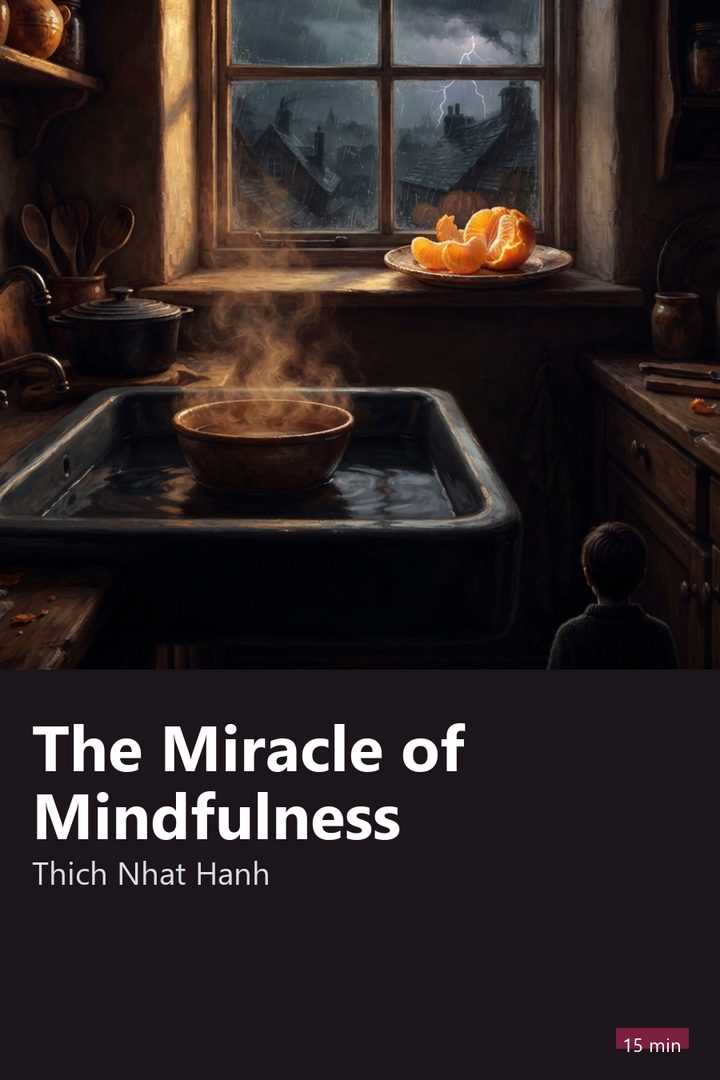
Cover of The Miracle of Mindfulness

Spirituality · 16 min

The Miracle of Mindfulness

Thich Nhat Hanh · 1975

Who it's for

For people who live with their heads in the next task before finishing the current one, and who want to understand where the term mindfulness came from before it became a wellness app product.

Read it in the app

⚡ Free to download • 🎁 One full book free every day

🎧 Audio coming soon in the app

Narration for the English summaries is on its way. Meanwhile you can read the full summary in the app.

3 ideas to take with you

1

The mindfulness described in this book was born as an emotional survival tool for exhausted volunteers in a war, not as a wellness product.

2

For the author, what we call the self is a flow of moving layers, not a fixed, solid identity.

3

According to the book, watching a thought pass without stepping into it creates a distance that changes your relationship with your own mind.

“
For Thich Nhat Hanh, doing the task in front of you with your head already on the next one means doing both halfway.
An idea from The Miracle of Mindfulness, in the words of 15 Minutes

Preview

Start reading now

A letter written in the middle of a war

In 1974, Vietnam was still at war, and a group of young monks and lay volunteers worked day and night rebuilding bombed villages, caring for the wounded, and burying the dead. The group was called the School of Youth for Social Service, and one of its youngest leaders, a monk named Quang, asked Thich Nhat Hanh for help: how could they keep serving without destroying themselves inside?

The answer was a long, handwritten letter that later became a book. It is not an academic manual or a weekend meditation course: it is a text of rescue, written by someone worried about the burnout of people who buried friends in the morning and went back to work in the afternoon.

That detail changes how you read the whole book. The mindfulness it describes was not born in a quiet retreat. It was born as an emotional survival tool for people who did not have the luxury of stopping. It is the opposite of a wellness product sold to people with plenty of free time.


Washing the dishes just to wash the dishes

The author tells of a friend who washed dishes in a hurry, paying no attention at all, just to finish quickly and sit down for tea. He then proposes the opposite: wash the dishes to wash the dishes, with total attention to what your hands are doing at that moment, without rooting for the next one.

It seems like a silly detail, but it is the heart of the whole book. Most people spend the entire day rushing to finish one task and get to the next, pushing every minute away to feel that real life only begins later: after work, after the weekend, after paying the bills.

The proposal is not to give up your plans or stop working. It is to notice that doing the task in front of you while your head is already on the next one costs a lot: both things come out half done, and neither turns out well.

What mindfulness is not

The term became a fad, so it is worth separating what the book actually proposes from what the word came to mean afterward. Mindfulness, in the original text, is not relaxing, not emptying your mind, and not running from your problems. It is exactly the opposite: paying total attention to what is happening, even when it is uncomfortable.

The author describes mindfulness as keeping awareness of present reality alive, whether it is good or bad. If you are angry, mindfulness is not faking calm: it is recognizing 'I am angry right now' with clarity, instead of acting on autopilot or suppressing the feeling.

This difference matters because many people try to use breathing techniques to make a discomfort vanish when, really, it needs to be faced. The book treats mindfulness as a way of seeing your own life more clearly, not as an emotional painkiller.

12 more sections and the quiz

Continue in the app

Read the whole summary, finish with the The Miracle of Mindfulness quiz and follow the guided Journeys. No ads in the app.

About Thich Nhat Hanh

Thich Nhat Hanh (1926-2022) was a Vietnamese Zen Buddhist monk, born in Hue. During the Vietnam War, he founded the School of Youth for Social Service, training volunteers to rebuild villages destroyed by the fighting. In 1967, he was nominated for the Nobel Peace Prize by Martin Luther King Jr. He lived for decades in exile from his homeland and founded the Plum Village community in France, where he taught mindfulness for decades before returning to Vietnam, where he died in 2022.

Explore

Category:
Spirituality
Part of the Journeys:
Let Your Mind Go