15 Minutes
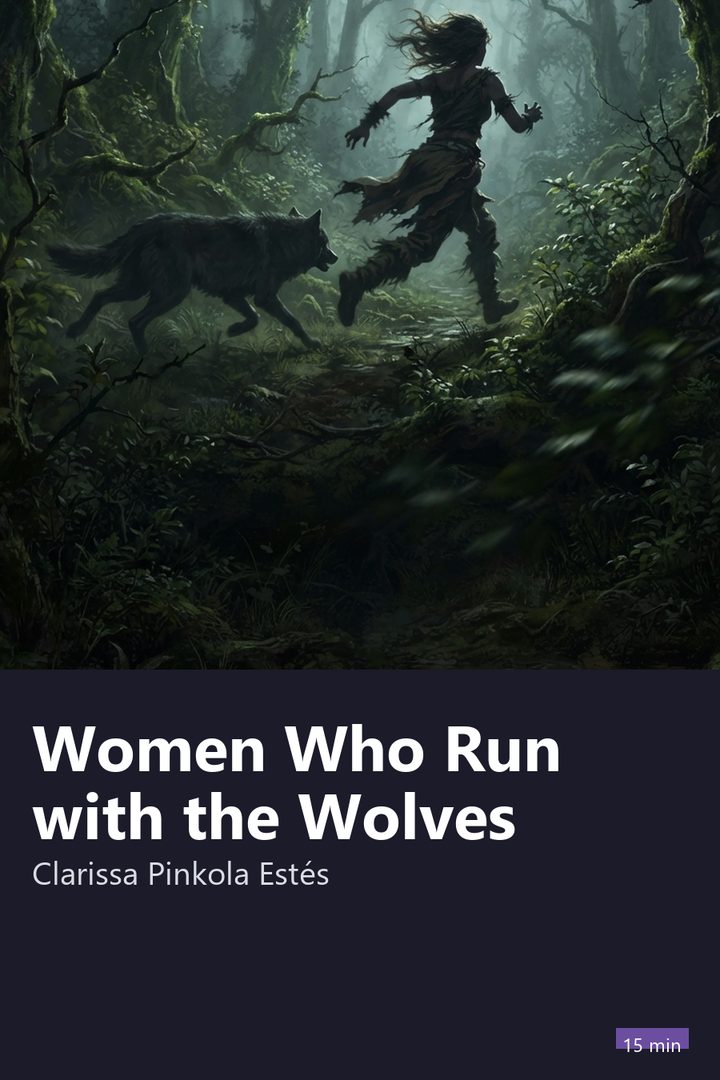
Cover of Women Who Run with the Wolves

Psychology · 14 min

Women Who Run with the Wolves

Clarissa Pinkola Estés · 1992

Who it's for

For women who are tired of pleasing everyone and want to find their way back to what is truly their own, through the path of tales and symbols. It is also for readers who enjoy Jungian psychology and ancient stories, as long as they don't expect a scientific manual.

Read it in the app

⚡ Free to download • 🎁 One full book free every day

🎧 Audio coming soon in the app

Narration for the English summaries is on its way. Meanwhile you can read the full summary in the app.

3 ideas to take with you

1

In the author's reading, charm that doesn't match the actions of the person showing it is a warning sign, and it's worth watching what someone does more than what they promise.

2

According to the book, not fitting into a group may simply mean that your pack is a different one, and you just haven't found it yet.

3

The text suggests that living only to be useful to others hollows a person out, and that her own joy is also part of what she has to offer.

“
What you set aside can be gathered little by little, bone by bone, and patience usually pays off more than hurry.
An idea from Women Who Run with the Wolves, in the words of 15 Minutes

Preview

Start reading now

The Woman Who Lost Her Sense of Smell

You know someone like this, or you've been her yourself: the woman who wakes up early, takes care of the kids, her aging father, her husband, her job and her church group, and reaches the end of the day not knowing what she likes. She still smiles, she still handles everything, but inside she feels a kind of strange silence, as if some part of her had been left behind.

This is the feeling that Clarissa Pinkola Estés's book starts from. Her thesis is that many women were taught to adapt to others so much that they ended up losing touch with their own instinctive nature. The author gives this forgotten part the name Wild Woman.

Wild here doesn't mean rude or out of control. It means natural, intuitive, connected to what is alive in you. The book is an attempt to help you find that part again through ancient stories, which the author retells and comments on with a psychoanalyst's eye.

Who the Wild Woman Is

The Wild Woman is not a person, she is an archetype, a word used in Jung's psychology to talk about images and patterns that show up in many cultures. For the author, this figure represents the part of a woman that knows how to sniff out what is true, say no, create, rest and protect what she loves.

The wolf comes in as a symbol because, according to her, wolves and women share similar traits: acute sensitivity, a strong bond with their young and with the group, the ability to endure exhaustion, and a great need for space of their own. In both cases, the author reminds us, they have been misunderstood and persecuted.

It's best to read this as a poetic comparison, not as biology. What the book offers is an image, a lens for seeing your own exhaustion, and each reader decides whether it helps or not.

Why Stories and Not Rules

The book's method is to tell tales. Instead of listing advice, the author retells narratives from many origins, such as peasant stories, fairy tales and legends, and then interprets each scene step by step. The idea is that the story speaks through images, and that the reader recognizes something of her own in it.

Think of the grandmother who, instead of lecturing, told a story from the farm and let the moral appear on its own. It works the same way: the tale enters through the imagination, and later we realize it was about us. For Jungian psychology, ancient symbols show universal ways of facing loss and new beginnings.

Readers who prefer data and experiments will find this strange. But those who accept the game may find, in the stories, a way of talking about pain and desire that technical language often lets slip away.

11 more sections and the quiz

Continue in the app

Read the whole summary, finish with the Women Who Run with the Wolves quiz and follow the guided Journeys. No ads in the app.

About Clarissa Pinkola Estés

Clarissa Pinkola Estés was born in the United States in 1945, to a family with Latin and Hungarian roots. She holds a doctorate in ethno-clinical psychology, and she is a Jungian psychoanalyst and a poet. She also presents herself as a storyteller, a tradition she learned in her family and one that sits at the center of her work. Women Who Run with the Wolves came out in 1992 and stayed on the bestseller lists in the United States for a long time.

Explore

Category:
Psychology
Part of the Journeys:
Jung, Myths, and Symbols