15 Minutes
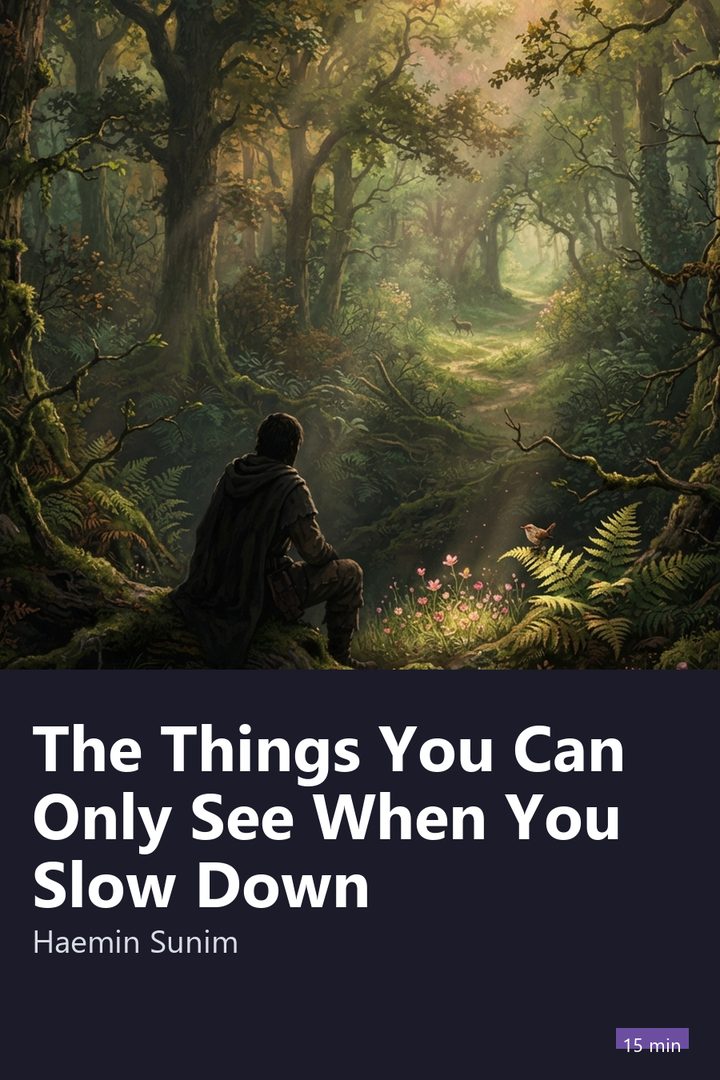
Cover of The Things You Can Only See When You Slow Down

Psychology · 15 min

The Things You Can Only See When You Slow Down

Haemin Sunim · 2012

Who it's for

For you if you are always rushing, feel tired on the inside, and suspect that life is passing by unseen. The book gathers short reflections from a Buddhist monk on rest, emotions, relationships, and purpose.

Read it in the app

⚡ Free to download • 🎁 One full book free every day

🎧 Audio coming soon in the app

Narration for the English summaries is on its way. Meanwhile you can read the full summary in the app.

3 ideas to take with you

1

Intense emotion tends to pass like a wave: naming it and taking a breath helps you avoid acting at your worst moment.

2

Loving someone also means leaving room for them to be who they are, instead of shaping them to your liking.

3

According to the book, figuring out what suits you takes time, and it is worth more than copying the path of the person next door.

“
According to the book, resting is not wasting time: it is what lets you see what hurry hides.
An idea from The Things You Can Only See When You Slow Down, in the words of 15 Minutes

Preview

Start reading now

A book to read slowly

Haemin Sunim is a South Korean Zen Buddhist monk who lived and studied in the United States. In 2012, he published in South Korea a collection of short reflections on rest, emotions, relationships, and purpose. The book sold millions of copies there and reached the West a few years later, in English translation and then in other languages.

Unlike a treatise, the work is made of short texts that fit into a lunch break or a bus ride. There is no step-by-step method and no single thesis. The idea that ties it all together is in the title: when we slow down, we start to notice things that hurry hides, such as the tiredness of the body, the mood of the person beside us, and our own desires.

This summary organizes the book's themes and offers everyday examples, without reproducing the texts. It is worth remembering that this is a book of reflection and inspiration, not of treatment. When we talk about anxiety, sadness, or burnout, the recommendation is to add the book to professional help, not to swap one for the other.

Resting is not wasting time

The first big theme is rest. For the author, we live as if hurry were a virtue, and whoever stops is seen as lazy. The book suggests the opposite: stopping now and then is what lets you see clearly what really matters. A tired mind sees bigger problems and smaller solutions.

This holds true in everyday American life, where long workdays, traffic, and phones take up every minute. The suggestion is to create small islands of pause: five minutes looking out the window without a screen, a short walk after lunch, a Sunday with no schedule. It sounds simple, but it takes courage to accept that the world will not fall apart if you stop.

Rest also shows up as care for the body. Sleeping well, eating slowly, and breathing deeply are part of the work. The consensus in health is clear: too little sleep and chronic stress harm mood, memory, and immunity. The book works as a gentle reminder. If you have been exhausted for weeks, it is worth talking to a doctor, who can look into possible causes.

What changes when you don't react right away

Another theme is mindfulness. The book invites you to watch emotions the way you watch waves in the sea: they rise, reach a peak, and fall. When we are overtaken by anger or anxiety, it feels like it will last forever, but experience shows that the intensity tends to pass.

The suggested practice is the pause: between feeling and acting, breathe, name what you feel (I'm angry, I'm scared), and wait a few moments. This prevents the text sent in the heat of a fight, the snappy reply to the boss, the yelling at the kid. The emotion does not have to be denied, it just does not have to take the wheel.

The author also teaches not to confuse yourself with what you feel. I feel sad is different from I am a sad person, and that small difference opens room for self-care. Studies on mindfulness show moderate benefits for stress and anxiety in many people, but it does not replace treatment for disorders that call for professional follow-up.

10 more sections and the quiz

Continue in the app

Read the whole summary, finish with the The Things You Can Only See When You Slow Down quiz and follow the guided Journeys. No ads in the app.

About Haemin Sunim

Haemin Sunim is a South Korean Zen Buddhist monk. He studied in the United States, at Berkeley, Harvard, and Princeton, and taught Buddhist studies at Hampshire College. The book, published in South Korea in 2012, sold millions of copies. The English edition came out in 2017, followed by translations into many other languages.

Explore

Category:
Psychology
Part of the Journeys:
Truly Rest