15 Minutes
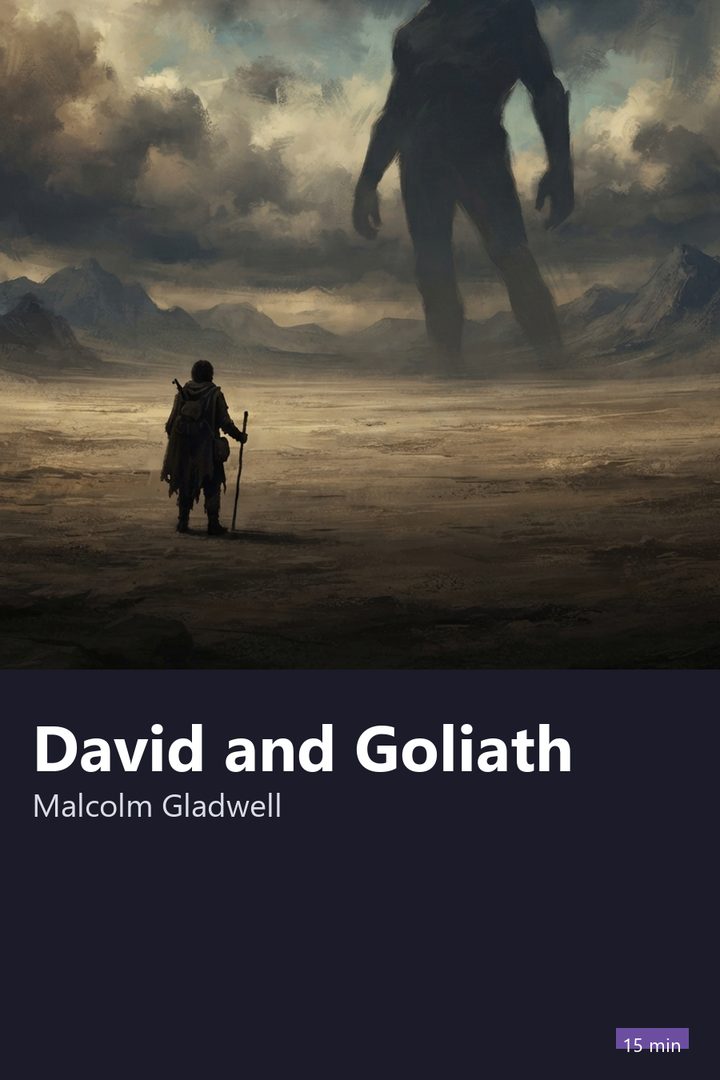
Cover of David and Goliath

Psychology · 16 min

David and Goliath

Malcolm Gladwell · 2013

Who it's for

For you if you've ever felt small next to a competitor, an exam, or a boss, and want to understand how the underdog sometimes wins. The book mixes stories from basketball, school, war, and justice to rethink what strength really is.

Read it in the app

⚡ Free to download • 🎁 One full book free every day

🎧 Audio coming soon in the app

Narration for the English summaries is on its way. Meanwhile you can read the full summary in the app.

3 ideas to take with you

1

According to Gladwell, more resources help up to a point; after that, more can bring new problems.

2

A difficulty that gets support can become a unique way of learning; without support, it's just a difficulty.

3

Someone who can't win the big player's game can win by changing the game, but that takes effort and the courage to look strange.

“
Before deciding the other side is too big, ask which rules of the game make them big and whether you can play a different game.
An idea from David and Goliath, in the words of 15 Minutes

Preview

Start reading now

Giants aren't always what they seem

Everybody knows the story: a scrawny shepherd brings down a huge warrior with a single stone. Malcolm Gladwell starts there to ask whether we really understand what strength and weakness are. In the book, he mixes characters from all kinds of places, from kids' basketball teams to doctors, lawyers, and entire communities.

His thesis is that advantages and disadvantages are less clear-cut than they look. What seems like an advantage, such as money, size, or power, can bring problems. What seems like a disadvantage, such as poverty, dyslexia, or a loss in childhood, can force a person to create paths that the better positioned never even imagine.

The book has three parts: the advantages of disadvantages, the idea of difficulties that help you grow, and the limits of power. It's written as a collection of stories, which makes it light, but calls for care when drawing general rules. We'll go through the main points and the objections.

Was David really the weak one?

Gladwell revisits the biblical story. Goliath, protected by heavy armor, expected hand-to-hand combat, the only kind of duel he knew. David, a shepherd used to protecting his flock from predators, had a different weapon: the sling, used from a distance and at great speed, which was feared in ancient armies.

By refusing the king's armor and picking stones from the stream, David refused his opponent's game. Gladwell also mentions a medical hypothesis that Goliath may have had a health condition that affected his vision and slowed him down. It can't be proven, and the author admits it's speculation, but it helps shake the idea that the giant had everything.

The lesson is that weak and strong depend on the rules. The giant was only strong in the kind of fight he chose. Anyone facing someone much bigger, whether a large company, a wealthy competitor, or a more experienced opponent, can ask: can I play a different game?

The girls' team that played differently

One of the most cited cases is that of Vivek Ranadivé, a tech entrepreneur who, knowing nothing about basketball, decided to coach his daughter's team of twelve-year-old girls. The players had little skill, and he realized that, playing the usual way, they would lose by a lot.

The solution was to guard the opposing team all over the court for the entire game, a tiring and unusual kind of pressure at that age. The team won games it shouldn't have won and reached the national final. Gladwell points out that the tactic demands enormous effort and accepting looking strange, even ridiculous, which most big teams won't do.

He compares it to Lawrence of Arabia, who, in the First World War, led Arab fighters in a surprise attack across the desert against a Turkish port. Closer to home, the equivalent is the small team that goes off script and pressures the bigger one, or the small shop that beats the supermarket with a kind of service the chain can't deliver. The price of the strategy is the extra work.

10 more sections and the quiz

Continue in the app

Read the whole summary, finish with the David and Goliath quiz and follow the guided Journeys. No ads in the app.

About Malcolm Gladwell

Malcolm Gladwell was born in 1963 in England and grew up in Canada. He is a journalist and has written for The New Yorker since 1996. His best-known books include The Tipping Point, from 2000, and Outliers, from 2008. He also hosts the podcast Revisionist History.

Explore

Category:
Psychology
Part of the Journeys:
High Performance