15 Minutes
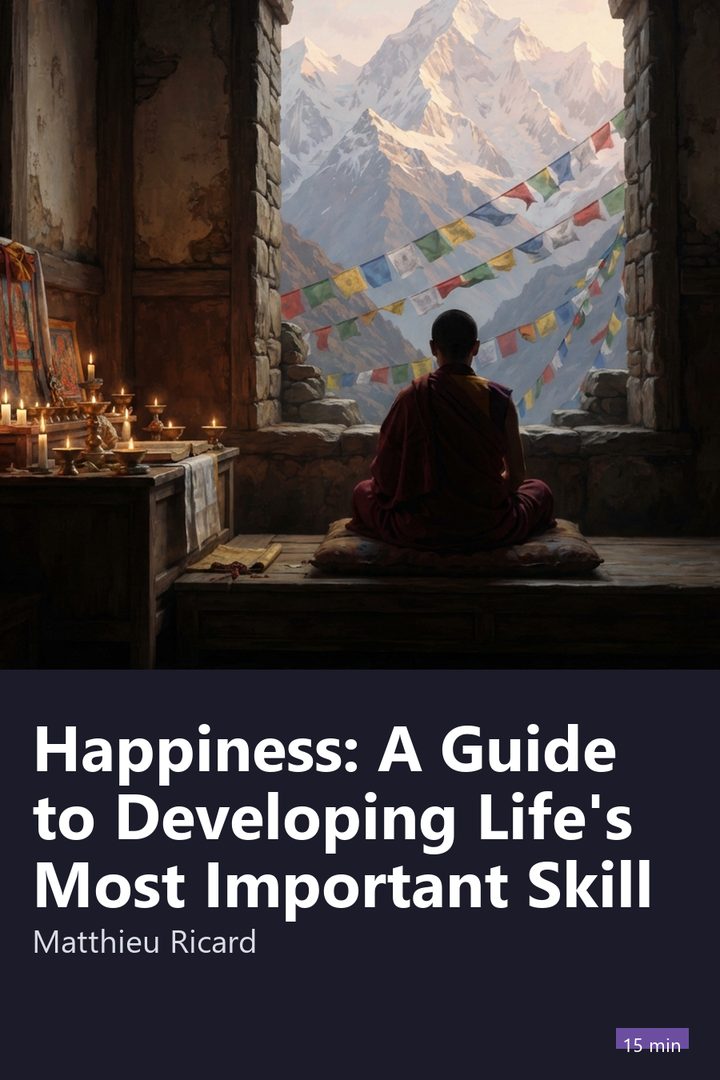
Cover of Happiness: A Guide to Developing Life's Most Important Skill

Psychology · 14 min

Happiness: A Guide to Developing Life's Most Important Skill

Matthieu Ricard · 2003

Who it's for

For you if you chase happiness through promotions, trips, and achievements, and feel it slipping through your fingers. It suits anyone who wants a Buddhist and scientific view of well-being, with simple mind-training exercises.

Read it in the app

⚡ Free to download • 🎁 One full book free every day

🎧 Audio coming soon in the app

Narration for the English summaries is on its way. Meanwhile you can read the full summary in the app.

3 ideas to take with you

1

Training the mind is like training the body: a little every day pays off more than a lot once in a while.

2

Being happy doesn't mean denying pain; it means learning to move through it without getting lost in it.

3

Training the mind helps, but it doesn't replace treatment when suffering is an illness.

“
For Ricard, pleasure comes from outside and passes; deep well-being is what remains when the stimulus is gone.
An idea from Happiness: A Guide to Developing Life's Most Important Skill, in the words of 15 Minutes

Preview

Start reading now

The question everyone asks and almost no one studies

Almost everyone says they want to be happy, but few can explain how. We organize our lives around goals, like a better job, a home of our own, a new car, and we imagine happiness will come in the package. When it arrives, it doesn't last long, and the cycle starts again with another goal.

Matthieu Ricard wrote the book to take this question seriously. For him, happiness is not a stroke of luck or a passing mood, but a state of deep well-being that can be cultivated. The idea is to treat it as a skill, something learned through training, not a gift.

The book blends the Buddhist tradition, in which the author has lived for decades, with research from psychology and neuroscience. Its aim is to be practical: instead of promising a magic formula, it offers a way of seeing and exercises for gradually developing a steadier, more generous mind.

The scientist who became a monk

The author's path helps explain the tone of the book. Ricard had a promising career in biology, worked at one of the most important institutes in Europe, and rubbed shoulders with leading researchers. Even so, he felt something was missing, and decided to study with Tibetan masters in the Himalayas.

He spent decades in retreats and monasteries, and became one of the people closest to the Dalai Lama in the West, serving as his interpreter. He also took part in scientific studies on meditation, which gave him a rare position: he speaks from inside the practice and knows the language of the laboratory.

This profile has advantages and risks. On one hand, he has real experience and scientific vocabulary. On the other, he writes from a life very different from most readers', with no paycheck job, no bills, no kids. It's worth reading with an eye to what can be adapted and what may only work in another context.

Happiness is not pleasure

The first step in the book is to separate two things we tend to mix up. Pleasure is an agreeable sensation that depends on a stimulus: the taste of food, music, a compliment. It's nice, but it has an expiration date. If you eat too much ice cream, pleasure turns into nausea.

For Ricard, true happiness is something else: a lasting well-being that doesn't depend on outside stimuli and can coexist even with hardship. It's like the difference between weather, which changes every day, and climate, which comes from deeper conditions. It doesn't eliminate emotions, but it gives you a foundation for moving through them.

That doesn't make pleasure a villain. Eating well, traveling, and enjoying a barbecue with friends are all great. The warning is against entrusting your happiness only to these things. Whoever depends on the next stimulus is chasing things that, by nature, pass, and ends up always one step behind what they seek.

11 more sections and the quiz

Continue in the app

Read the whole summary, finish with the Happiness: A Guide to Developing Life's Most Important Skill quiz and follow the guided Journeys. No ads in the app.

About Matthieu Ricard

Matthieu Ricard was born in France in 1946. He earned a doctorate in molecular genetics at the Pasteur Institute in Paris, but left his scientific career and became a Tibetan Buddhist monk, living in the Himalayas. He is the Dalai Lama's French interpreter and lives in a monastery in Nepal. He donates much of the proceeds from his books to humanitarian projects.

Explore

Category:
Psychology
Part of the Journeys:
The Science of Happiness