15 Minutes
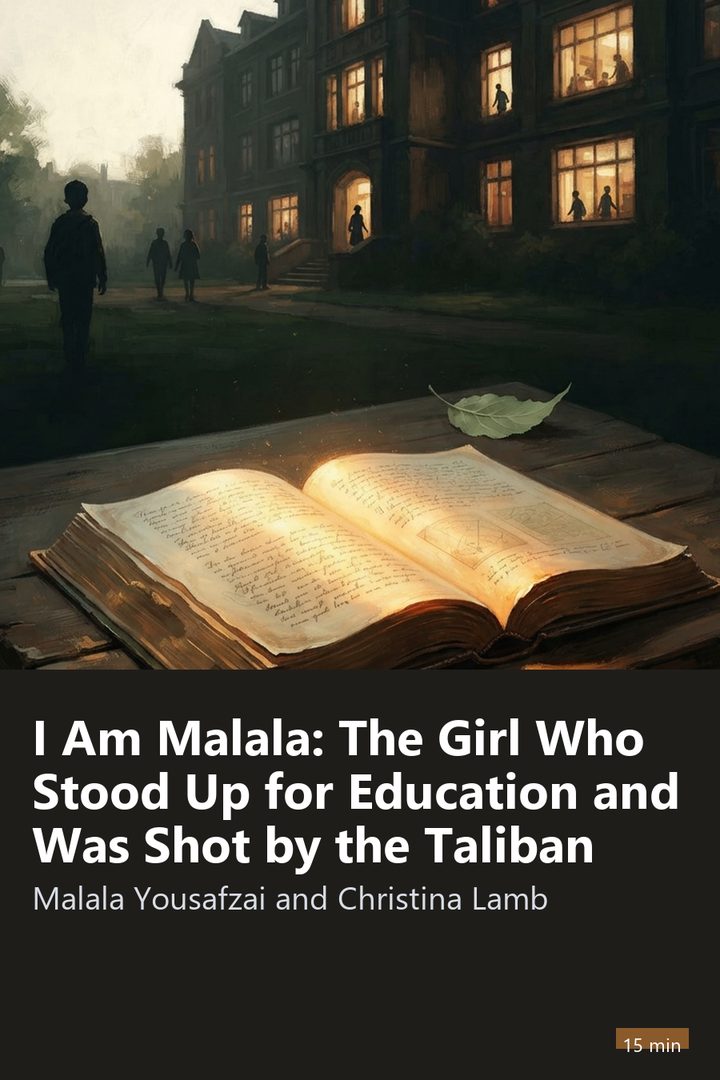
Cover of I Am Malala: The Girl Who Stood Up for Education and Was Shot by the Taliban

Biographies and Memoirs · 14 min

I Am Malala: The Girl Who Stood Up for Education and Was Shot by the Taliban

Malala Yousafzai and Christina Lamb · 2013

Who it's for

For anyone who wants to know Malala's story in her own voice and understand what is at stake when girls are kept from school. It is also useful for teachers, parents, and young people who want to talk about education and courage.

Read it in the app

⚡ Free to download • 🎁 One full book free every day

🎧 Audio coming soon in the app

Narration for the English summaries is on its way. Meanwhile you can read the full summary in the app.

3 ideas to take with you

1

When the state fails, whoever offers order, even a cruel one, gains ground, and that is why extremism grows where there is a vacuum.

2

A young, simple, well-placed voice can bring a hidden problem into the world's news.

3

According to the book, the same person can be a global symbol and, at the same time, a teenager homesick for her family.

“
A father who listens to his daughter can open a door that tradition kept closed.
An idea from I Am Malala: The Girl Who Stood Up for Education and Was Shot by the Taliban, in the words of 15 Minutes

Preview

Start reading now

A Girl and the Swat Valley

I Am Malala is the autobiography of a Pakistani teenager who became a global symbol of the fight for girls' education. The book is told in the first person and was written with the help of a British journalist, Christina Lamb, who organizes the political and historical context. The voice, though, is Malala's, with the direct tone of someone who was barely fifteen when the main story takes place.

She was born in 1997 in Mingora, a city in the Swat Valley, in northern Pakistan, a region of mountains, rivers, and orchards. She grew up in a Pashtun family, with very strong codes of honor, in a world where the birth of a girl was usually met with sadness rather than celebration. Her own birth was a sign that her home would be different.

Her name comes from an Afghan heroine, Malalai, who in the nineteenth century is said to have inspired soldiers to fight. The name carries the idea of courage from the start, and the book makes a point of recalling that the girl grew up among stories of bravery and also amid the harsh reality of a conservative society.
The Father, the School, and the Dream of Studying

Malala's father, Ziauddin Yousafzai, is a central figure in the book. He was a teacher and founded a school in Mingora with enormous effort, going through debt, overdue rent, and doubts about whether it was worth it. He stuttered as a child and overcame the problem by speaking in public, which made him a passionate speaker.

At home, he treated his daughter as someone entitled to an opinion. He invited Malala to listen in on adult conversations, gave her room to speak, and encouraged her to study. For him, a girl who learns is a girl who decides her own life. Her mother, Toor Pekai, could not read, but she supported the plan, though with some fear.

Picture a dad in your neighborhood who opens a little tutoring room in the back of his house because he believes education changes lives. That is a bit of the energy the book portrays: ordinary people who decide to believe in school as a way out, even with few resources.

The Mullah's Radio and the Fear That Arrives

The peace of Swat began to unravel in 2007. An extremist religious leader named Maulana Fazlullah started speaking on the radio every night, with a message that mixed religion, threats, and promises of quick justice. Many residents, tired of corruption and the slowness of the state, at first listened with curiosity or even sympathy.

Little by little, the tone became more aggressive. The group tied to him, part of the Pakistani Taliban movement, began imposing rules on how people should dress, think, and live. The book shows how extremism advances where there is a vacuum of authority: when the state fails, whoever offers order, even a cruel one, gains ground.

What began as preaching turned into control. Music shops were attacked, women were pushed out of public spaces, and anyone who criticized was threatened. The life of the Yousafzai family, always in favor of schools, became dangerous.

12 more sections and the quiz

Continue in the app

Read the whole summary, finish with the I Am Malala: The Girl Who Stood Up for Education and Was Shot by the Taliban quiz and follow the guided Journeys. No ads in the app.

About Malala Yousafzai and Christina Lamb

Malala Yousafzai was born in 1997 in the Swat Valley, in Pakistan, and became known for defending girls' right to education. She was shot in 2012 by men linked to the Taliban movement and, after recovering in England, received the Nobel Peace Prize in 2014. Christina Lamb is a British journalist and foreign correspondent for The Sunday Times, with long experience covering Pakistan and Afghanistan. The book was published in 2013 and has sold millions of copies.

Explore