15 Minutes
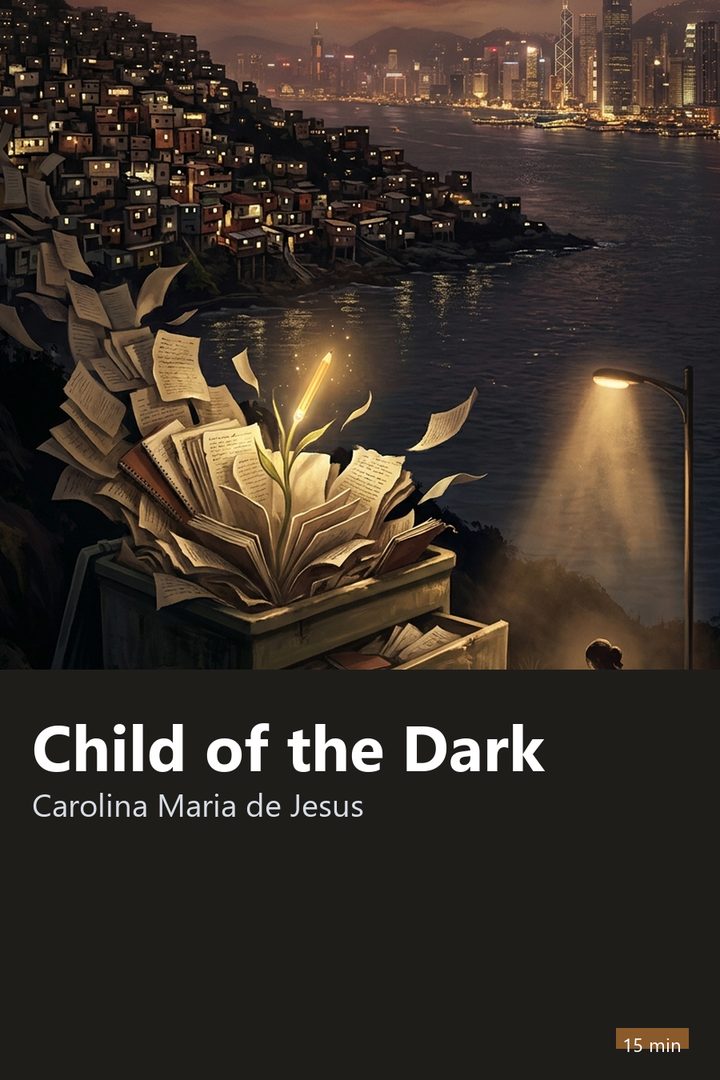
Cover of Child of the Dark

Biographies and Memoirs · 18 min

Child of the Dark

Carolina Maria de Jesus · 1960

Who it's for

For you who want to understand the roots of urban inequality through the eyes of someone who lived misery in her own skin. This book is essential reading for anyone seeking to see the power of writing as a tool of resistance and human dignity.

Read it in the app

⚡ Free to download • 🎁 One full book free every day

🎧 Audio coming soon in the app

Narration for the English summaries is on its way. Meanwhile you can read the full summary in the app.

3 ideas to take with you

1

Urban segregation works like a storage room that hides from public view the workers who keep the city itself running.

2

The extreme scarcity of food drains mental energy and reduces any life planning to a desperate race for the next meal.

3

Election-season handout politics offers temporary relief in poor neighborhoods to buy votes without changing the structures that perpetuate poverty.

“
Those who live off informal work carry the weight of the economy on their backs without the right to the smallest safety net when the body falls ill.
An idea from Child of the Dark, in the words of 15 Minutes

Preview

Start reading now

The junk room of the metropolis

In the 1950s, the city of Sao Paulo presented itself to the world as the capital of progress, raising modern buildings and celebrating its vibrant industry at a breakneck pace. Yet on the banks of the Tiete River, an entirely opposite reality was growing in the mud of the Caninde favela. It is in this setting that Carolina Maria de Jesus formulates the central metaphor of her work: she compares the wealthy city center to the living room of a mansion, while the favela serves as the junk room where society hides whatever it considers disposable.

This spatial division translates with precision the urban segregation that still marks the great Brazilian cities. Those who live in the outskirts travel for hours on packed buses and trains to work in the paved downtown, then return to alleys deprived of sanitation and running water. Carolina understood that the wealth displayed on Sao Paulo's avenues depended directly on the silent toil of thousands of workers ignored by the government.
The harsh routine of collecting scrap

Carolina's daily survival depended on heavy manual labor. She woke before dawn, tied a kerchief around her head, and walked for miles pushing burlap sacks, gathering newspaper sheets, torn cardboard, pieces of iron, and crushed tin cans. Every pound collected on the sidewalks was sold at the scrapyard to earn the few cruzeiros that guaranteed the day's food.

This daily routine portrays the harshness of anyone who works as a scrap collector with no labor protections at all. In total informality, there is no signed work card, no vacation, no paid rest. When it rained and the cardboard got soaked, the scrapyard refused the load and the family was left without income, proving that informal subsistence is a tightrope where any setback turns into hunger.

The constant effort charged a high price from the author's physical health. In occupational medicine, carrying excessive weight without proper ergonomics destroys joints and demands medical care that Carolina could not afford. Even with back pain and calloused hands, she kept pulling her bundles to feed her children.

The yellow color of hunger

For governments and statisticians, malnutrition is usually just an abstract number in reports. In Carolina's account, however, the lack of food gains a terrifying physical presence: she describes that hunger has a yellow color. That color symbolizes the sudden dizziness, the vertigo in one's gaze, and the cold sweat that appear when an empty stomach begins to corrode one's very vital strength.

Extreme scarcity alters the mind and reduces life's ambitions to an immediate biological urgency. The author recounts entire days feeding the children nothing but water and sugar or spoiled scraps gathered at the market. A mother's despair before her children's crying overcomes any fear and forces her to accept food unfit for consumption.

The biological precariousness imposed by hunger harms overall health and intellectual performance. Nutritionists confirm that chronic caloric deficiency compromises children's neurological development and raises depression in adults. By exposing this pain without makeup, Carolina turned food deprivation into the central denunciation of her work.

11 more sections and the quiz

Continue in the app

Read the whole summary, finish with the Child of the Dark quiz and follow the guided Journeys. No ads in the app.

About Carolina Maria de Jesus

Carolina Maria de Jesus was born in Sacramento, Minas Gerais, in 1914, and completed only two years of elementary school. She moved to Sao Paulo in the middle of the twentieth century and lived as a paper scavenger in the Caninde favela to support three children. She became an international literary phenomenon in 1960 with the publication of her diaries, translated into more than a dozen languages. She died in 1977 in the city of Sao Paulo and is celebrated today as one of the most powerful and original voices in Brazilian literature.

Explore