15 Minutes
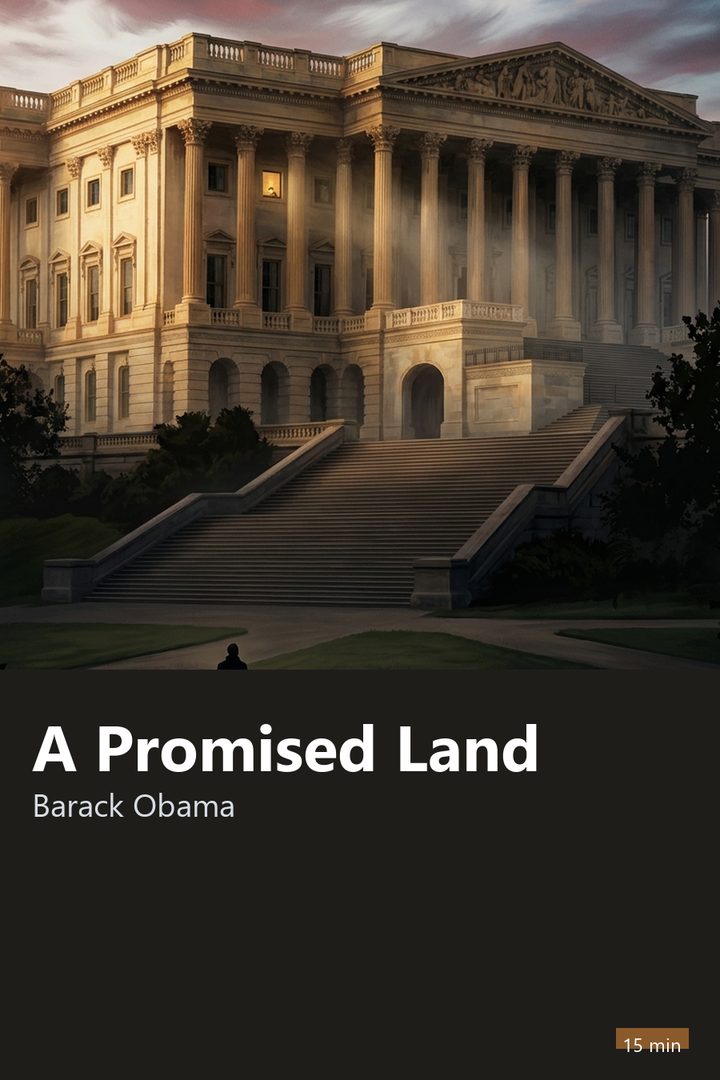
Cover of A Promised Land

Biographies and Memoirs · 19 min

A Promised Land

Barack Obama · 2020

Who it's for

For anyone who wants to understand what happens behind the scenes of the presidency, the limits of political change, and the personal costs of leadership. Best suited to readers willing to follow detailed negotiations and question the central figure's own version of events.

Read it in the app

⚡ Free to download • 🎁 One full book free every day

🎧 Audio coming soon in the app

Narration for the English summaries is on its way. Meanwhile you can read the full summary in the app.

3 ideas to take with you

1

Listening to a complaint until you understand where it comes from can create more potential for change than offering a solution before you know the problem.

2

A policy can prevent a collective disaster and still distribute its costs unfairly. Assessing effectiveness and fairness requires different questions.

3

Knowing how a decision turned out makes it easy to forget the uncertainty that preceded it. Responsibility begins with preserving that distinction.

“
One person's ambition also takes up space on the calendars of those who live with them.
An idea from A Promised Land, in the words of 15 Minutes

Preview

Start reading now

1. The Promise Meets the Machine

A Promised Land follows Barack Obama's political development, his rise to the U.S. presidency, and part of his first term, through 2011. It is not the complete story of his administration. It is an attempt to explain how public decisions emerge from environments that combine urgency, incomplete information, and competing interests.

The central contrast is between the hope the campaign inspired and the resistance encountered in office. Governability depends on alliances, rules, and interests that do not disappear after an election. Even in the country's most powerful office, Obama discovers that announcing a direction does not mean you can actually move in it.

For an everyday comparison, think of a mayoral election followed by a debate over the city budget. Promising better bus service is different from negotiating contracts, confronting city council members, and finding funding. The book gains strength when it abandons the portrait of a savior and shows the constrained, collective, conflict-filled work of governing.

2. Belonging Before Representing

Obama presents his identity as something shaped by movement between places and cultures. The son of a white American mother and a Black Kenyan father, he grew up mainly in Hawaii and spent part of his childhood in Indonesia. Moving among different cultural reference points fueled questions about belonging, inequality, and what being American means in practice.

His search does not end with a sudden revelation. Books, friendships, education, and work experiences help organize questions that would remain with him. Political representation emerges from that journey: how do you speak for a community without reducing different people to a single identity or a caricature?

That question also applies to a family in which someone is the first to attend college. You can enter new environments while still carrying your roots with you. The book suggests that acknowledging these tensions is more honest than pretending to have possessed a secure sense of self from an early age.

3. Listening Is Political Work

Obama's work as a community organizer in Chicago plays an important role in his development. Far from the national stage, he meets residents concerned about jobs, housing, and basic services. He learns that a community does not take action simply because someone delivers a beautiful speech or knows a technically sophisticated solution.

Community organizing requires repeated conversations, relationships built on trust, and a willingness to hear complaints that are not neatly articulated. It also depends on identifying leaders already active in the neighborhood. The lesson is less romantic than it sounds: building participation takes work, encounters distrust, and delivers smaller results than initial enthusiasm tends to imagine.

In everyday life, this happens when residents try to improve street lighting. Before launching a social media campaign, they need to understand who is affected, collect accounts, and identify the responsible agency. Obama values this shift from individual outrage to a collective ability to demand specific, verifiable changes.

11 more sections and the quiz

Continue in the app

Read the whole summary, finish with the A Promised Land quiz and follow the guided Journeys. No ads in the app.

About Barack Obama

Barack Obama was born in Honolulu, Hawaii, in 1961. He graduated from Columbia University and Harvard Law School, where he became the first Black president of the Harvard Law Review. He worked as a community organizer in Chicago and served as an Illinois state senator and a U.S. senator. He was the 44th president of the United States, serving from 2009 to 2017, and received the Nobel Peace Prize in 2009.

Explore

Part of the Journeys:
How Power Works