15 Minutes
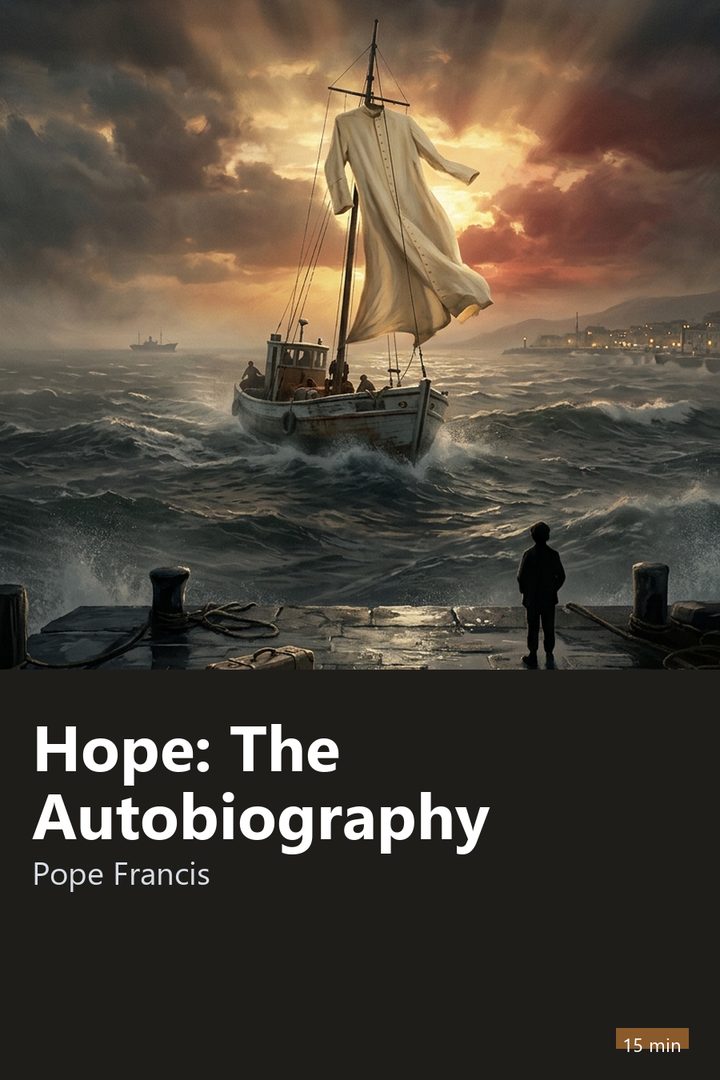
Cover of Hope: The Autobiography

Biographies and Memoirs · 18 min

Hope: The Autobiography

Pope Francis · 2025

Who it's for

For anyone who wants to know the human journey of Pope Francis and the experiences that guided his papacy. It may also interest non-religious readers, provided they are looking for an openly Catholic testimony rather than an independent biography.

Read it in the app

⚡ Free to download • 🎁 One full book free every day

🎧 Audio coming soon in the app

Narration for the English summaries is on its way. Meanwhile you can read the full summary in the app.

3 ideas to take with you

1

Learning the story of a migrant family can turn a debate about borders into a conversation about people.

2

Re-examining the way you exercise authority can show more maturity than defending every past decision.

3

An environmental decision becomes much more concrete when we ask who gets its benefits and who pays its costs.

“
Before great offices, there are the small encounters that teach a person how to belong.
An idea from Hope: The Autobiography, in the words of 15 Minutes

Preview

Start reading now

A life told by the one who lived it

Hope presents the memories of Jorge Mario Bergoglio, the Argentine who became Pope Francis. Written with Carlo Musso over the course of six years, this autobiography reached the public in early 2025. Family stories, religious choices, and political responsibilities appear woven together through the eyes of someone trying to understand his own path.

The project was originally meant to be published after the pontiff's death. Francis decided to move the release up, tying his testimony to the 2025 Jubilee, which is dedicated to hope. That decision clarifies the purpose of the book: to share a personal and religious experience, not to offer an independent investigation into every event and conflict of his leadership.

This distinction guides how we read it. The narrator selects episodes, admits mistakes, and interprets events in the light of faith. We can welcome his memories without treating every assessment as a definitive historical conclusion. As in a family conversation, memory preserves experiences, yet it also shapes the meaning those experiences have taken on for the person telling them.
The crossing that began before his birth

Bergoglio's paternal roots lie in Piedmont, in northern Italy. His grandparents and his father emigrated to Argentina in 1929. Before that, the family had planned to board the Principessa Mafalda, a ship that sank in 1927. Difficulties in wrapping up their move delayed the trip and profoundly altered that family's destiny.

Francis recalls this story with gratitude and a providential interpretation. It is important to keep two things distinct: the postponement of the trip belongs to family history, while seeing God's hand in it expresses his faith. The episode does not allow us to conclude that people spared from tragedies received a care that was denied to those who died.

The experience of immigration helps explain his attention to refugees. Before the statistics, there are families carrying memories, work, and insecurity. Getting to know the story of an immigrant neighbor can bring about a similar shift: the issue stops being just an abstract debate about borders and begins to involve a real, concrete person.

Flores and the first ways of belonging

Jorge Mario was born in Buenos Aires on December 17, 1936, and grew up in the neighborhood of Flores. Home, the neighborhood, and the streets form the backdrop of his earliest memories. The future pope appears as a boy woven into ordinary relationships, surrounded by affection, chores, games, and references from popular culture.

His grandmother Rosa holds a defining place in his religious upbringing. Faith arrives through stories, daily life together, and personal example, not just through formal instruction. Soccer is also part of this world, especially his bond with the San Lorenzo club. Those touchstones would remain present even after his life moved to the Vatican.

This portrait offers a counterpoint to the distant image of a global authority. Before the office, there were people who taught him how to speak, care for others, and face hardship. A chat at the corner diner, a Sunday lunch, or cheering for the same team can also pass down values, even if none of those experiences alone determines who a person will become.

11 more sections and the quiz

Continue in the app

Read the whole summary, finish with the Hope: The Autobiography quiz and follow the guided Journeys. No ads in the app.

About Pope Francis

Pope Francis was born Jorge Mario Bergoglio in Buenos Aires on December 17, 1936. He entered the Society of Jesus in 1958, was ordained a priest in 1969, and became Archbishop of Buenos Aires in 1998. Elected on March 13, 2013, he was the first Latin American pope and the first Jesuit to hold the office. He died on April 21, 2025, after the publication of this autobiography, written with Carlo Musso.

Explore

Part of the Journeys:
Inspiring Biographies