15 Minutes
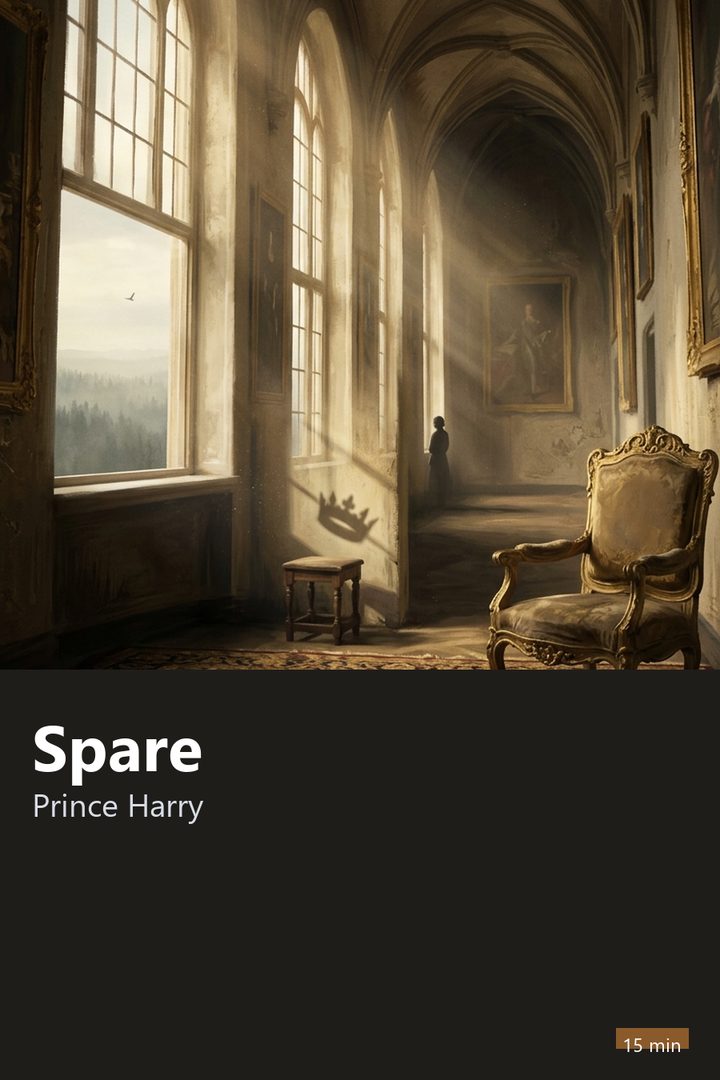
Cover of Spare

Biographies and Memoirs · 18 min

Spare

Prince Harry · 2023

Who it's for

For anyone who wants to understand how repressed grief, institutional pressure, and family feuds shape personal identity. A memoir exploring the conflict between public duty and the search for personal autonomy.

Read it in the app

⚡ Free to download • 🎁 One full book free every day

🎧 Audio coming soon in the app

Narration for the English summaries is on its way. Meanwhile you can read the full summary in the app.

3 ideas to take with you

1

Family roles assigned in childhood often dictate who takes priority long before individual choices ever begin.

2

Environments with impersonal rules and hands-on tasks offer a refuge for those looking to escape the scrutiny of others.

3

Deciding to break away from a dysfunctional cycle demands giving up privileges and accepting the personal cost of survival.

“
Burying a profound loss merely postpones the pain, turning an absence into an invisible ghost guiding every decision.
An idea from Spare, in the words of 15 Minutes

Preview

Start reading now

The Burden of Being Born a Spare

The book's title captures a cold requirement of constitutional monarchy: the court needs a sovereign ruler and an immediate backup to secure the lineage. By the centuries-old rule of primogeniture, the firstborn son inherits titles, lands, and the undeniable destiny of ruling, while the second son is born as biological insurance in case of misfortune. Harry grew up hearing that his purpose in the world was to supply replacement organs or keep the throne safe if tragedy struck the legitimate heir.

This hierarchy governed their domestic lives. Better bedrooms and privileges clearly demarcated who stood at the center of power and who remained in reserve. The author's childhood became a constant reminder of dispensability, in which his existence held value only in the absence of his older brother.

This dynamic echoes through ordinary families, where expectations of success often fall on the firstborn while other siblings scramble for validation. Yet while typical households can reevaluate their bonds, within the British court this disparity is funded by the public purse and institutionally celebrated as a patriotic virtue.
Frozen Grief and a Childhood in Silence

Diana's tragic death in 1997 shattered Harry's childhood when he was just twelve years old. Forced to march behind his mother's coffin under the gaze of massive crowds and television cameras from around the globe, the boy was instructed to hold back his tears and display traditional British composure. This premature demand smothered natural grief, erecting a rigid emotional barrier that stunted his emotional development for nearly two decades.

To cope with the pain, the author's mind crafted a protective fantasy: the conviction that Diana had not died, but had merely faked the car crash to escape the reporters and would one day return to rescue him. The royal institution's refusal to address the loss drove his suffering underground, fueling adolescent rebellion and bouts of aggression.

Losing his mother under the siege of the press left profound scars. Finding no warmth or emotional safety within the court, the young prince learned that royalty does not tolerate weakness. That emotional numbness became an armor during his boarding school years, but it extracted a heavy toll in adulthood, turning tender memories into painful triggers.

Hounded by the Press and Fearing the Cameras

From an early age, Harry learned to dread the mechanical click of camera shutters and the blinding flashes of light as warnings of imminent danger. The pack of street photographers, known worldwide as paparazzi, tracked the prince's every move, bribed security guards for leaks, and hacked private phones to pry into his personal routine and feed public curiosity.

The major British tabloids turned the young man's vulnerability into a lucrative commodity. Any youthful mistake, party dispute, or romantic relationship splashed across front pages with humiliating headlines designed to boost circulation. Living under relentless surveillance destroyed his ability to trust anyone around him, fueling an ongoing terror of reliving the tragedy that claimed his mother.

This abusive pursuit reached all the way into private conversations at school, which were sold to unscrupulous editors for hefty sums. The constant invasion of privacy bred deep, lasting resentment toward the sensationalist press, convincing the author that tabloid editors acted as ruthless predators profiting from scandal.

10 more sections and the quiz

Continue in the app

Read the whole summary, finish with the Spare quiz and follow the guided Journeys. No ads in the app.

About Prince Harry

Prince Harry, Duke of Sussex, was born in London in 1984 and is the younger son of King Charles III and Princess Diana. He served for ten years in the British Armed Forces, completing two tours of duty in Afghanistan. In 2014, he founded the Invictus Games, an international sporting event for wounded, injured, and sick service personnel. He married Meghan Markle in 2018 and, two years later, stepped back as a working member of the British royal family.

Explore

Part of the Journeys:
Memoirs That Hurt and Heal