15 Minutes
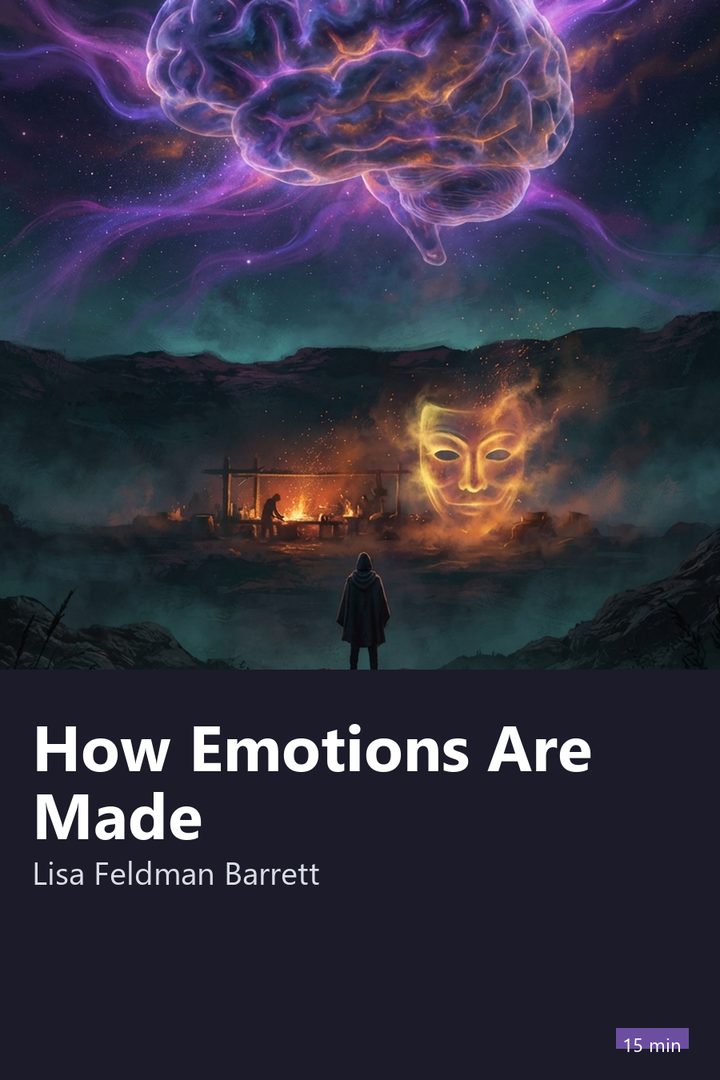
Cover of How Emotions Are Made

Psychology · 15 min

How Emotions Are Made

Lisa Feldman Barrett · 2017

Who it's for

For anyone who wants to understand where feelings come from and why putting a name to what you feel helps so much. It is great for those who deal with kids, teams, or themselves and want a current, and debated, view of the science of emotion.

Read it in the app

⚡ Free to download • 🎁 One full book free every day

🎧 Audio coming soon in the app

Narration for the English summaries is on its way. Meanwhile you can read the full summary in the app.

3 ideas to take with you

1

According to the author, the same tightness in your chest becomes suspense at the movie theater and anguish in a hospital hallway, because the brain chooses the explanation.

2

The book argues that the brain works in networks, which is why the old battle between reason and emotion is more of a metaphor than an accurate picture.

3

The theory of constructed emotion is challenged by those who defend universal basic emotions, and the debate remains open.

“
Giving a more precise name to what you feel gives the brain more response options than just saying you feel bad.
An idea from How Emotions Are Made, in the words of 15 Minutes

Preview

Start reading now

The idea that flips the table

If someone asks where emotions live in the brain, the popular answer is that there is a circuit for fear, another for anger, and another for joy, hardwired from birth and the same in everyone. Psychologist Lisa Feldman Barrett spent her career testing this idea and concluded that it does not hold up against the data. This book is the defense of an alternative theory.

The central proposal is that emotions are not reactions that happen to us, but constructions that the brain builds all the time. The fear you feel in the middle of an argument was not waiting in a little corner, ready to fire. It was assembled in that very instant, from ingredients the brain already had.

This thesis has a technical name: the theory of constructed emotion. It has practical, ethical, and even legal consequences, which is why the book goes from neuroscience to the courtroom, passing through parenting and the way we talk about feelings.

Why the fingerprint of an emotion never shows up

For decades, labs searched for a unique signature for each emotion, whether on the face, in the body, or in a region of the brain. Barrett reviewed hundreds of studies and saw an uncomfortable pattern: within a single emotion, there is a lot of variation, and across different emotions, there is a lot of overlap.

Think about how many different faces you make when you are angry. Sometimes you yell, sometimes you go quiet, sometimes you cry out of anger, sometimes you give a nervous smile. In the same way, your heart races in a scare, but also in love and excitement. If there is no fixed mark, it is hard to claim that a single, universal anger exists.

The author does not say that emotions are an illusion. She says that organizing them into fixed little boxes, like six or seven basic emotions, has no support in the lab. The categories exist, but they are made by the brain and by culture, not found in the world like a mineral in a mine.

A brain that predicts instead of reacting

A central shift in the book is the idea that the brain does not sit around waiting for the world to knock on the door before responding. It spends all its time making predictions based on past experiences, and uses the signals coming from the senses to correct those guesses.

When you smell coffee from the bakery and already know how it tastes, that is prediction. When someone raises a hand quickly and you blink, that is a risk forecast. Every second, the brain tries to guess what comes next and prepares the body for it, spending energy economically.

According to Barrett, emotions are the result of these predictions. The brain chooses, from the experiences it has already lived through, the one that best matches the current situation, and uses it as a template for feeling. That is why the same sensation in your stomach can turn into fear before a job interview and joy before graduation.

10 more sections and the quiz

Continue in the app

Read the whole summary, finish with the How Emotions Are Made quiz and follow the guided Journeys. No ads in the app.

About Lisa Feldman Barrett

Lisa Feldman Barrett is a psychologist and neuroscientist, a professor at Northeastern University in the United States, and a researcher affiliated with Massachusetts General Hospital. She has dedicated her career to studying emotion and the brain and runs a lab on the subject. She also wrote Seven and a Half Lessons About the Brain, aimed at the general public.

Explore

Category:
Psychology
Part of the Journeys:
Brain and Emotion in Practice