15 Minutes
Cover of Purple Cow

Marketing and Sales · 15 min

Purple Cow

Seth Godin · 2003

Who it's for

This one is for you if you sell something, whether it's a product, a service, or your own professional image, and you feel like no one notices your brand in the middle of so many similar offers. This summary is for people who would rather make a real impact than spend money trying to be one more of the same, only prettier.

Read it in the app

⚡ Free to download • 🎁 One full book free every day

🎧 Audio coming soon in the app

Narration for the English summaries is on its way. Meanwhile you can read the full summary in the app.

3 ideas to take with you

1

A product that only pleases people, without bothering or surprising anyone, tends to go unnoticed among so many similar options.

2

Getting the people who already love this kind of product to talk about it spreads a brand faster than advertising to everyone.

3

A brand that avoids any friction so it won't bother anybody runs the biggest risk of all: being forgotten in the crowd.

“
What makes people talk about a product has to be born inside it, not stuck on afterward in an advertising campaign.
An idea from Purple Cow, in the words of 15 Minutes

Preview

Start reading now

The end of marketing that shouted the loudest

For decades, selling well meant making noise: paying for a TV commercial, repeating the same jingle hundreds of times, making sure the brand showed up in front of millions of people at the same time. It worked because there were few TV channels, little competition for attention, and an audience that still trusted what it saw advertised.

Godin calls this period the era of mass marketing, when a decent product plus a generous dose of repetitive advertising was enough to guarantee sales. The problem is that this formula depended on a landscape that no longer exists: today anyone skips the ad, mutes the commercial, or doesn't even turn on the TV at the time the brand picked.

Why good is no longer enough

If you walk down any supermarket aisle, you'll see dozens of brands of rice, laundry detergent, or cookies, almost all of them reasonably good. Being merely competent stopped being a differentiator, because the entire competition is competent too; the average product became invisible among so many similar options.

Today's consumer has limited time and patience to evaluate everything out there, so they filter fast: either something grabs their attention right away, or it gets ignored. A product with no standout feature isn't rejected for being bad, it's simply forgotten before it's even considered.

A simple example: two bakeries on the same street sell similar bread at similar prices, and neither one really grows, because neither gives customers a clear reason to pick one over the other. Meanwhile, a third bakery, two blocks down, decided to sell only sourdough, and it has a line out the door even at higher prices, because it became the only option of that specific kind in the neighborhood.

The purple cow: what makes something remarkable

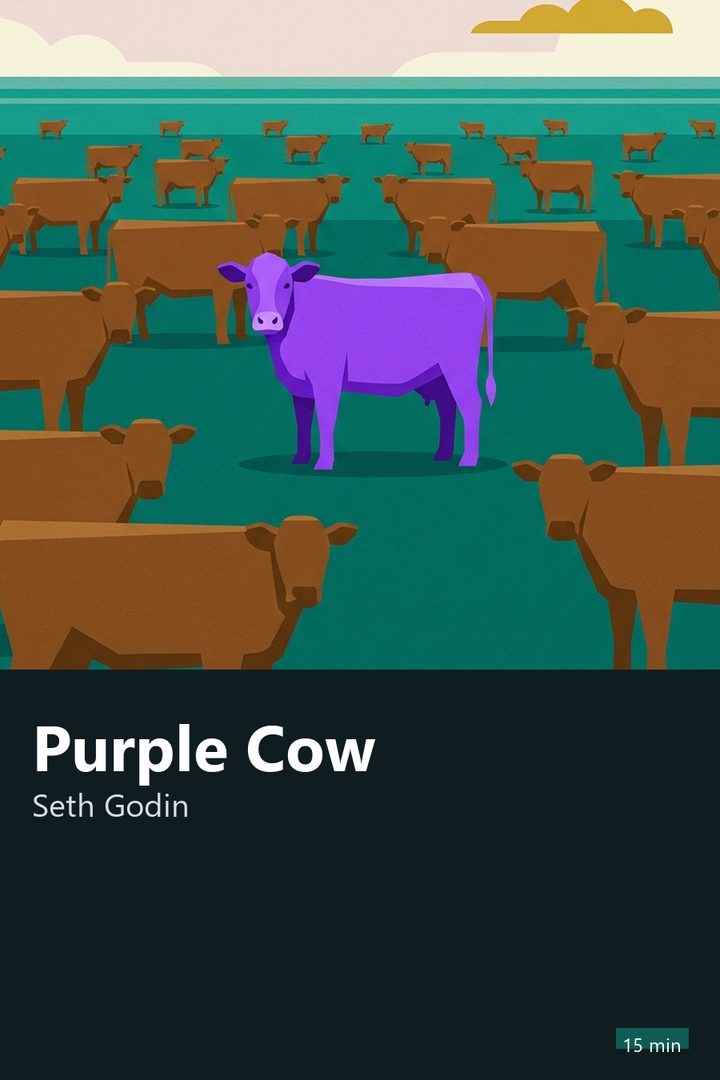
Imagine driving down a country road and passing a pasture full of brown and white cows, standing still, chewing grass. After a few minutes, the scenery becomes part of the background and no one notices it anymore. Now imagine that, among those ordinary cows, a purple cow appears: the car stops, everyone takes a picture, everyone talks about it.

That is the central idea of the book: being remarkable isn't being the best in a generic way, it's having something specific that makes someone stop and talk. It's not enough to be good in the same way every competitor is good; you need a detail that breaks the expectations of whoever is looking.

This applies even outside the world of products: a résumé full of qualifications similar to every other candidate's goes unnoticed in a huge pile, while an unusual personal project, even a small one, is the kind of detail that makes a recruiter stop and read carefully.

12 more sections and the quiz

Continue in the app

Read the whole summary, finish with the Purple Cow quiz and follow the guided Journeys. No ads in the app.

About Seth Godin

Seth Godin is an American writer, entrepreneur, and speaker, the author of more than twenty books on marketing, leadership, and changing behavior. He studied computer science and philosophy at Tufts University and earned an MBA at Stanford, where he worked before founding Yoyodyne, one of the first permission marketing companies on the internet, sold to Yahoo in 1998. Purple Cow, originally published in 2003, is one of his best-known titles and helped popularize the idea of the remarkable product as a central marketing strategy. Godin also created the altMBA and keeps one of the most widely read marketing blogs in the world, published daily for more than twenty years.

Explore