15 Minutes
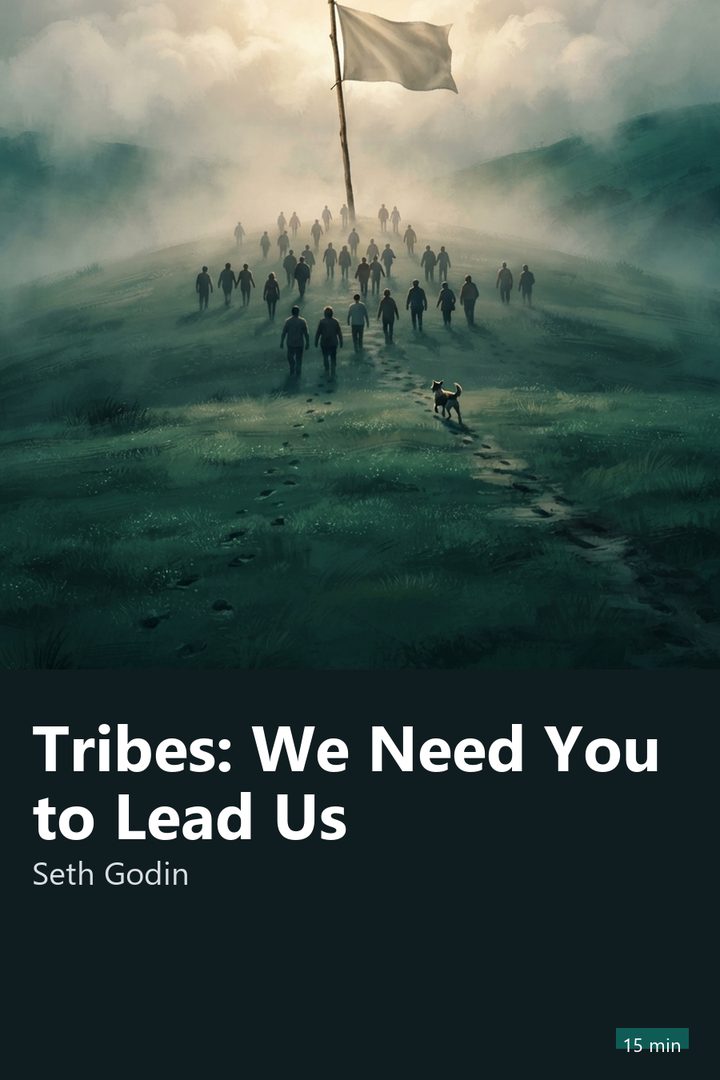
Cover of Tribes: We Need You to Lead Us

Marketing and Sales · 16 min

Tribes: We Need You to Lead Us

Seth Godin · 2008

Who it's for

For anyone who already leads a group, small or large, without having a name for what they're doing: the neighbor who runs the homeowners association, the person who keeps the running group going, the one who started a page that turned into a community. Tribes helps you understand why people follow someone and what to do with that responsibility.

Read it in the app

⚡ Free to download • 🎁 One full book free every day

🎧 Audio coming soon in the app

Narration for the English summaries is on its way. Meanwhile you can read the full summary in the app.

3 ideas to take with you

1

Every tribe already exists before it has a ready-made leader; what's missing is someone willing to take the first step and accept the risk of being wrong.

2

Faith isn't believing for no reason. It's deciding to act before you have complete proof, the opposite of the habit of only following rules that have already been tested.

3

Having lots of followers doesn't mean having a tribe. A tribe is people who talk to each other, not just wait for announcements from whoever is out front.

“
The biggest obstacle to leading isn't a lack of good ideas, it's the fear of letting down exactly the people you most wanted to please.
An idea from Tribes: We Need You to Lead Us, in the words of 15 Minutes

Preview

Start reading now

A tribe is people, an idea, and someone who takes the first step

Notice the difference between a crowd and a tribe. A crowd is people standing in the same place, waiting for the game to start. A tribe is that same group after someone leads the battle cry and gets everyone to recognize themselves as part of the same thing. A tribe, in the sense the book uses, is people connected to each other, connected to a shared idea, and connected to someone willing to point the way.

The difference between an audience and a tribe shows up in interaction. A channel with lots of followers may have no tribe at all if nobody comments and nobody seeks each other out beyond it. But a neighborhood group of a few dozen people who know each other by name and trade favors without charging a thing, that's a full tribe, even if it's small.

The book's central bet is that leading a tribe has become the most valuable work there is, precisely because you can't buy it with an ad or create it by decree. It's born when someone offers people something to believe in together, and takes on the responsibility of keeping that thread pulled tight.


The internet lowered the price of the megaphone, but it didn't create the desire to belong

Before, gathering people around an idea required expensive infrastructure: TV airtime, newspapers, advertising budgets that only big companies or political parties could afford. Anyone without that budget simply didn't have enough voice to form a group larger than their close circle of friends.

What the internet did was drive that cost almost to zero. A messaging app group, a neighborhood page, a video channel, all of it now gathers fifty, five hundred, five thousand people with the same effort that once only brought together the folks on your street. The tool got cheap, but the desire to belong to something bigger has always been there.

That's why the book treats technology as a means, not a cause. Nobody leads a tribe just because they opened an online group; the group is only the pipe the water runs through. What makes the water flow is the idea that unites people and someone's willingness to look after it.

Managing resources is not the same as leading people

The book separates two jobs that often get confused. Managing is taking care of the hierarchy that already exists, chasing spreadsheets and deadlines. It's necessary work, but it doesn't move anyone to a new place, it just keeps what already exists running without surprises.

Leadership is something else: it's proposing a change that has no guarantee of working and getting people to decide to follow on their own, not because of a job title. A supervisor who only chases the monthly target is managing; the person who proposes a different way of organizing the work and convinces the team to try it, that one is leading.

The book calls leadership a scarce resource for exactly this reason: managers with spreadsheets are plentiful on the market, but people willing to take the risk of proposing something new and sustaining that proposal to the end are rare. That scarcity is what makes leadership as valuable as it is.

11 more sections and the quiz

Continue in the app

Read the whole summary, finish with the Tribes: We Need You to Lead Us quiz and follow the guided Journeys. No ads in the app.

About Seth Godin

Seth Godin is a writer, entrepreneur, and one of the most influential voices in marketing and leadership in the United States. He founded Yoyodyne, one of the first direct marketing companies for the internet, which Yahoo bought in 1998. He has kept a daily blog since the early 2000s, one of the most widely read in the world on business and behavior change. He is also the author of other highly influential books, such as Purple Cow and This Is Marketing, and he founded Squidoo, a platform for content pages.

Explore

Part of the Journeys:
Marketing That Works