15 Minutes
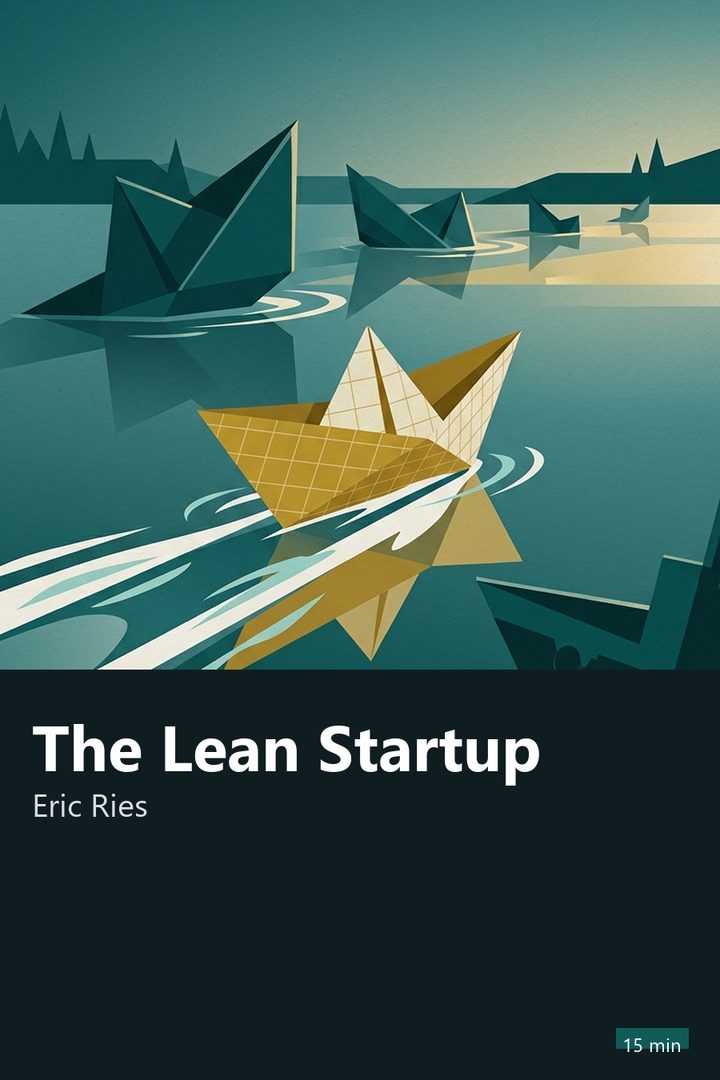
Cover of The Lean Startup

Business · 15 min

The Lean Startup

Eric Ries · 2011

Who it's for

This summary is for you if you want to start a small business, or already run one, and you live in fear of pouring time and money into an idea nobody will want to buy. It's for people who would rather test cheap before betting big.

Read it in the app

⚡ Free to download • 🎁 One full book free every day

🎧 Audio coming soon in the app

Narration for the English summaries is on its way. Meanwhile you can read the full summary in the app.

3 ideas to take with you

1

A new company learns faster by testing small pieces of its idea with real people than by polishing a perfect plan inside a closed room.

2

A number that only goes up, like total accumulated followers, rarely tells you whether the business is healthy; what matters is who comes back and pays again.

3

Talking directly to ten potential customers before you write any code reveals more about real demand than any technical detail you refine later.

“
Testing a small idea before betting everything on it costs far less than discovering the mistake after you've already spent all your savings.
An idea from The Lean Startup, in the words of 15 Minutes

Preview

Start reading now

Starting a business isn't following a plan, it's running an experiment

Most entrepreneurship courses teach you to write a detailed business plan before selling anything: revenue projections, competitor analysis, a five-year timeline. Ries proposes the opposite: treat the new company as a series of scientific experiments, where every assumption becomes a question to be tested against the real market, not against a pretty spreadsheet.

This changes the central question from "Is this plan well made?" to "What do I need to learn before spending more money on this?" A startup, for him, isn't a small company. It's any team trying to create something new under conditions of extreme uncertainty, whether in a garage or inside a giant corporation.

In practice, this means accepting that a good part of what you imagine about your customer is wrong, and the early work is figuring out which part, as cheaply and quickly as possible, before building anything at scale.
The simplest product that still teaches you something

The book's most quoted concept is the minimum viable product: the leanest possible version of an idea, able to generate real learning about customer behavior with the least building effort. It isn't an unfinished version of the final product. It's an experiment disguised as a product.

A classic example from outside the book: before coding an entire app, a founder creates a single page explaining the offer, with a "I want to buy" button that actually processes nothing and just records how many people clicked. If nobody clicks, the idea changed course before costing six months of development.

The most common mistake among people who read about the MVP is confusing "minimum" with "sloppy." The point isn't to deliver something bad. It's to deliver the smallest possible piece that still answers a real question about whether the customer wants it.

Build, measure, learn: the cycle that replaces the rigid plan

Instead of a fixed launch schedule, Ries proposes a short cycle that repeats: build a small version of something, measure how the market really reacts, learn from the result, and use that learning to decide the next step. The faster this cycle spins, the faster the company discovers what works.

The common trap is spending months only on the build stage, pushing measuring and learning until after the official launch, when it's too late to fix things cheaply. The cycle only works if all three stages are treated as equally urgent, not as separate phases of a linear schedule.

Think of a street food stand testing a new dish: make a small batch, see how many people reorder the following week, adjust the recipe or the price, and only then decide whether the dish joins the permanent menu. It's the same cycle, just without the Silicon Valley jargon.

12 more sections and the quiz

Continue in the app

Read the whole summary, finish with the The Lean Startup quiz and follow the guided Journeys. No ads in the app.

About Eric Ries

Eric Ries is an American entrepreneur and writer, a cofounder of tech companies in Silicon Valley, including IMVU, where he developed much of the thinking behind the book. He graduated from Yale University and worked as a software engineer before turning to consulting and writing about startup management. After The Lean Startup, originally published in 2011, he wrote The Startup Way, applying the same method to large companies and the public sector. He also founded the Long-Term Stock Exchange, a stock exchange designed to encourage long-term business decisions.

Explore

Category:
Business
Part of the Journeys:
Start a Business From Scratch