15 Minutes
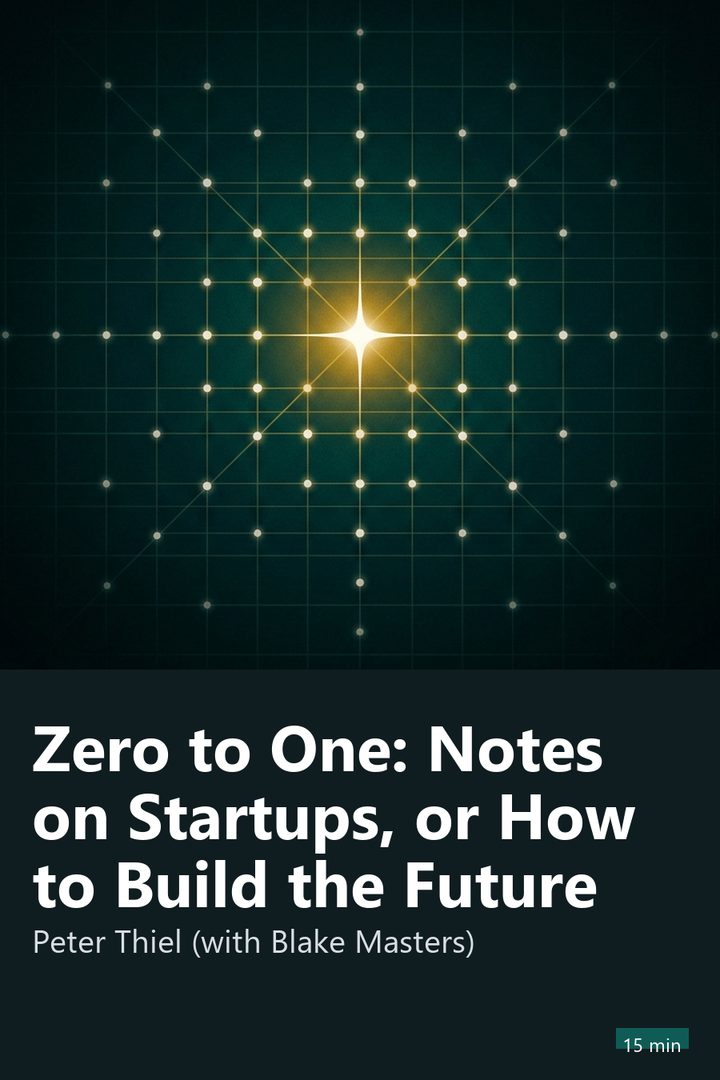
Cover of Zero to One: Notes on Startups, or How to Build the Future

Business · 15 min

Zero to One: Notes on Startups, or How to Build the Future

Peter Thiel (with Blake Masters) · 2014

Who it's for

For anyone who wants to start a truly new business, not just another copy of what already exists, and feels the need for a way to think about where it's worth competing and where it's better not to enter the fight at all.

Read it in the app

⚡ Free to download • 🎁 One full book free every day

🎧 Audio coming soon in the app

Narration for the English summaries is on its way. Meanwhile you can read the full summary in the app.

3 ideas to take with you

1

Companies that grow too fast trying to be everything to everybody end up fighting everybody on price, too.

2

Having a concrete plan for where the business will end up changes today's choices, even with no guarantee about the future.

3

Almost all the return from a portfolio of risky bets tends to come from a single bet that nobody could guarantee in advance.

“
A product with nothing that truly sets it apart becomes just one more option that competes only by lowering prices.
An idea from Zero to One: Notes on Startups, or How to Build the Future, in the words of 15 Minutes

Preview

Start reading now

The question that separates creating from copying

Thiel likes to test whoever sits in front of him with a simple provocation: he asks the person to defend an opinion they hold with conviction but that almost nobody else in the market would buy. Most people freeze, because we're trained to repeat the consensus, not challenge it.

From that provocation the book separates two kinds of progress. One is horizontal: taking something that already works in one place and replicating it somewhere else, more or less what globalization did over the last few decades. The other is vertical: making something appear that simply didn't exist before.

Think of a bakery chain that opens the same store in neighborhood after neighborhood: that's horizontal growth, useful, but it replicates a ready-made formula. A digital bank that reinvents the experience of opening an account, with no branch and no line, is attempting the vertical leap, creating something that didn't really exist yet in the country.

Competition: the addiction disguised as discipline

Going head to head with a competitor feels productive and gives you an adrenaline rush, but it steals the one resource a small company can't afford to waste: attention. When the focus becomes beating the rival, the customer leaves the stage and cutting prices becomes the only weapon available.

Picture two little smoothie shops on the same street, one lowering the price of a cup to steal customers from the other, which responds by lowering it even more. It's the classic price war: by the end of the month both sell more and earn less, because the fight just divided the same slice into thinner and thinner pieces.

A shop with a recipe nobody can properly replicate, or a way of delivering that solves a specific problem in the neighborhood, doesn't need to enter that war. It charges what it's worth, because the customer isn't comparing prices, they're comparing what only that place offers.

How a healthy market lead is born

The word monopoly scares people, because it brings to mind abuse and cartels, but the book uses it in a narrower sense: a company that has become so much better at one specific thing that, in practice, it's the only serious option for anyone who needs that. Without that kind of difference, any product becomes a commodity, and a commodity competes only on price.

A neighborhood bakery known for thirty years for a cornmeal cake nobody else makes in that particular way isn't committing any abuse: it simply built something customers can't find anywhere else, and so it can charge a little more without losing anyone.

The difference lies in the origin: one is born from real differentiation, from delivering more value; the other is born from blocking the entry of those who would do it better. The first sustains profit for years because customers choose to come back; the second attracts regulators or competitors willing to break through the blockade.

12 more sections and the quiz

Continue in the app

Read the whole summary, finish with the Zero to One: Notes on Startups, or How to Build the Future quiz and follow the guided Journeys. No ads in the app.

About Peter Thiel (with Blake Masters)

Peter Thiel is an American entrepreneur and investor, cofounder of PayPal and Palantir Technologies, and the first outside investor in Facebook. He also founded the venture capital firm Founders Fund and became known for high-risk bets on small tech companies. Blake Masters was a student of Thiel's at Stanford University and turned his notes from the course the two gave in 2012 into the text that became this book, originally published in 2014.

Explore

Category:
Business
Part of the Journeys:
Start a Business From Scratch