15 Minutes
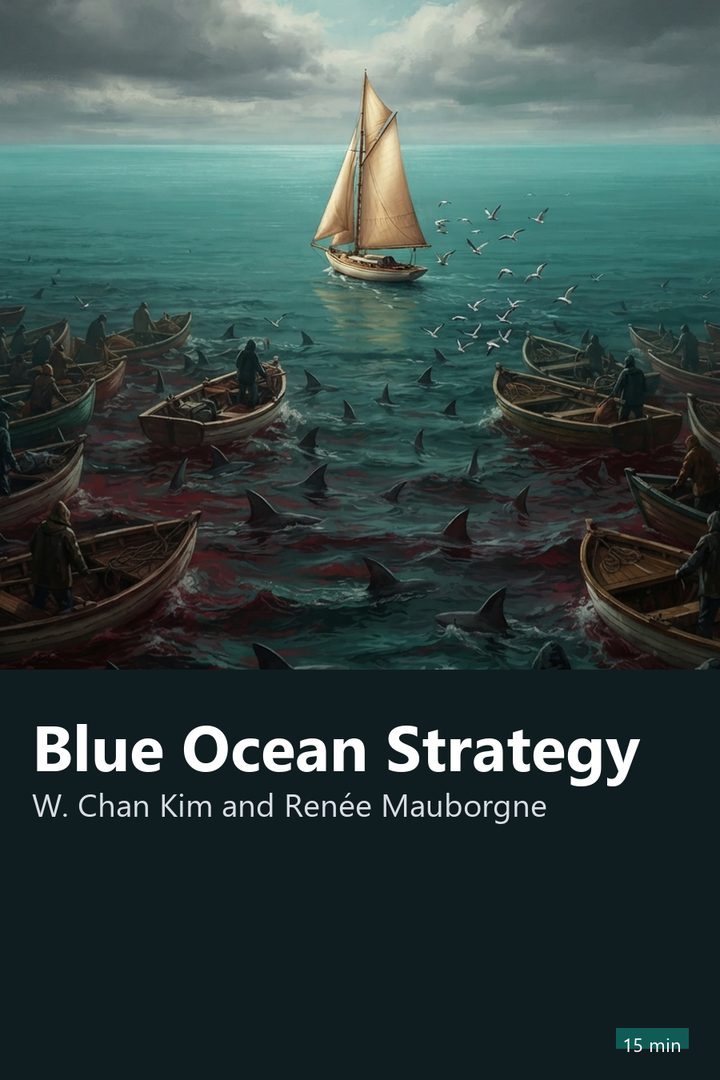
Cover of Blue Ocean Strategy

Business · 16 min

Blue Ocean Strategy

W. Chan Kim and Renée Mauborgne · 2005

Who it's for

For people who run a small or medium business and feel like the only way they know how to compete is by copying the competitor down the street on price and hours. Blue Ocean Strategy is for anyone who wants to learn to ask the right question before trying to be cheaper or faster than everybody else.

Read it in the app

⚡ Free to download • 🎁 One full book free every day

🎧 Audio coming soon in the app

Narration for the English summaries is on its way. Meanwhile you can read the full summary in the app.

3 ideas to take with you

1

Going head to head in a fight where everyone already knows the rules cuts your margin until all that's left is exhaustion.

2

The value nobody is delivering yet usually pays off more than lowering your price one more notch.

3

A small business can also draw its own map instead of copying the pattern set by the competitor down the street.

“
Whoever invents a new category doesn't need to beat anyone, they just need to get there first.
An idea from Blue Ocean Strategy, in the words of 15 Minutes

Preview

Start reading now

Two ways to compete: the bloody fight or the open sea

Picture a street full of pizzerias, all selling the same pepperoni pizza, fighting over the same customer with the same discount coupon. The more they compete, the lower the price drops and the thinner the margin gets. Chan Kim and Renée Mauborgne call this a red ocean: a known market with defined rules, where everyone fights over the same slice of the pie.

The alternative is to get out of the fight instead of trying to win it. A blue ocean is a market space that doesn't exist yet, created when someone offers something nobody thought to offer that way, to people who maybe didn't even know they needed it. In there, for a while, you have no competitors at all.

The central idea is easy to say and hard to do: instead of comparing price and service with the guy next door, stop and ask what value nobody is delivering yet. Whoever finds that answer first doesn't have to compete, because for a while they're the only one in there.


Value innovation: the engine behind every blue ocean

Classic strategy usually gives you two options: compete on low price, or bet on differentiation and charge more for it. The book rejects that choice. It calls value innovation the pursuit of both at once: cutting costs in places the customer never valued, and using the money left over to deliver something new they never had.

Think of a neighborhood salon that doesn't spend on luxury decor, something its clients barely notice. With what's left over, it builds a space with good wifi, free coffee, and hours until ten at night for people who get off work late. It didn't get cheaper or more expensive, it got different in the way that matters.

It's this crossing, lower cost on one side and higher value on the other, that separates a blue ocean from just another passing promotion.

The value curve: an X-ray of the competition on a single chart

The value curve is simple: you list the attributes your industry competes on, like price, variety, service, and hours, and score your company and each competitor from zero to ten on each one. In the end, you connect the dots and you're left with a drawing, a curve, showing the profile of each business.

A neighborhood gym could use monthly fee, number of machines, hours, and whether it has personal trainers. If its curve goes up and down exactly like the competitor's down the street, the chart itself is warning you that nobody there offers anything different, they're just copying someone else's yardstick.

The value of the curve isn't memorizing the drawing, it's seeing where everyone looks alike. Doing this kind of benchmarking shows that, at the point where the lines meet, lies the chance to trace a new path.

11 more sections and the quiz

Continue in the app

Read the whole summary, finish with the Blue Ocean Strategy quiz and follow the guided Journeys. No ads in the app.

About W. Chan Kim and Renée Mauborgne

W. Chan Kim and Renée Mauborgne are strategy professors at INSEAD, a business school with campuses in France and Singapore, where they co-direct the Blue Ocean Strategy Institute. The pair published Blue Ocean Strategy in 2005 through Harvard Business School Press, and the book became one of the best-selling and most widely translated strategy titles of the last two decades. In 2017 they released the follow-up, Blue Ocean Shift, focused on how to put the first book's ideas into practice inside real companies.

Explore

Category:
Business
Part of the Journeys:
Management Behind the Scenes