15 Minutes
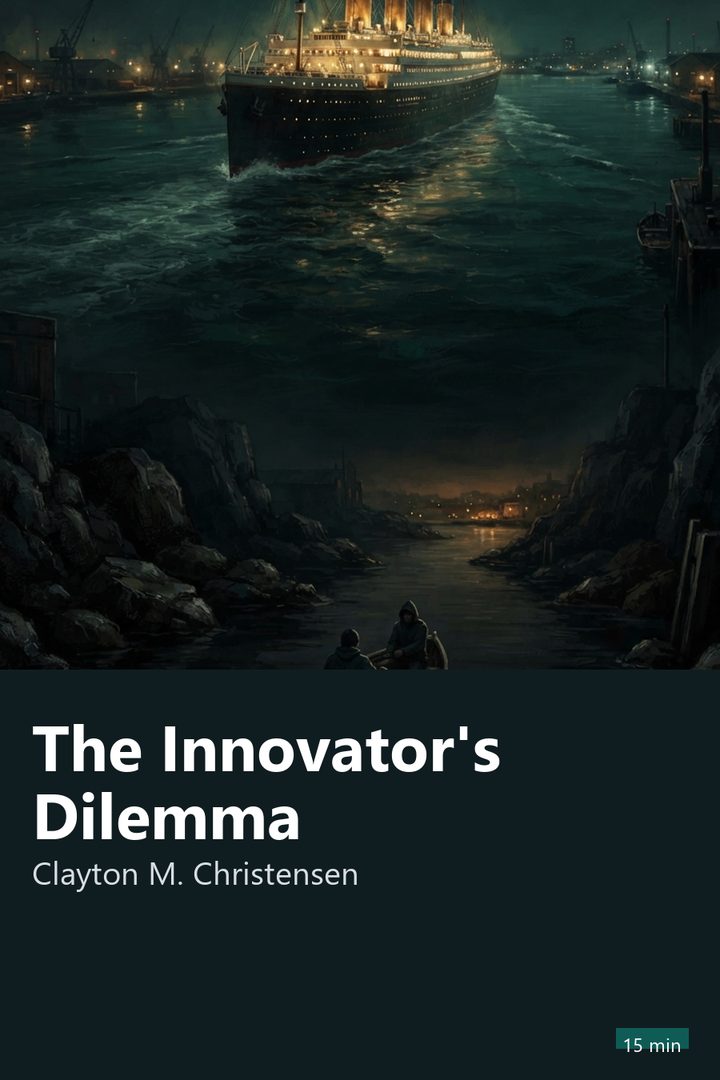
Cover of The Innovator's Dilemma

Business · 17 min

The Innovator's Dilemma

Clayton M. Christensen · 1997

Who it's for

For anyone who runs a business, leads a team, or just wants to understand why giant companies suddenly vanish from the map. The Innovator's Dilemma explains why doing everything right, according to the management textbooks, can be exactly the path to losing your market to a competitor who looks too weak to take seriously.

Read it in the app

⚡ Free to download • 🎁 One full book free every day

🎧 Audio coming soon in the app

Narration for the English summaries is on its way. Meanwhile you can read the full summary in the app.

3 ideas to take with you

1

The biggest risk for leaders today is not the obvious, strong competitor. It's the small, ignored one aiming at a customer nobody at the top is fighting over.

2

Listening too closely to the customer who already pays well can shut your ears to exactly the signal that would warn you about the market's next turn.

3

A product that looks worse today, but solves something more cheaply, more simply, or more conveniently, has time on its side to improve until it becomes a real threat.

“
The structure that made a company grow is usually the same one that keeps it from changing when the market turns.
An idea from The Innovator's Dilemma, in the words of 15 Minutes

Preview

Start reading now

A book about why doing everything right can bring you down

The Innovator's Dilemma grew out of a question that bothered Clayton Christensen his whole life: why do giant, well-run companies that listen to their best customers and invest heavily in research still lose the market to smaller competitors that look weaker on paper? The answer is not a lack of competence. It's the opposite.

Christensen shows, with years of data from the disk drive industry, that market leaders do exactly what the management textbooks say: listen to the customer, invest where profit is highest, focus on the product that already sells well. By doing this right, they open the door for a small competitor to grow from below, without anyone noticing the danger in time.

That is the dilemma in the title: there is no obvious choice between managing well and managing badly. There is an almost invisible trap in which today's best practices set up tomorrow's defeat. Understanding this trap is why the book is still cited decades later, in any conversation about a company that missed its timing.


Sustaining innovation: improving what the customer already asked for

Christensen separates innovation into two types, and that split is the heart of the book. Sustaining innovation improves a product along the path it is already on: more power, more quality, more features, serving what the most profitable customers already ask for. A more fuel-efficient car, a faster processor, a bank with a more complete app, all of that is sustaining.

The important detail is that this kind of innovation can be a radical and very expensive technological leap and still be sustaining, because it improves the product within the same logic of value that the usual customer already recognizes and pays for.

Established companies are great at this kind of innovation, and that's where the problem lives: they get so good at sustaining what already works that all the company's energy, from the budget to the board's attention, gets pulled in that direction, leaving almost nothing for anything else.

Disruptive innovation: worse at first, different where it matters

Disruptive innovation, on the other hand, comes in through the back door. It usually starts as a product that is worse than the existing one by the traditional customer's standards: less powerful, less complete. But it is cheaper, simpler, or more convenient, and so it attracts a different customer, one who wasn't even buying that kind of product before.

That word, different, is what most people forget when they use the term disruption today. A product isn't disruptive just because it's new or shakes up an industry. It's disruptive when it starts out serving the people the high-end product wasn't serving, and keeps improving until it steals the customers at the top.

The pattern repeats: the disruptive product enters small, is ignored by the leaders, gains traction with an audience nobody was fighting over, improves fast, and one day crosses the quality line that the top customer also accepts, while costing far less. By the time the leader notices, the customer base has already migrated.

11 more sections and the quiz

Continue in the app

Read the whole summary, finish with the The Innovator's Dilemma quiz and follow the guided Journeys. No ads in the app.

About Clayton M. Christensen

Clayton Christensen was a professor at Harvard Business School and one of the most influential authors on strategy and innovation of recent decades. He became known worldwide for popularizing the concept of disruptive innovation with the publication of The Innovator's Dilemma in 1997. Over his academic career, he wrote other books on management and strategy and became a reference cited both in business schools and in the startup world. He died in 2020, leaving the theory of disruption as one of the most discussed, applied, and also challenged frameworks in management literature.

Explore

Category:
Business
Part of the Journeys:
Inside Great Companies