15 Minutes
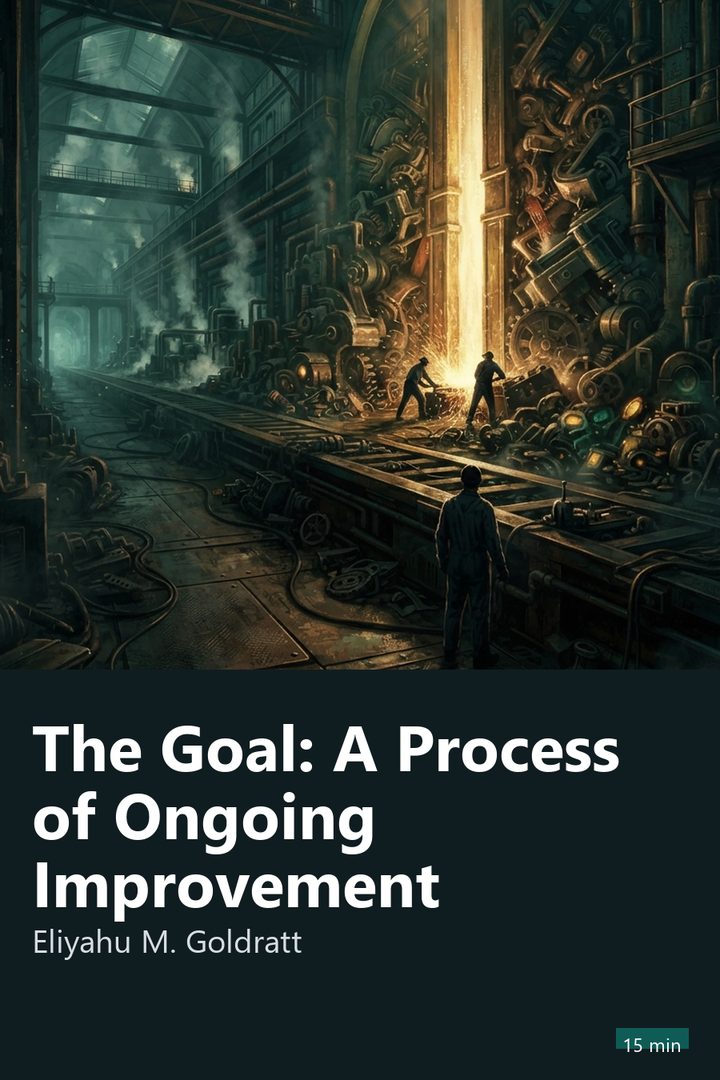
Cover of The Goal: A Process of Ongoing Improvement

Business · 16 min

The Goal: A Process of Ongoing Improvement

Eliyahu M. Goldratt · 1984

Who it's for

For anyone who works in production, operations, a kitchen, a shop, or any team where everything depends on everyone, and who feels the crew is always busy but the results never land on time. It's also for people who have heard the word bottleneck turn into a meeting cliché and want to understand where it really comes from.

Read it in the app

⚡ Free to download • 🎁 One full book free every day

🎧 Audio coming soon in the app

Narration for the English summaries is on its way. Meanwhile you can read the full summary in the app.

3 ideas to take with you

1

Counting miles driven or hours worked proves nothing if nobody paid for any of it in the end.

2

A relationship also has a point that jams everything: it's usually real attention, not an expensive gift or a repeated excuse.

3

Releasing new work at the pace of the bottleneck, not at the pace of whoever has slack, is what keeps the pile of stalled work from growing endlessly.

“
A factory doesn't get richer just because every machine is running all day.
An idea from The Goal: A Process of Ongoing Improvement, in the words of 15 Minutes

Preview

Start reading now

A Factory with 90 Days to Live

The Goal opens in a scramble: plant manager Alex Rogo arrives at work and finds vice president Bill Peach furious on the factory floor because an urgent order is late. The plant he runs, in a small American town, lurches from one fire to the next: a stopped machine, parts piled up in a corner, deliveries that never go out on the promised date.

Peach gives an ultimatum: ninety days to prove the plant is profitable, or it closes and hundreds of employees are out on the street. Desperate, Alex remembers a chance meeting, days earlier, with Jonah, his old college physics professor, who had asked a simple question about a new robot at the plant that Alex couldn't answer. Cornered by the deadline, he calls for help, never imagining he will have to relearn from scratch what it means to run a factory.

Jonah, the Professor Who Only Asked Questions

Jonah never gives a ready-made answer, not once. Every time Alex calls in a panic looking for a solution, the professor hands back another question, the kind that forces you to rethink everything from the beginning. The first one seems silly: what is the goal of your company? Alex gives the obvious answers: produce efficiently, have cutting-edge technology, employ skilled people, gain market share. Jonah rejects every one, one by one.

This Socratic method, getting a person to reach the conclusion alone instead of handing it over on a platter, is the backbone of the whole book. Goldratt chose to tell the story this way on purpose: he wanted the reader, alongside Alex, to discover the Theory of Constraints step by step, instead of just reading a list of ready-made rules.

The Goal Nobody Could Answer

After walking the plant and flipping through accounting reports, Alex arrives at the answer Jonah was waiting for: the goal of a company is to make money, now and in the future. It sounds obvious, but in practice almost nobody works guided by that sentence: each department optimizes its own little piece. Production wants machines always running, sales wants plenty of stock, purchasing wants low prices, and nobody measures whether the company as a whole is making more money from any of it.

This is the book's first blow against the traditional way of managing: the efficiency of each isolated machine or employee means nothing if the whole plant isn't delivering more sold product, on time, for less money. Think of a corner diner owner: if he measures success only by how many plates the kitchen fries per hour, he may be cranking out appetizers that go stale in the fridge with no customers to buy them, while the line at the register, where money actually comes in, sits stuck.

12 more sections and the quiz

Continue in the app

Read the whole summary, finish with the The Goal: A Process of Ongoing Improvement quiz and follow the guided Journeys. No ads in the app.

About Eliyahu M. Goldratt

Eliyahu Goldratt, who lived from 1947 to 2011, was an Israeli physicist who became one of the most influential thinkers in operations management. After developing production-scheduling software based on constraints, he wrote The Goal, published in 1984, to explain the same ideas in the form of a novel. The book became a worldwide best-seller and gave rise to the Theory of Constraints, now taught in business schools and applied in factories and service companies around the world. Goldratt founded an institute to spread the method and wrote other management books until his death in 2011.

Explore

Category:
Business
Part of the Journeys:
Management Behind the Scenes