15 Minutes
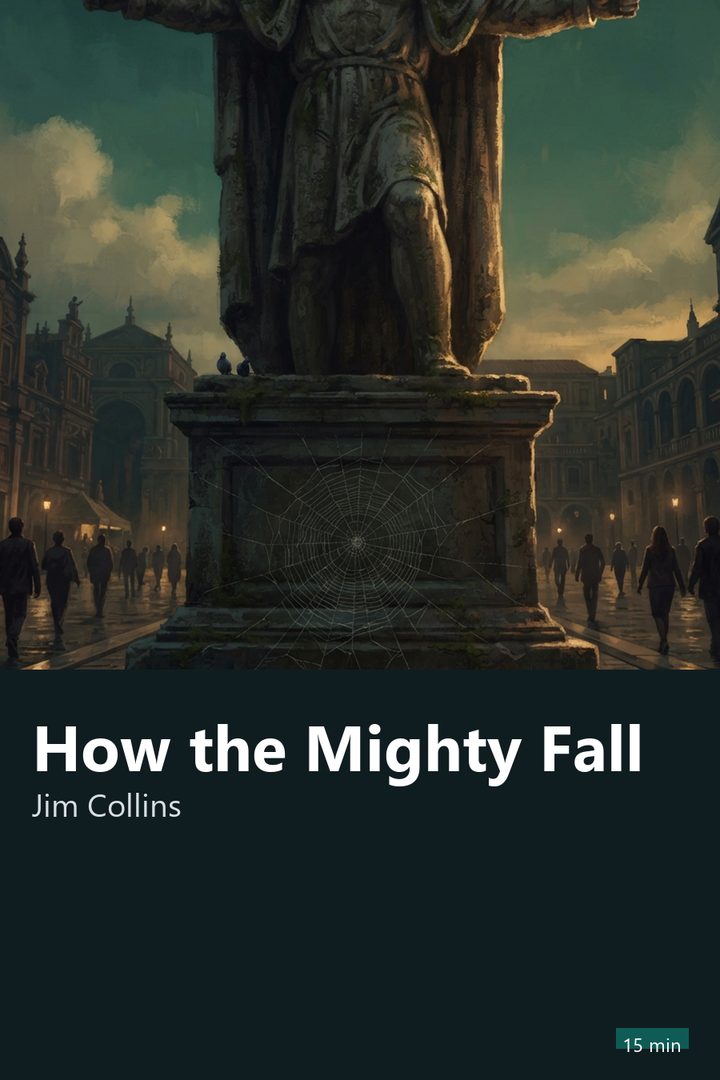
Cover of How the Mighty Fall

Business · 15 min

How the Mighty Fall

Jim Collins · 2009

Who it's for

For small business owners, managers, or entrepreneurs who are doing well right now and don't want to learn the hard way that success guarantees nothing. How the Mighty Fall works as a mirror to help you spot, while there's still time, the first signs that things have started to unravel from the inside.

Read it in the app

⚡ Free to download • 🎁 One full book free every day

🎧 Audio coming soon in the app

Narration for the English summaries is on its way. Meanwhile you can read the full summary in the app.

3 ideas to take with you

1

Success becomes a blind spot the moment the team starts treating what worked as natural talent, and not as a specific decision made at a specific moment.

2

The size of the final damage tends to be proportional to how long leadership took to admit, even in private, that the problem was real.

3

Falling is not destiny: as long as there's still cash and the will to face the problem, even a company in full decline can come back, as long as it stops betting on a quick rescue.

“
Growing too fast is trading solidity for speed, and that bill always comes later, with interest.
An idea from How the Mighty Fall, in the words of 15 Minutes

Preview

Start reading now

Why Giants Fail Too

Every company you admire today, from the bank where you have an account to the burger chain that became the neighborhood hangout, was once small and could have vanished without a trace. The opposite is also true: companies that seemed eternal, market leaders for decades, hiring by the thousands, became a footnote in less than ten years. Jim Collins, the same author who spent years studying good companies that became great, decided to flip the question around: why did giants, some of them studied in his own earlier books, spin out of control and sink?

The answer he found isn't about bad luck, unfair competition, or an isolated outside crisis. It's about an internal sequence, almost always silent, that begins long before the problem shows up on the balance sheet. By the time the money finally runs out, the company has been sick on the inside for years.

A Study Born from an Uncomfortable Question

Collins and his team combed through decades of financial and press history of companies that were once benchmarks and later went under, were sold for pennies, or dwindled until they became irrelevant. For each one, they looked for a similar competitor, in the same industry and of the same size, that went through the same storm without falling. The question wasn't just what the fallen company did wrong, but what the survivor did differently during the same difficult period.

From that comparison came a pattern that repeats with uncomfortable regularity: the fall of a giant is almost never a single event, like a stroke of bad luck. It's a sequence of five stages of decline, and the worst part is that the first three happen while the company still looks, from the outside, absolutely victorious.

Stage 1: The Arrogance That Success Plants

The first stage doesn't look like a problem, it looks like a victory. The company grows, becomes a benchmark, wins awards, makes the cover of a business magazine. But at some point, the team stops asking why it's working and starts assuming that success is an earned right, almost a trait of the company, and not the result of specific decisions made in a specific context.

That's when arrogance sneaks in through the back door. Meetings that used to discuss risk turn into celebration meetings. Internal criticism that used to be welcome starts to sound like a lack of faith in the team. The owner or top executive begins to think the success is their personal merit, not the combination of the right product, the right moment, and the right team, and that is the first, almost invisible sign that the clock of the fall has started ticking.

11 more sections and the quiz

Continue in the app

Read the whole summary, finish with the How the Mighty Fall quiz and follow the guided Journeys. No ads in the app.

About Jim Collins

Jim Collins is an American researcher, professor, and consultant dedicated to studying why some companies thrive for decades and others disappear. Before this book, he was already known for Built to Last and Good to Great, works about longevity and high corporate performance. Collins taught at the Stanford Graduate School of Business before setting up his own management research lab in Boulder, Colorado, where he still conducts his studies today. How the Mighty Fall, published in 2009, was born as a natural extension of that research: the question of what makes a company fall, after years of studying what makes a company win.

Explore

Category:
Business
Part of the Journeys:
Inside Great Companies