15 Minutes
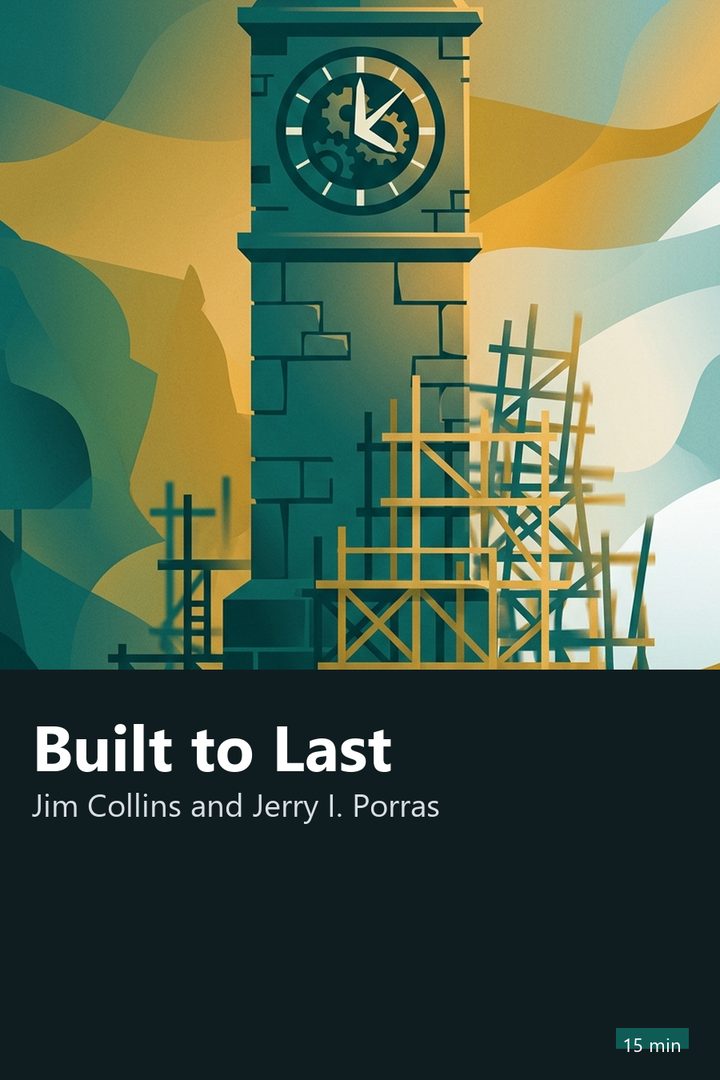
Cover of Built to Last

Business · 15 min

Built to Last

Jim Collins and Jerry I. Porras · 1994

Who it's for

This one is for you if you run a family business, lead a small team, or dream of building a company that outlives your own exhaustion. Built to Last is for anyone who wants to understand why certain companies make it through decades, changing owners, products, and markets without losing their identity along the way.

Read it in the app

⚡ Free to download • 🎁 One full book free every day

🎧 Audio coming soon in the app

Narration for the English summaries is on its way. Meanwhile you can read the full summary in the app.

3 ideas to take with you

1

What holds a company together for decades is not that brilliant spark at the beginning, it's having turned into a factory of new sparks.

2

A company that changes products and markets without losing its identity lasts longer than one stuck in an old formula for success.

3

Choosing who joins the team based on values, and not just technical skill, saves years of culture rework down the road.

“
A decade-long goal only works when anyone in the company can repeat it from memory without rereading any poster.
An idea from Built to Last, in the words of 15 Minutes

Preview

Start reading now

The six-year experiment behind the book

Jim Collins and Jerry Porras didn't want to write yet another opinion book about management. The two spent six years comparing, pair by pair, eighteen companies admired for decades with direct competitors in the same industry and of the same size, but without the same prestige. The question wasn't which company had the better product today, it was why one survived by changing markets, products, and generations of leadership several times, while its neighbor in the same field stagnated or vanished from the map.

That methodological choice is what sets the book apart from most management books. Instead of the biography of a charismatic founder told in the tone of a legend, it's a structured comparison, company against company, decade after decade, looking at what really differed between the two over time.

The result is not a magic formula for instant success, it's a list of recurring patterns that showed up in the lasting companies and were missing in the ordinary ones. A pattern is not a guarantee, but it's already a lot more than loose intuition about what works in a company.

It's not about the genius founder

Common sense pictures a great company being born from the brilliant idea of a lone visionary who saw the future before everyone else. The book dismantles that image: a good share of the companies studied started without any grand plan, some selling products quite different from what they became famous for, and only found the right business by trying and failing in the early years.

What set the lasting ones apart was not the brilliance of the first idea, it was the discipline of building an organization capable of producing good decisions over and over, even after the founder left the scene. A company that depends on one person's talent is like a neighborhood bakery living off the secret recipe of a single baker: it works while he's in the kitchen and becomes a serious problem the day he gets sick or wants to retire.

The key shift is to trade the search for a genius idea for the construction of a machine that keeps turning on its own after the person who built it leaves the room. That takes process, training for the people who stay, and above all accepting that the credit doesn't belong to one person alone.

Core ideology: what doesn't change when everything changes

The book calls core ideology the combination of a company's core values, what it believes in even when it costs money in the short term, and its core purpose, the reason it exists beyond making a profit at the end of the month. Core ideology is not the product, it's not the strategy of the moment, it's what stays the same even when product and strategy change completely.

Think of a neighborhood bakery that refuses to switch flour suppliers even when the price goes up a lot, because the longtime customer notices the difference in the bread the next day. That's not pointless stubbornness, it's core ideology in action, a value that is only truly proven at exactly the moment when giving it up would be cheaper.

Core ideology is not a pretty phrase hanging on the lobby wall. It only truly exists when it's tested at a moment when following that value is expensive and the company follows it anyway.

11 more sections and the quiz

Continue in the app

Read the whole summary, finish with the Built to Last quiz and follow the guided Journeys. No ads in the app.

About Jim Collins and Jerry I. Porras

Jim Collins is an American consultant and researcher, trained at Stanford, who built a career studying what separates a good company from a lasting one. Jerry Porras was a professor at the Stanford Graduate School of Business for decades, an expert in organizational behavior and change inside companies. The two met in a Stanford classroom and spent six years comparing pairs of companies in the same industry before publishing Built to Last in 1994. Collins went on to a solo career, writing other management books that also became reference points in the corporate world.

Explore

Category:
Business
Part of the Journeys:
Inside Great Companies