15 Minutes
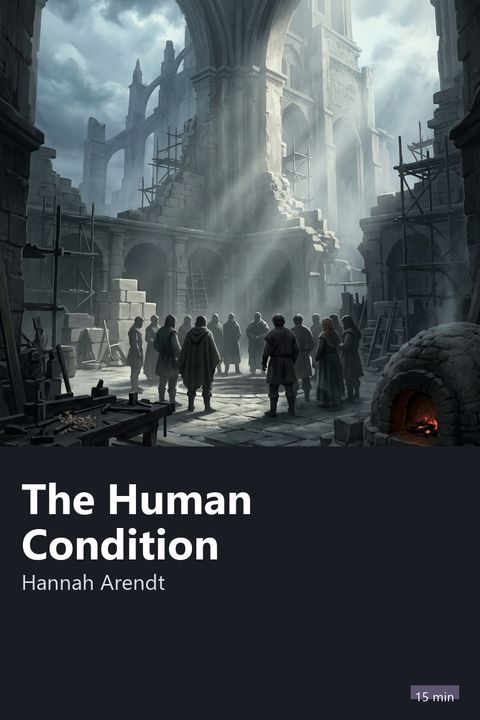
Cover of The Human Condition

Philosophy · 15 min

The Human Condition

Hannah Arendt · 1958

Who it's for

For you if you want to rethink what it means to work, act, and live among others in a world of employment, consumption, and politics. This book is for anyone who enjoys philosophy and isn't afraid of a demanding read.

Read it in the app

⚡ Free to download • 🎁 One full book free every day

🎧 Listen to this summary in the app

Every summary has audio narration. Open the app to read it or listen to it.

3 ideas to take with you

1

According to the book, every human being is born as a beginning, which is why each person brings into the world the possibility of starting something no one anticipated.

2

When someone's worth is measured solely by their job, retirement and unemployment begin to threaten their entire identity.

3

For Arendt, each person's life takes on its full meaning only when others tell its story, and that is what gives some lasting presence to what would otherwise pass.

“
Cooking, washing, and caregiving are tasks whose results disappear that same day, which is precisely why so many people forget how much the world depends on them.
An idea from The Human Condition, in the words of 15 Minutes

Preview

Start reading now

A Simple Question: What Are We Doing?

In The Human Condition, Hannah Arendt offers a seemingly modest proposal: to think about what people do when they are active in the world. She calls this vita activa, the active life, and divides it into three kinds of activity: labor, work, and action. The distinction sounds technical, but it changes how you look at everyday life.

The underlying question is: what are we doing when we do what we do? Working to pay the bills, building a house, and discussing politics at a condo association meeting are different things, and Arendt believes confusing them creates much of modern life's unease. Naming the difference is the first step toward understanding the problem.

The book was published in 1958, against the backdrop of the Cold War and factory automation. Arendt looks back to the Greeks and Romans to understand what the modern age has lost and gained. This isn't a happiness handbook. It's an invitation to slow down and think.
The Human Condition Is Not Human Nature

Arendt distinguishes between two things. Human nature, if it exists, would be a fixed essence defining what we are. The human condition, on the other hand, is the set of circumstances in which life unfolds: being born, having a body, living among others, inhabiting the Earth, and dying. She refuses to speak of an essence and instead examines these conditions.

Each activity corresponds to a condition. Labor responds to the need to sustain biological life. Work responds to the fact that we live in a world of lasting things that we ourselves have made. Action responds to the fact that we do not live alone and that each person differs from everyone else.

This way of thinking avoids easy formulas claiming that human beings are simply a certain way. Instead, she asks what changes when conditions change, and how each era values one activity while dismissing others. Her analysis is both historical and philosophical, giving weight to ordinary things.

Labor: The Cycle That Never Ends

Labor is activity tied to the body: eating, cleaning, cooking, doing laundry, and caring for children. It includes everything that must be done again every day because the results quickly disappear. You make lunch, someone eats it, and tomorrow everything starts over. It's an endless cycle tied to survival.

For Arendt, labor is necessary and often exhausting, but it leaves nothing lasting behind. Throughout history, these tasks were therefore pushed onto people without power, such as enslaved people and women, so that others could be free to engage in politics. Arendt points out this inequality without romanticizing the past.

Think about the routine of a house cleaner, a mother caring for her home, or someone cleaning a hospital. Their work is essential and invisible precisely because it leaves no lasting object behind. The book helps explain why this activity so often goes unrecognized, even though everything depends on it.

11 more sections and the quiz

Continue in the app

Read the whole summary, finish with the The Human Condition quiz and follow the guided Journeys. No ads in the app.

About Hannah Arendt

Hannah Arendt was born in 1906 in Germany to a Jewish family and studied philosophy with Martin Heidegger and Karl Jaspers. She fled Nazism and settled in the United States in 1941. She taught at American universities, including the New School in New York. Her works include The Origins of Totalitarianism and Eichmann in Jerusalem. She died in 1975.

Explore

Category:
Philosophy