15 Minutes
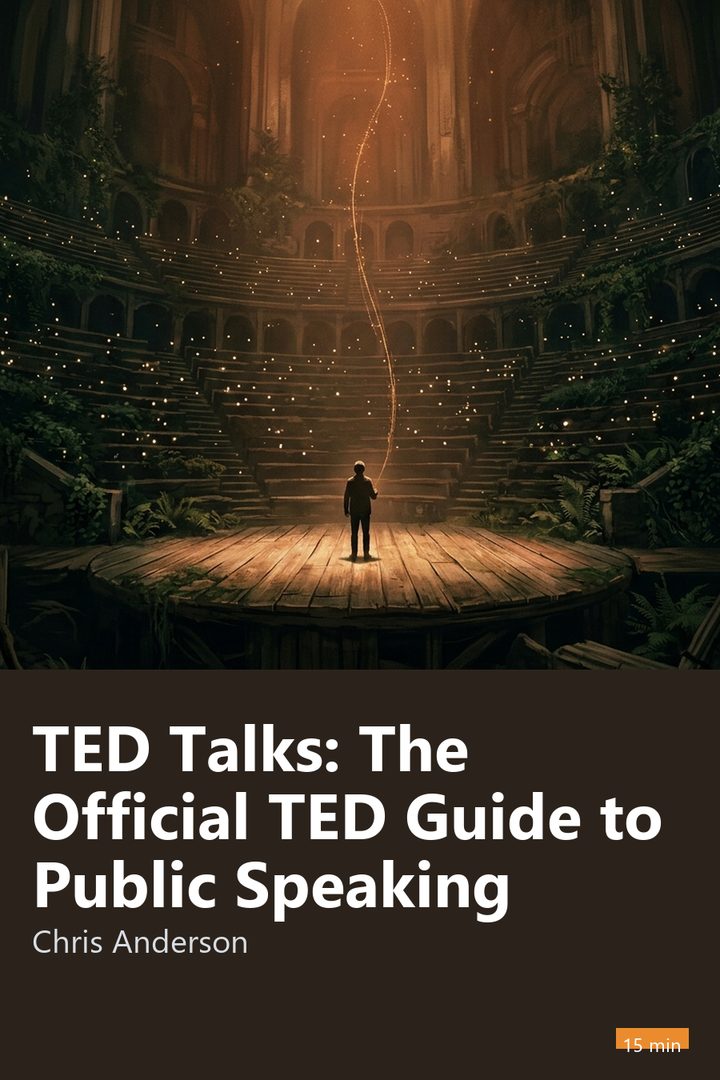
Cover of TED Talks: The Official TED Guide to Public Speaking

Personal Development · 13 min

TED Talks: The Official TED Guide to Public Speaking

Chris Anderson · 2016

Who it's for

For anyone who needs to present ideas in meetings, pitch projects in college, teach classes, or speak in public without fear or boredom. It is an indispensable guide for anyone who wants to master the ancient art of planting transformative ideas in the minds and hearts of an audience.

Read it in the app

⚡ Free to download • 🎁 One full book free every day

🎧 Audio coming soon in the app

Narration for the English summaries is on its way. Meanwhile you can read the full summary in the app.

3 ideas to take with you

1

Eye contact and a sincere display of vulnerability disarm cynicism and open the audience's heart.

2

Explaining difficult concepts requires building analogies that anchor the unfamiliar in what the audience already knows.

3

Exhaustive rehearsal does not make a speech stiff; it internalizes the material so deeply that it unlocks pure spontaneity on stage.

“
Public speaking is not an act of personal vanity, but a generous gift of an idea to someone else.
An idea from TED Talks: The Official TED Guide to Public Speaking, in the words of 15 Minutes

Preview

Start reading now

The True Purpose of Public Speaking

There is a widespread myth that high-impact public speaking is an innate gift reserved for charismatic extroverts born with velvet voices and a natural flair for telling jokes on stage. Chris Anderson opens his official guide by dismantling this fallacy: public speaking is not a theatrical vanity performance, but a generous act of giving.

The only legitimate goal of a meaningful presentation is to build a living idea inside the mind of the listener. A well-explained idea has the miraculous power to rewire a person's worldview, altering their career choices, ethical values, and the trajectory of their life story.

We see this happen whenever a passionate teacher steps up in front of a noisy public school classroom and manages to captivate dozens of restless teenagers. They do not need dazzling visual effects; the true power of communication lies in the clarity with which they share a spark of insight that makes a student's eyes light up.

The Throughline That Anchors the Narrative

The fatal mistake made by beginners and arrogant experts alike is trying to dump an entire lifetime of knowledge into a fifteen- or twenty-minute presentation. A talk that tries to cover ten separate topics goes deep on none, leaving the audience bewildered and unable to recall a single core takeaway once they walk out the door.

To prevent this disastrous scattering of focus, Anderson prescribes identifying a clear throughline. This is the invisible thread that ties together every sentence, story, chart, and metaphor you use. The throughline is the central thesis of your talk, distilled into a single, compelling, and surprising sentence.

Any element of the presentation that does not directly illustrate, prove, or expand that throughline must be ruthlessly cut in the editing process. Having the courage to prune secondary details and dry data is what guarantees your core idea will be understood with crystal clarity by any non-expert listener.

The Four Toxic Styles That Must Be Banned

Over two decades of analyzing thousands of memorable talks along with painful flops, the TED curatorial team identified four disastrous styles that destroy any chance of connecting with an audience.

The first is the sales pitch in disguise, where a speaker takes the stage not to gift the audience an idea, but to sell courses, consulting, or books, breaking the ethical contract of trust. The second is the aimless ramble, typical of speakers who wing it without structure and waste listeners' time with disconnected anecdotes. The third is the corporate bore, where an executive spends half their time walking through an organizational chart that nobody outside the company cares about.

The fourth harmful style is the trap of fake inspiration, where a speaker mimics rehearsed charisma and forces hollow melodrama without delivering real substance. Modern audiences have sharp radar for manipulation and will reject cheap theater in favor of genuine authenticity.

9 more sections and the quiz

Continue in the app

Read the whole summary, finish with the TED Talks: The Official TED Guide to Public Speaking quiz and follow the guided Journeys. No ads in the app.

About Chris Anderson

Chris Anderson is a British-American journalist, entrepreneur, and publisher who took the helm of the TED Conference in 2001 through his non-profit foundation. He was the visionary behind making TED Talks freely available online in 2006, sparking one of the world's largest cultural and educational movements with billions of annual views. Under his curatorship, the TED stage has welcomed Nobel laureates, heads of state, and brilliant thinkers from every walk of human knowledge.

Explore