15 Minutes
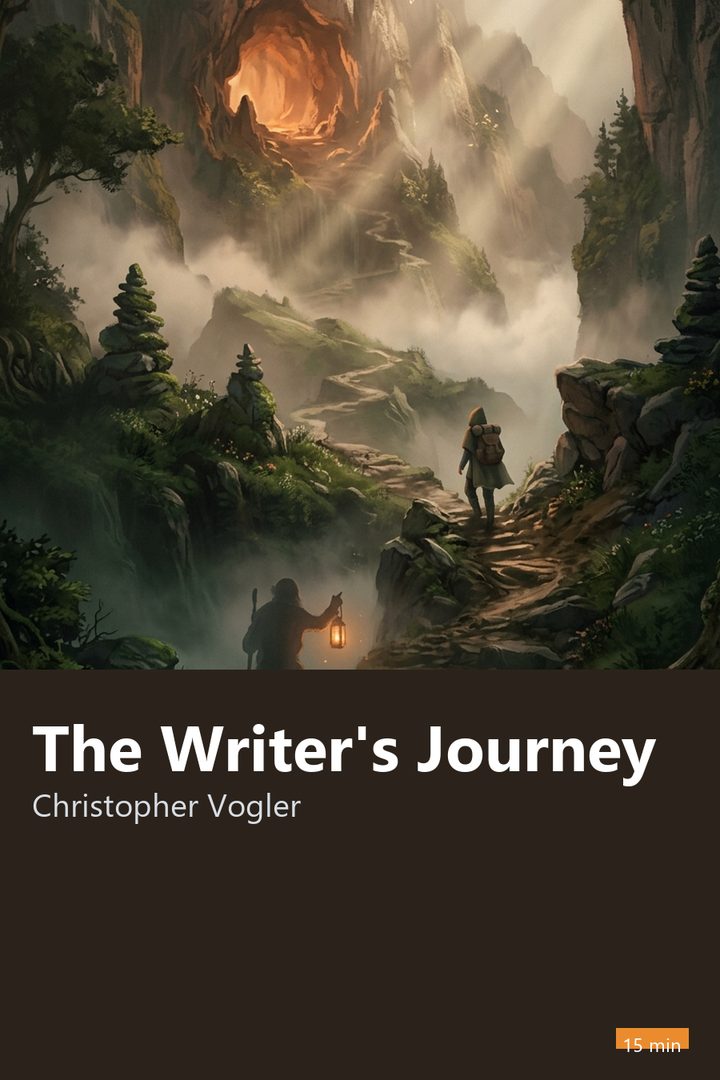
Cover of The Writer's Journey

Personal Development · 14 min

The Writer's Journey

Christopher Vogler · 1992

Who it's for

For you if you write, want to write, or love watching movies and reading novels while understanding how a story works from the inside. It is also great for anyone who works with screenwriting, content creation, or brand storytelling.

Read it in the app

⚡ Free to download • 🎁 One full book free every day

🎧 Audio coming soon in the app

Narration for the English summaries is on its way. Meanwhile you can read the full summary in the app.

3 ideas to take with you

1

When a character has both a flaw and a desire, the reader starts rooting for them even before the first adventure begins.

2

If the decision to enter the new world costs the hero nothing, the crossing loses its power.

3

Giving a name to the writer's crisis turns it into a stage, and every stage comes to an end.

“
A map is what keeps you from getting lost, and a formula is what makes one movie look like a copy of another.
An idea from The Writer's Journey, in the words of 15 Minutes

Preview

Start reading now

From a studio memo to a classic book

The Writer's Journey grew out of a short text. In the mid-1980s, Christopher Vogler, who worked as a story analyst at Hollywood studios, wrote a seven-page memo for colleagues summarizing a theory by mythologist Joseph Campbell. The document was passed around the studio halls and soon many people were using it to evaluate and improve stories.

Later, the author expanded the memo into a book, published in 1992 and revised in subsequent editions. Its goal is to present, in practical workshop language, a pattern that shows up in folktales, myths, movies, and novels around the world, and to show how screenwriters and authors can use it to build stronger narratives.

The book's subtitle speaks of mythic structure for writers, and that is exactly what it delivers. The book does not promise to guarantee success or replace talent. Instead, it offers a shared vocabulary for talking about what works in a story and why, which is already a huge help for anyone who writes alone.
Campbell, Jung, and the pattern behind stories

To understand the book, you need to know two key sources. The first is Joseph Campbell, who in his 1949 book The Hero with a Thousand Faces compared myths from various cultures and proposed that many of them follow the same path, which he called the monomyth: the hero leaves home, faces trials, goes through a crisis, and returns transformed.

The second is Carl Jung, the Swiss psychiatrist who wrote about archetypes, meaning recurring figures in the human imagination, such as the wise old man, the shadow, and the trickster. Vogler brings the two together and suggests that these characters and stages tap into something universal in readers and audiences, which is why they work across such different stories.

Whatever your opinion of the theory, its practical value is huge. If the audience intuitively recognizes certain patterns, the writer gains a map for deciding what to place at each moment of the narrative, and for diagnosing why a particular section has stalled.

Not a formula, but a map

Throughout the book, Vogler insists that the hero's journey is not a formula. It is a flexible pattern that can be inverted, combined, shortened, or partially ignored. Each story decides what to use. The goal is to serve as a guide, not a rigid rule.

The difference is important. A formula is what makes one movie feel like a copy of another; a map is what keeps a writer from getting lost. The author points out that the stages can appear out of order, repeat several times, or remain implied, and that good stories usually surprise us within the pattern.

That is why the best way to use the book is as a checklist of questions. Does my character have an ordinary world the reader can feel? What pushes them into the adventure? What are they afraid of? Answering those questions in your own voice is far more useful than filling out a twelve-box spreadsheet.

Anyone who watches classic dramas or soap operas recognizes the outline: the humble young woman called into the world of the wealthy, the hesitation, the godmother who shows up with advice, the mansion door opening. The pattern is right there, and yet no two shows are identical because of it.

10 more sections and the quiz

Continue in the app

Read the whole summary, finish with the The Writer's Journey quiz and follow the guided Journeys. No ads in the app.

About Christopher Vogler

Christopher Vogler is an American script consultant and writer with a long career as a story analyst for Hollywood studios. His memo on the work of Joseph Campbell circulated in the 1980s and became the foundation of this book. He has taught courses and consulted on narrative structure for screenwriters in several countries. The book has gone through multiple editions and is widely used in writing workshops.

Explore