15 Minutes
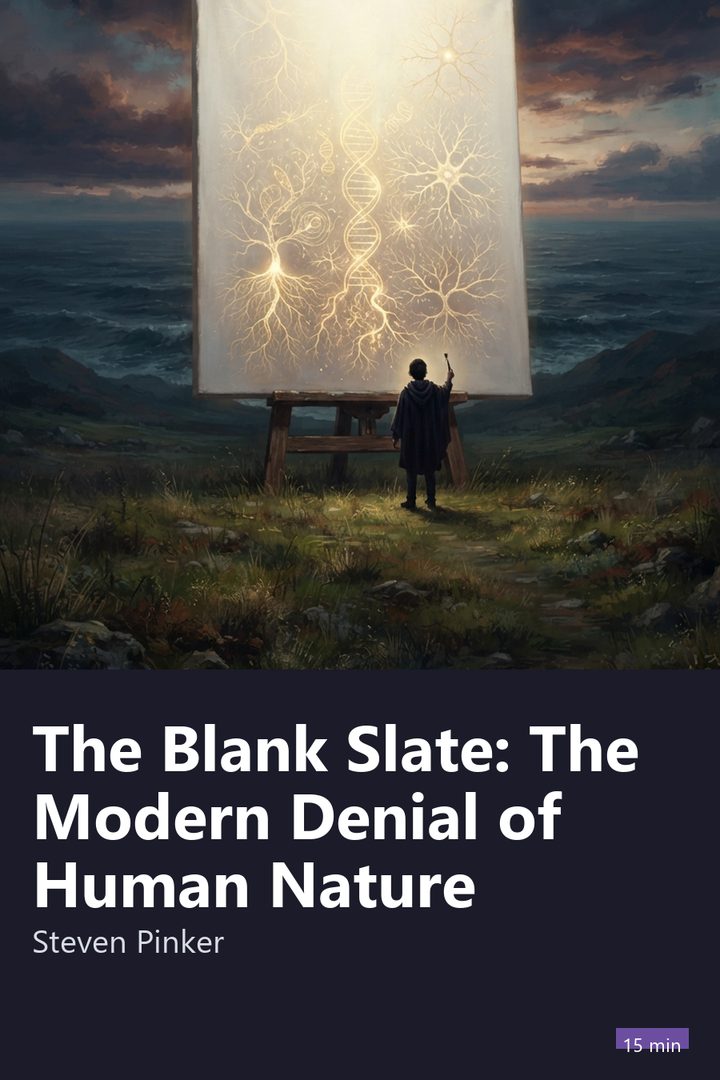
Cover of The Blank Slate: The Modern Denial of Human Nature

Psychology · 15 min

The Blank Slate: The Modern Denial of Human Nature

Steven Pinker · 2002

Who it's for

For anyone interested in the age-old debate between nature and nurture who wants to understand the arguments of one of the most widely read and debated authors on the subject. Perfect if you enjoy ideas, politics, and science, and are up for examining a controversial thesis with a critical eye.

Read it in the app

⚡ Free to download • 🎁 One full book free every day

🎧 Audio coming soon in the app

Narration for the English summaries is on its way. Meanwhile you can read the full summary in the app.

3 ideas to take with you

1

Much of the resistance to the idea of human nature stems from fear of what it might justify, rather than an objective analysis of the facts.

2

Pinker divides politics between those who view human beings as constrained and those who view them as perfectible, with each side getting right what the other gets wrong.

3

The three dogmas highlighted in the book, the blank slate, the noble savage, and the ghost in the machine, appeal to us because they promise that anything can be fixed.

“
Explaining where a behavioral tendency comes from is not the same as excusing someone who acts on it, and confusing the two stalls productive conversation.
An idea from The Blank Slate: The Modern Denial of Human Nature, in the words of 15 Minutes

Preview

Start reading now

The Idea the Book Aims to Overturn

Tabula rasa is a Latin term for a scraped tablet, and it became the metaphor for a mind born blank, free of inherent tendencies, written upon solely by experience. Cognitive psychologist Steven Pinker argues that this concept has spread so deeply through our culture that many accept it as scientific fact, even though modern science points in the opposite direction.

Published in 2002, the book's core thesis is that the human mind comes with an innate structure shaped by evolution, and denying this reality carries intellectual, moral, and political costs. It is not an argument claiming everything is genetic, but rather that experience operates on something that already exists.

Pinker writes as a polemicist. His targets are intellectuals, schools of thought, and social movements that, in his view, have pushed society toward denying human nature. It pays to read his work with a critical eye, scrutinizing both what he critiques and how he frames his arguments.


The Three Dogmas

Pinker identifies three prevailing ideas that sustain this denial. The first is the blank slate itself: the notion that the mind is shaped almost entirely by nurture and culture. The second is the noble savage: the belief that humans are naturally peaceful and good, and that wickedness originates in society. The third is the ghost in the machine: the idea that the mind is something distinct and separate from the body.

Each of these concepts has deep historical roots and strong emotional appeal. They tell comforting stories: that anyone can become anything, that evil can be cured, and that we are more than mere physical matter. Pinker acknowledges this appeal, but argues that these ideas directly clash with hard evidence from genetics, neuroscience, and evolutionary psychology.

The book's strategy is to dismantle each dogma, reveal where it came from, and show the damage it caused. From there, Pinker demonstrates that we can fully acknowledge human nature without giving up on equal rights or the ongoing pursuit of social justice.

Where These Ideas Came From

The book traces a brief intellectual history. The blank slate goes back to English philosopher John Locke, who argued in the seventeenth century that all knowledge comes from experience rather than innate ideas. The noble savage is closely associated with Jean-Jacques Rousseau, who viewed civilization as a corrupting force. The ghost in the machine originates with René Descartes and his division between the immaterial mind and the physical body.

Pinker acknowledges that these concepts originally served noble purposes: Locke helped undermine the hereditary privileges of royalty and aristocracy, and believing that people could change fueled essential social reforms. The trouble begins, in his view, when a political tool is turned into a dogmatic scientific doctrine.

During the twentieth century, movements like behaviorism and branches of the social sciences reinforced this mindset. If human beings are completely shaped by their environment, then altering that environment should be enough to engineer a better person, an assumption that fueled well-intentioned social experiments and, at times, dangerous utopian projects.

12 more sections and the quiz

Continue in the app

Read the whole summary, finish with the The Blank Slate: The Modern Denial of Human Nature quiz and follow the guided Journeys. No ads in the app.

About Steven Pinker

Steven Pinker was born in Montreal, Canada, in 1954, and earned his doctorate in experimental psychology from Harvard University. He taught at MIT and later at Harvard, conducting research on language and cognition. He is the author of The Language Instinct, How the Mind Works, and The Better Angels of Our Nature, among others. The Blank Slate was published in 2002.

Explore

Category:
Psychology
Part of the Journeys:
Journey Through the Brain