15 Minutes
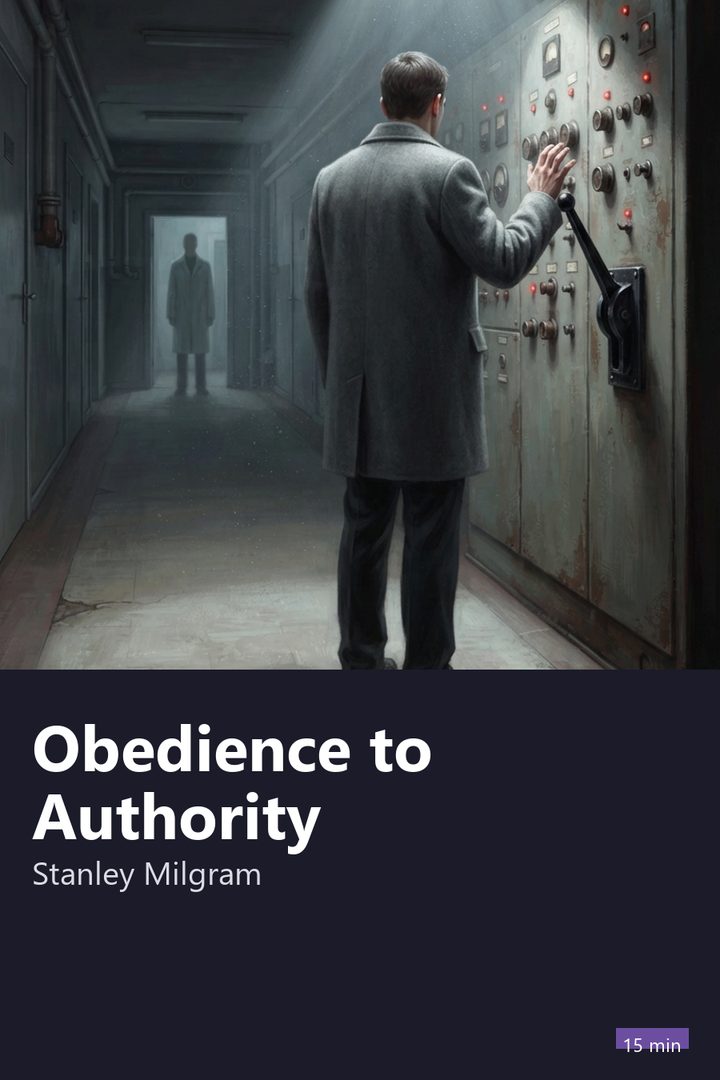
Cover of Obedience to Authority

Psychology · 16 min

Obedience to Authority

Stanley Milgram · 1974

Who it's for

For you if you want to understand why ordinary people follow orders they know are wrong, at work, in groups, or in public life. It is also for anyone who leads a team and wants to create an environment where saying no is possible.

Read it in the app

⚡ Free to download • 🎁 One full book free every day

🎧 Audio coming soon in the app

Narration for the English summaries is on its way. Meanwhile you can read the full summary in the app.

3 ideas to take with you

1

No one is asked to commit the extreme act all at once: the path consists of small steps, each just a little worse than the last.

2

For Milgram, people who see themselves as agents carrying out someone else's orders replace the question 'Is this right?' with 'Am I doing what I was told correctly?'

3

Before the study, experts predicted that almost no one would go all the way, and that mistaken prediction shows how much we underestimate the pressure of the situation.

“
All it takes is one voice saying no in a room full of silent people to change the direction of the entire room.
An idea from Obedience to Authority, in the words of 15 Minutes

Preview

Start reading now

The Unsettling Question

After World War II, the world looked at the crimes of Nazism and asked: How had so many ordinary people taken part in so much brutality? The comforting explanation was that Germans had a character flaw. Stanley Milgram, a young psychologist, doubted that easy answer and wanted to test in a laboratory how far an ordinary person would go when given an order.

The question is uncomfortable because it challenges the image we have of ourselves. Almost everyone thinks that, in someone else's shoes, they would have said no. Milgram wanted to know whether that certainty holds up when the pressure is real, rather than just imagined during a conversation at a bar.

The 1974 book brings together years of experiments and the author's interpretation. It is not about Nazism itself, but about a human mechanism that appears in offices, military bases, churches, hospitals, and families.

How the Experiment Was Set Up

In 1961, at Yale University, people answered a newspaper ad offering payment to participate in a study of memory and learning. Upon arrival, each volunteer was assigned the role of teacher. Another participant, actually a hired actor, took the role of learner.

The learner was strapped into a chair in another room, and the teacher went to a machine with a row of switches, ranging from mild to very strong shocks, with labels going up to 450 volts and the word danger. Every time the learner made a mistake, the teacher was supposed to administer the next shock, increasing it in fifteen-volt increments.

The shocks were fake, but the teacher did not know that. They heard groans, complaints, pleas to stop, and, at high voltages, silence. The step-by-step structure is central: no one is asked to commit the extreme act all at once, but simply to go one step beyond the last.

The Man in the Lab Coat and His Instructions

An experimenter in a gray lab coat stood beside the teacher, calm and unemotional. When the volunteer hesitated, he responded with standardized, firm prompts of increasing intensity: continue, the experiment requires you to continue, it is essential that you continue, and you have no choice. There were no threats or shouting.

Notice how understated the authority was. There was no weapon and no punishment. There was only a scientific setting, a professional-looking man, and the expectation that a good participant follows through on an agreement. It is the same logic that makes an employee find it hard to refuse when a supervisor says, 'Please do it this way.'

If the volunteer insisted on stopping after four prompts, the experiment ended. In other words, the volunteer could always leave. The question was how many would.

12 more sections and the quiz

Continue in the app

Read the whole summary, finish with the Obedience to Authority quiz and follow the guided Journeys. No ads in the app.

About Stanley Milgram

Stanley Milgram was born in New York in 1933 to Jewish immigrant parents and earned his doctorate in social psychology at Harvard. He taught at Yale and later at the City University of New York, where he remained until his death in 1984. Besides his obedience experiments, he is known for the small-world study, which gave rise to the idea of six degrees of separation. Obedience to Authority was published in 1974.

Explore

Category:
Psychology
Part of the Journeys:
Voices Against Injustice