15 Minutes
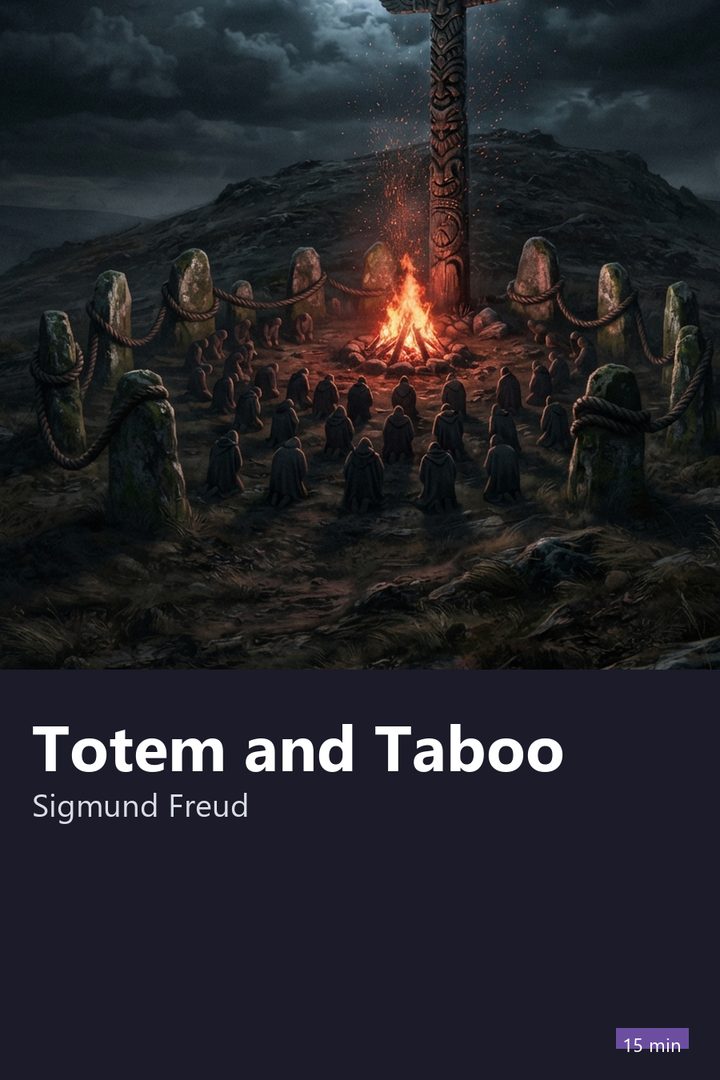
Cover of Totem and Taboo

Psychology · 16 min

Totem and Taboo

Sigmund Freud · 1913

Who it's for

For anyone curious about how Freud tried to explain religion, prohibitions, and guilt by looking at ancient societies. It's also for anyone who wants to understand where the idea that civilization began with a collective crime comes from, and why it remains so controversial.

Read it in the app

⚡ Free to download • 🎁 One full book free every day

🎧 Audio coming soon in the app

Narration for the English summaries is on its way. Meanwhile you can read the full summary in the app.

3 ideas to take with you

1

A strict prohibition often conceals a powerful temptation, and understanding the rule helps reveal the desire it surrounds.

2

For Freud, group life begins with an agreement among equals after the end of absolute power, a theory that continues to spark debate despite lacking historical evidence.

3

If you admire and criticize the same boss at the same time, you're not being two-faced. You're experiencing the ambivalence the book describes.

“
Fighting those in charge may be just another way of staying attached to them.
An idea from Totem and Taboo, in the words of 15 Minutes

Preview

Start reading now

A Book That Combines the Consulting Room and Anthropology

Totem and Taboo came out in 1913 and is one of Freud's boldest works. Instead of discussing patients in Vienna, he turns to peoples whom Europeans of his time called primitive and uses psychoanalytic ideas to try to explain where prohibitions, religion, and morality come from.

The book contains four essays. The first two explore the horror of incest and taboo. The third discusses magic and what Freud called the omnipotence of thoughts. The fourth, the most famous, presents the story of the original crime and the totem.

The underlying idea is that the minds of people in these societies function as magnified reflections of the mind of a child or a neurotic person. Today, that comparison sounds problematic, and we'll return to it in the critique. For now, it's worth understanding his reasoning.
What Is a Totem?

A totem is generally an animal or plant that a clan considers its ancestor and protector. Clan members feel connected to it through kinship and cannot kill or eat it, except on very special occasions. Think of fans who treat their team's mascot with something close to devotion, and you have a faint image of the idea.

According to the scholars Freud draws on, the most important rule of totemism is exogamy: people belonging to the same totem cannot marry or have sexual relations with one another. The kinship that matters is membership in the clan, more than blood ties.

Freud is interested in the totem because it brings together two very old prohibitions: not killing the sacred animal and not having sexual relations with members of one's own group. For him, these rules match the two great repressed desires of childhood, and that is the book's central clue.

The Horror of Incest

In the first essay, Freud shows that many peoples surround incest with elaborate rules. In certain groups, a man cannot even speak to his mother-in-law or be alone with his sister. These barriers go far beyond what would be necessary simply to prevent marriages between close relatives.

Anyone who grew up in a family may recognize milder versions: the endless mother-in-law jokes, the awkwardness of discussing sex in front of your parents, the care taken not to let an older male cousin share a bedroom with his female cousins. It seems like mere custom, but it echoes the logic of taboo.

For Freud, so much caution indicates that the desire exists and must be restrained. Nobody makes a law against something nobody wants to do. If the prohibition is so strict, the temptation must be powerful, and children already harbor this unconscious desire for their own parents.

11 more sections and the quiz

Continue in the app

Read the whole summary, finish with the Totem and Taboo quiz and follow the guided Journeys. No ads in the app.

About Sigmund Freud

Sigmund Freud was born in 1856 in Freiberg, now in the Czech Republic, and spent most of his life in Vienna. He trained as a physician and developed psychoanalysis through treating patients whose symptoms had no physical cause. He published The Interpretation of Dreams in 1900 and, persecuted by the Nazi regime, left Austria in 1938 for London, where he died in 1939.

Explore

Category:
Psychology
Part of the Journeys:
Freud and Psychoanalysis