15 Minutes
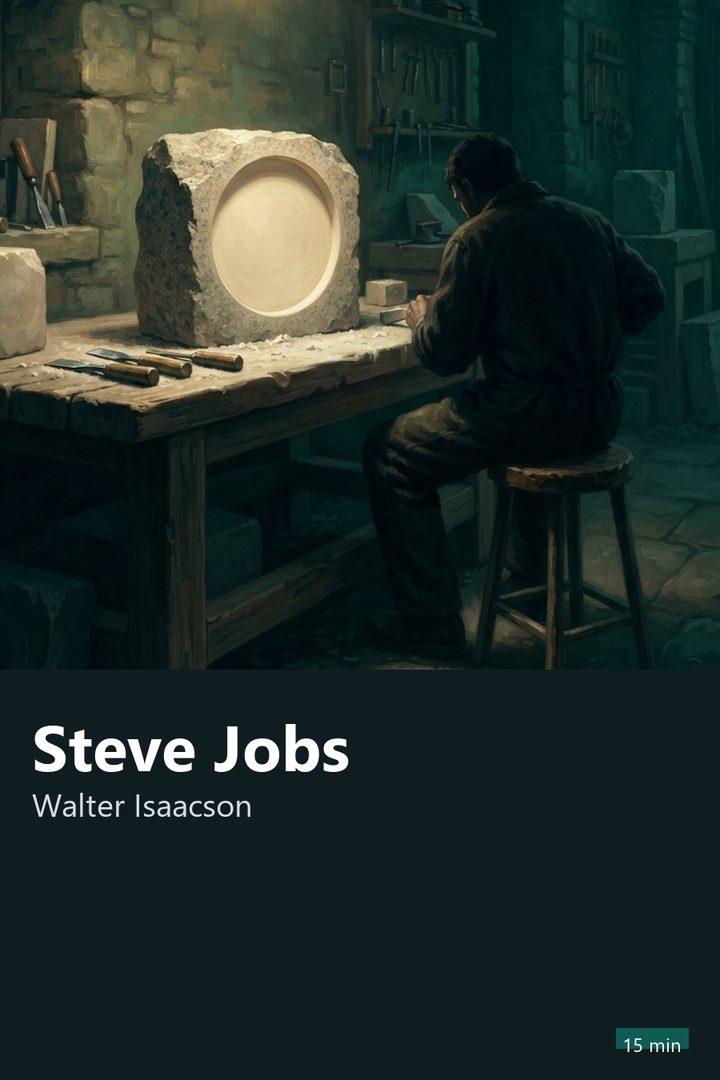
Cover of Steve Jobs

Biographies and Memoirs · 16 min

Steve Jobs

Walter Isaacson · 2011

Who it's for

For anyone who wants to understand how product vision and obsession with detail build real empires. And also for those who can look at success without closing their eyes to the human price that came with it: employees who were humiliated and a daughter who was denied for years.

Read it in the app

⚡ Free to download • 🎁 One full book free every day

🎧 Audio coming soon in the app

Narration for the English summaries is on its way. Meanwhile you can read the full summary in the app.

3 ideas to take with you

1

Cutting features from a product until only the essentials are left takes more courage than adding one more button to please everybody.

2

Recognizing someone's talent doesn't mean you have to excuse the cruel way they treated the people around them.

3

A huge commercial failure can turn out, years later, to be exactly the technical piece that was missing for an even bigger success.

“
Not even the man who controlled every detail at Apple could control a disease on his own: faced with a serious diagnosis, the conversation is with the doctor, not with your own stubbornness.
An idea from Steve Jobs, in the words of 15 Minutes

Preview

Start reading now

A baby given up for adoption and the foundation of everything that came after

Steven Paul Jobs was born in 1955, the biological son of a couple of students who decided to give the child up for adoption. He was raised by Paul and Clara Jobs, an ordinary California couple. Paul was a mechanic and passed on to his son a taste for taking apart and putting together gadgets in the family garage.

This origin marked Jobs his whole life. He said that being chosen by adoptive parents mattered more than being the product of a biological accident, but at the same time he carried a fear of abandonment that shows up later in the way he handled relationships, including with his own daughter.

The family moved to Silicon Valley back when the area was still mostly orchards and electronic parts factories, not the tech hub it is today. It was there, surrounded by retired engineers who lived in the neighborhood, that the curious boy got interested in electronics before he was even a teenager.

As an adult, Jobs went looking for his biological story and discovered he had a sister by blood, the writer Mona Simpson, with whom he built a close relationship. His biological father, though, he never really tried to find, even though the man ran a restaurant that Jobs had eaten at without knowing who he was.


Reed College, the calligraphy class and a different way of seeing

Jobs enrolled at Reed College but dropped out of the formal program after just a few months, continuing to sit in for free on the classes that interested him, without following any curriculum at all.

One of those classes was calligraphy, which taught him about typography and the spacing between letters. Years later he would say that it directly influenced the beautiful fonts of the Macintosh, proof that a seemingly useless curiosity can end up in a successful commercial product.

During this period he also traveled through India in search of spiritual enlightenment, adopted restrictive diets and experimented with psychedelic substances, later saying that experience had been one of the most important of his life.

With no steady income, he slept on the floor of friends' rooms and collected empty soda bottles to trade for spare change so he could get a hot meal on Sundays at a local Hare Krishna temple, a reality far from the billionaire executive he would later become.

The garage, Wozniak and the birth of Apple

Back in California, Jobs reconnected with Steve Wozniak, a brilliant and awkward engineer who was already building homemade computers to show off to friends in an amateur electronics club.

While Wozniak understood hardware and circuits like few others, Jobs saw what all of that could become in the market: a finished, sellable product inside a good-looking box. This duo, one with the technical talent and the other with the commercial vision, founded Apple in 1976 in the garage of Jobs's parents' house.

The first computer, the Apple I, was sold in a handmade way to local electronics stores. The bigger success came with the Apple II, which brought color to the screen and helped open the personal computer market to ordinary people, not just engineers.

11 more sections and the quiz

Continue in the app

Read the whole summary, finish with the Steve Jobs quiz and follow the guided Journeys. No ads in the app.

About Walter Isaacson

Walter Isaacson is an American journalist, a former managing editor of Time magazine and former chairman of CNN. He is the author of heavyweight biographies such as those of Albert Einstein and Benjamin Franklin, and he was chosen by Steve Jobs himself to write his official story, based on dozens of interviews and conversations with more than a hundred people close to him. The book was published just a few weeks after the death of its subject, in October 2011.

Explore