15 Minutes
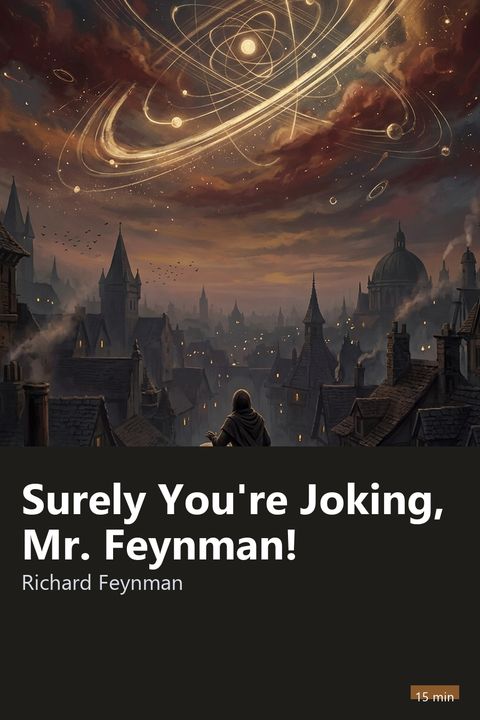
Cover of Surely You're Joking, Mr. Feynman!

Biographies and Memoirs · 15 min

Surely You're Joking, Mr. Feynman!

Richard Feynman · 1985

Who it's for

For anyone who enjoys true stories about science, curiosity, and humor, even without knowing physics. It will also appeal to teachers and students who want to think about what it really means to learn.

Read it in the app

⚡ Free to download • 🎁 One full book free every day

🎧 Listen to this summary in the app

Every summary has audio narration. Open the app to read it or listen to it.

3 ideas to take with you

1

If you cannot explain a topic to someone outside your field, you should probably suspect that your own understanding is lacking.

2

Going back to playing with a small problem can restore your motivation when the big project has lost its spark.

3

Humorous stories coexist with grief, and anyone facing a severe loss may need professional support.

“
Knowing the name of a bird in several languages teaches you nothing about what the bird actually does.
An idea from Surely You're Joking, Mr. Feynman!, in the words of 15 Minutes

Preview

Start reading now

A Physicist Who Told Stories

Surely You're Joking, Mr. Feynman!, published in 1985, collects memories from physicist Richard Feynman told to his friend Ralph Leighton, who transcribed them from tape-recorded conversations, many over drumming sessions. It is not an autobiography in the classical sense, but rather a conversational collection of anecdotes about curiosity, mischief, and science.

The book became a popular classic because it shows a Nobel laureate as someone who has fun, fixes radios, cracks safes for sport, and plays drums. The image of the solemn, serious scientist crumbles. In its place emerges a person who treats the world like one big puzzle.

Since these are oral memoirs, it is wise to read them with the caveat that the episodes were embellished. What the text delivers most authentically is the author's attitude toward knowledge, and that is what this summary aims to highlight.

The Boy Who Fixed Radios

The narrative begins in the author's childhood in a New York neighborhood. His father, a uniform salesman, taught him to look closely at nature, pointing out that knowing the name of a bird in several languages is not the same as knowing the bird itself. What matters is observing what the animal does, not just what people call it.

As a boy, he set up a makeshift lab, tinkered with circuits, and became known around the neighborhood for fixing radios. His secret was thinking calmly through what the device ought to do and why it was failing, rather than randomly turning screws. That habit of solving problems through thought became his trademark.

The takeaway for the reader is that hands-on curiosity can be more formative than many classes. Taking apart an old fan teaches you something that a written test never can.

True Understanding versus Memorizing Names

A recurring idea is the distinction between knowing the name of something and understanding how it works. Feynman criticizes learning formulas, terms, and definitions without being able to apply them to a concrete case. For him, understanding means being able to explain something in plain words and predict what happens in a novel situation.

In college, he used to reframe every concept with everyday examples. If he could not, he figured he had not grasped it yet. This test works for anyone: if you cannot explain a subject to someone outside the field, your understanding might still be shallow.

This critique targets education built on rote learning, a topic the author revisits repeatedly. In an everyday classroom, the equivalent is the student who recites the textbook definition of force but cannot predict what happens to passengers when a bus hits the brakes.

11 more sections and the quiz

Continue in the app

Read the whole summary, finish with the Surely You're Joking, Mr. Feynman! quiz and follow the guided Journeys. No ads in the app.

About Richard Feynman

Richard Feynman was born in New York in 1918 and died in 1988. He was a theoretical physicist who worked on the atomic bomb project at Los Alamos. He won the 1965 Nobel Prize in Physics, shared with Julian Schwinger and Sin-Itiro Tomonaga, for his work in quantum electrodynamics. He taught for decades at Caltech and served on the presidential commission that investigated the Space Shuttle Challenger disaster in 1986.

Explore