15 Minutes
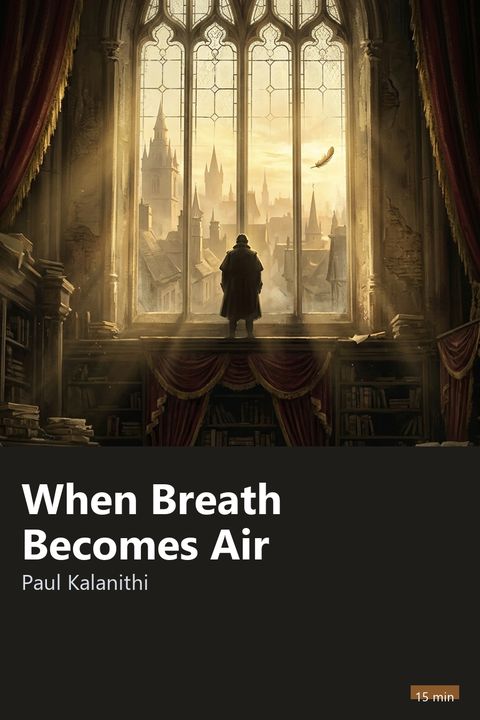
Cover of When Breath Becomes Air

Biographies and Memoirs · 15 min

When Breath Becomes Air

Paul Kalanithi · 2016

Who it's for

For anyone who wants to reflect on life's meaning in the face of death, works in health care, or has a loved one who is ill. It's a short, sensitive, honest book, without being self-help.

Read it in the app

⚡ Free to download • 🎁 One full book free every day

🎧 Listen to this summary in the app

Every summary has audio narration. Open the app to read it or listen to it.

3 ideas to take with you

1

A survival statistic tells you something about groups but little about an individual life, and living with that gap means accepting uncertainty.

2

According to the book, life's meaning lies more in relationships and contribution than in a job title or prestige.

3

Choosing to have a daughter despite knowing that time would be short shows that living well is about more than avoiding pain.

“
When time grows short, the question shifts from how much you can do to what is worth doing.
An idea from When Breath Becomes Air, in the words of 15 Minutes

Preview

Start reading now

A Doctor Becomes a Patient

Paul Kalanithi was just months away from completing one of medicine's most demanding training programs, becoming a neurosurgeon, when he began losing weight, coughing, and experiencing back pain. He knew hospitals inside and out, but never imagined he would soon be lying in a bed instead of standing beside one.

The diagnosis came at thirty-six: advanced-stage lung cancer, in someone who had never smoked. In a single sentence, the future he had spent decades planning fell apart. The book grows out of that turning point, telling how a man trained to save lives learns to confront his own mortality.

Published after his death, the book is divided into two parts: the first tells how he got to that point, and the second deals with his illness. Connecting them is a question that guides everything, both simple and enormous: what makes a life worth living when time is running out?


From Arizona to Literature

Paul grew up in Arizona in a family of Indian heritage that valued education and medicine. He loved books from an early age. In college, he studied English literature and biology, and began wondering how words and science could explain what it means to be human.

He did not choose medicine right away. He spent a period immersed in writing and philosophy, convinced that language offered a path toward understanding life and death. Only later did he decide that the hospital was the most direct place to confront those questions.

These beginnings help explain the book's tone. It isn't a technical account of illness, but the work of someone who read poets and philosophers and brought that background into the operating room. The fusion of science and the humanities is one of the book's most beautiful qualities.

The Meaning of Medicine

In medical school, Paul came to understand that caring for someone means more than repairing an organ. He saw the doctor-patient relationship as a moral responsibility: at their most vulnerable, people entrust themselves to a professional who must prove worthy of that trust.

He chose neurosurgery because it deals with the brain, the seat of identity, memory, and language. An operation there can save a life, but it can also change who someone is. To him, that demanded humility, courage, and a willingness to be present for the hardest decisions.

The book describes residency's punishing pace: endless shifts, exhaustion, little time with family, and the risk of becoming hardened to other people's suffering. Paul tried not to lose his human perspective, but he acknowledges the toll this training takes on the body, mind, and relationships.

11 more sections and the quiz

Continue in the app

Read the whole summary, finish with the When Breath Becomes Air quiz and follow the guided Journeys. No ads in the app.

About Paul Kalanithi

Paul Kalanithi was born in 1977 and grew up in Arizona. He studied English literature and biology at Stanford and earned his medical degree at Yale. He was finishing his neurosurgery residency when he was diagnosed with lung cancer. He died in 2015, at thirty-six, and his book was published after his death.

Explore