15 Minutes
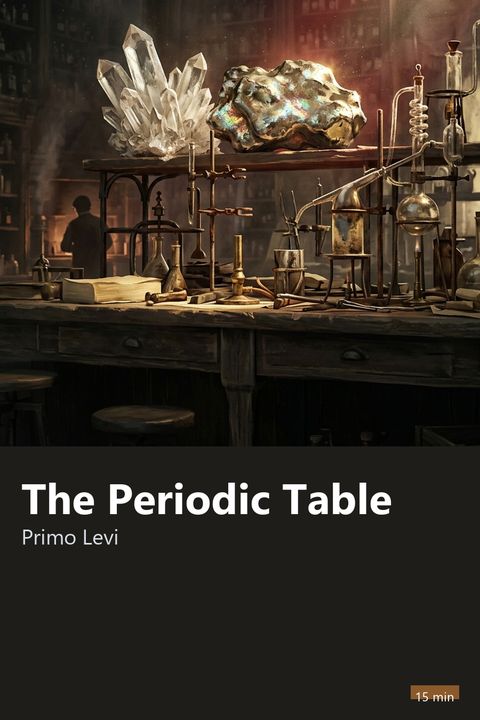
Cover of The Periodic Table

Biographies and Memoirs · 15 min

The Periodic Table

Primo Levi · 1975

Who it's for

For anyone who enjoys well-written memoirs and wants to discover the curious, deeply human chemist behind one of the great writers of the 20th century. It's also for anyone who thinks science and literature don't mix.

Read it in the app

⚡ Free to download • 🎁 One full book free every day

🎧 Listen to this summary in the app

Every summary has audio narration. Open the app to read it or listen to it.

3 ideas to take with you

1

The impurity that the rhetoric of purity tries to erase is exactly what sets things in motion.

2

Doing your work well restores dignity and direction, even when the world around you seems to be falling apart.

3

Understanding what someone did is not the same as absolving them, and Levi's writing knows how to inhabit that space.

“
People who learn to test and correct are more likely to question a big lie.
An idea from The Periodic Table, in the words of 15 Minutes

Preview

Start reading now

A memoir written with chemical elements

Primo Levi was a chemist by training and a writer out of necessity. In The Periodic Table, published in 1975, he brings together twenty-one short pieces, each named after a chemical element. Some are memories from his own life, others are invented stories, and one follows the journey of a carbon atom.

It's a beautiful idea: using chemistry as a thread to tell a life story. Each element provides a starting point for talking about a period, a person, a job, or a question. The book is neither a scientific treatise nor a chronological biography, but a collection of memories with the scent of a laboratory.

Readers who already know Levi as a witness to Auschwitz may be surprised: the war and the camp appear here, but they aren't the focus. The book shows the whole person, with his family, youth, friendships, jobs, and curiosity about matter.
Argon: the family of nearly inert gases

The first chapter introduces the author's ancestors, Jews from Piedmont in northern Italy. Levi compares their community to argon, a noble gas that barely reacts with other elements: people who kept to themselves, with their own customs and vocabulary, without mixing much with the surrounding world.

The tone is affectionate and good-humored. We meet uncles with their peculiar habits, expressions blending Italian and Hebrew, and stories of trades passed down from generation to generation. It's a portrait of a small world with a strong identity, which the author treats with affection and a certain irony.

This opening sets the stage for what follows: readers learn that the author comes from a tradition, and that the coming persecution targeted not faceless people, but a culture with humor, recipes, and everyday routines.

Hydrogen: curiosity starts early

In the next chapter, Levi describes doing chemistry experiments with a friend while still a teenager. The pair built makeshift equipment, produced hydrogen from water, and marveled at what matter could do.

The charm lies in the description of their desire to understand. They wanted to see the world from the inside, without being afraid of making mistakes. For Levi, chemistry begins less as a career than as a way of challenging the apparent order of things.

The chapter recalls a truth that applies to anyone: an interest in a craft often begins in a jumble of curiosity, long before it ever becomes something to put on a resume.

12 more sections and the quiz

Continue in the app

Read the whole summary, finish with the The Periodic Table quiz and follow the guided Journeys. No ads in the app.

About Primo Levi

Primo Levi was born in Turin, Italy, in 1919 and trained as a chemist. He was deported to Auschwitz in 1944 and survived. After the war, he worked in industry and wrote books of testimony and memoir, including Survival in Auschwitz. He died in Turin in 1987.

Explore