15 Minutes
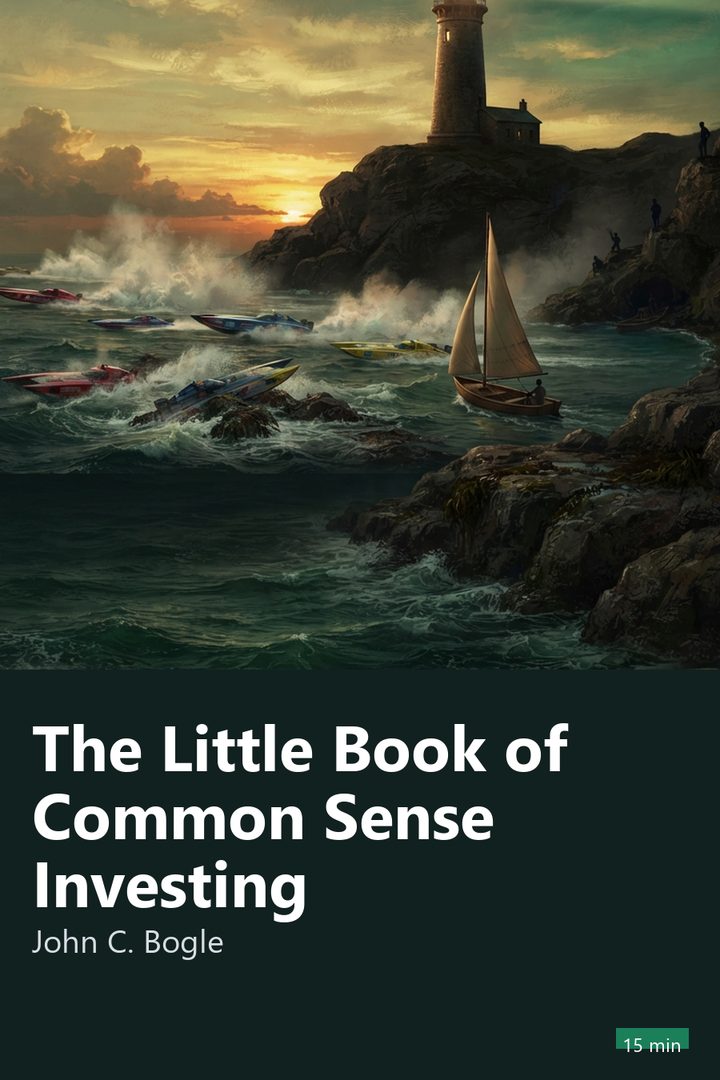
Cover of The Little Book of Common Sense Investing

Personal Finance · 17 min

The Little Book of Common Sense Investing

John C. Bogle · 2007

Who it's for

For you if you've heard about investing but feel lost among so many fund options and tips from group chats, and you want to understand, in plain English, why cost and time matter more than any expert's hunch. A starting point for anyone who wants to stop guessing and start thinking in decades, not months.

Read it in the app

⚡ Free to download • 🎁 One full book free every day

🎧 Audio coming soon in the app

Narration for the English summaries is on its way. Meanwhile you can read the full summary in the app.

3 ideas to take with you

1

A cost that looks small every year turns into a huge hole after twenty or thirty years, because it gets multiplied by compound interest too, only this time against you.

2

Trying to beat the market, in the aggregate, is a losing bet: for every investor who earns more than the average, another necessarily ends up with less, and the middleman still takes a slice from both sides.

3

The biggest risk to many people's money is not the market falling, it's getting scared by the drop and selling at exactly the wrong time.

“
The simplest way to invest is also usually the cheapest, and the cheapest, in the long run, usually wins.
An idea from The Little Book of Common Sense Investing, in the words of 15 Minutes

Preview

Start reading now

The little game the stock market seems to be, and isn't

Imagine a group of friends who get together every Friday to play cards at the bar, betting a round of beers. At the end of the night, what each person won and lost adds up to zero, aside from what the bar charged for the table. That's roughly how the stock market works: before any costs, the return of everyone together equals the market's average return.

Bogle starts from this simple reasoning: if before costs everyone's average equals the market average, then after costs the whole group has to end up with less than the market earned. Someone pays the tab for the table, and that tab comes out of the players' pockets.

This doesn't mean nobody can get a good result by investing. It means that, collectively, it's mathematically impossible for everyone to beat the average at the same time, because the average is born from the sum of all the players.
The math that settles itself: active management versus passive management

There are, at bottom, two ways to invest in stocks. One is trying to pick the right companies at the right time, hoping to beat the market average: that's what the book calls active management. The other is accepting to buy a little piece of everything that exists in the market, without trying to guess winners, and settling for the average: that's passive management.

The central argument is that, looking at all the investors who practice active management together, their average result, before subtracting management fees, has to equal the market's, because they are the market. After paying higher fees, that group, taken as a whole, falls below the average.

This isn't an opinion about who's smarter, it's arithmetic: anyone who charges more to deliver, on average, the same result or worse is at a disadvantage that no individual skill erases for the whole group, even if one manager does well in a given period.

This logic connects with the idea of an efficient market: the theory that a stock's price quickly reflects almost all available information about it, making it rare to find new information that no one else has noticed.

The name behind the idea: a fund that just tracks the market, without betting

The book's favorite tool for putting the idea into practice is a type of fund that simply tracks a market index, buying a little piece of each company in that index, with no one inside the fund picking which stock will rise the most.

This type of product exists today in many versions, with different names, fees and rules across institutions, both in the U.S. and abroad. This summary doesn't recommend which one to buy, or which institution to use: the book's central idea is about the logic of low cost and breadth, not about a specific product.

It's worth understanding the logic before choosing any product: the closer a fund is to simply tracking the entire market, and the lower the fee charged for it, the closer it gets to the result this book defends as a reasonable starting point for people just beginning.

11 more sections and the quiz

Continue in the app

Read the whole summary, finish with the The Little Book of Common Sense Investing quiz and follow the guided Journeys. No ads in the app.

About John C. Bogle

John Bogle founded The Vanguard Group in the 1970s and, in 1976, launched one of the first index funds open to everyday investors in the United States. He graduated in economics from Princeton University in 1951, where his senior thesis already discussed the mutual fund industry. He spent most of his career at the head of Vanguard, becoming one of the best-known critics of the high costs charged by the financial industry. He died in 2019, at age 89, after publishing several books on long-term investing.

Explore

Part of the Journeys:
Investing From Scratch