15 Minutes
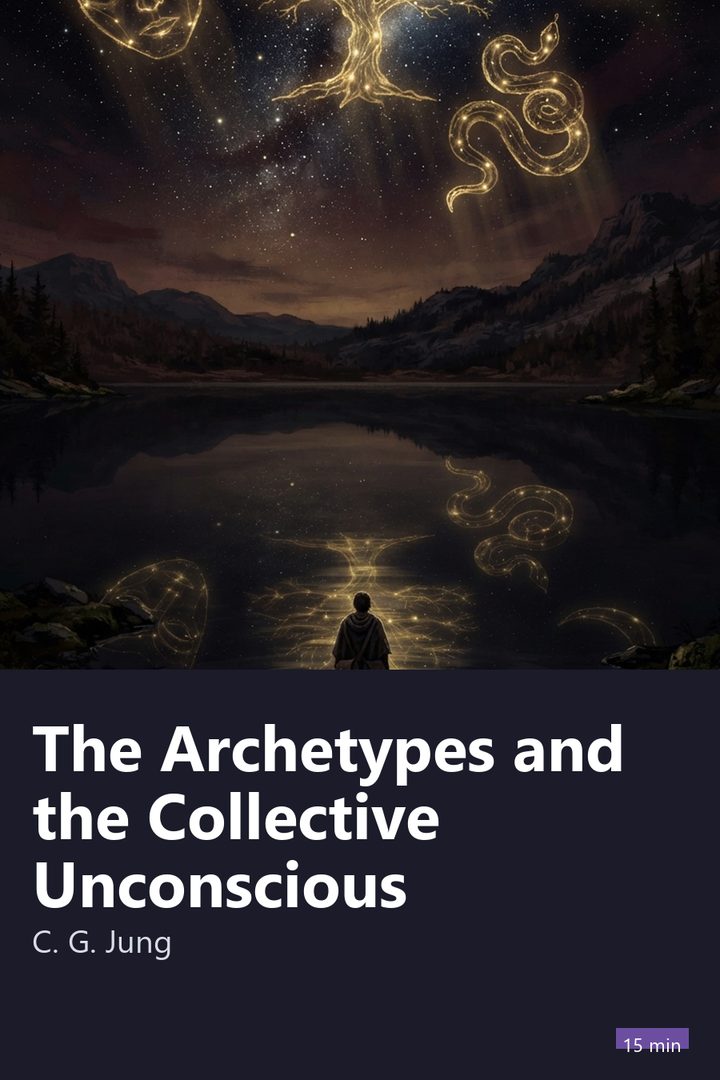
Cover of The Archetypes and the Collective Unconscious

Psychology · 16 min

The Archetypes and the Collective Unconscious

C. G. Jung · 1959

Who it's for

For anyone who enjoys myths, dreams, and symbols and wants to understand Jung's idea that the human mind carries patterns shared across all cultures. It's also for anyone who has heard of the shadow, anima, and individuation and wants to know where those ideas come from.

Read it in the app

⚡ Free to download • 🎁 One full book free every day

🎧 Audio coming soon in the app

Narration for the English summaries is on its way. Meanwhile you can read the full summary in the app.

3 ideas to take with you

1

What irritates you most about other people may be a clue to something you don't want to see in yourself.

2

For Jung, the human mind has shared ways of imagining, even when their content varies across cultures, and that claim remains open to debate.

3

Someone who projects the ideal mother onto a partner starts expecting complete protection and ends up disappointed in the real person.

“
Everyone needs to start over sometimes, and a New Year's celebration is the collective version of that.
An idea from The Archetypes and the Collective Unconscious, in the words of 15 Minutes

Preview

Start reading now

What This Collection Is About

The Archetypes and the Collective Unconscious brings together essays Jung wrote between the 1930s and the 1950s that were later collected in a single volume. They revolve around a bold idea: beyond the memories and desires each person holds, there is a layer of the mind that everyone shares.

This layer doesn't come from individual experience. According to Jung, it is inherited, just as the body's form is inherited. It shows itself in images and stories that recur across very different cultures, such as the hero, the great mother, the wise old man, and the trickster.

The book, then, combines clinical psychology, mythology, comparative religion, and dream analysis. It takes patience to read, because Jung writes at length and provides plenty of examples. But the central ideas fit into a few sentences, and those are what we'll focus on.
The Personal and Collective Unconscious

Jung begins by distinguishing two layers. The personal unconscious holds whatever has been forgotten, repressed, or noticed only in passing throughout an individual's life. That childhood scene you no longer remember and the shame you buried deep down belong here.

The collective unconscious, by contrast, would lie deeper. It doesn't hold personal memories, but predispositions shared by the entire species. It's as though each person were born with a template that guides how they perceive, feel, and imagine, before any learning takes place.

For Jung, this layer is the foundation of the psyche and explains why the dreams, tales, and myths of peoples who never met are so similar. The underlying structure would be the same, even if its outward forms change from place to place.

What an Archetype Is, and What It Isn't

Archetype is the name Jung gives these templates. The most important point, which many people get wrong, is that an archetype isn't a ready-made image or an inherited idea. It's an empty form, a tendency to organize experience into certain patterns, that only takes on content through actual life.

Think about language. Every child is born ready to learn to speak, but no child is born speaking English. The capacity is universal; the language is local. Likewise, the mother archetype is universal, but each person's image of a mother depends on the mother they had and the culture around them.

Jung compares archetypes to instincts. Just as instinct gives an animal a way to act without learning, an archetype gives human beings a way to interpret. It appears in dreams, fantasies, delusions, and works of art, always as images with a strong emotional charge.

12 more sections and the quiz

Continue in the app

Read the whole summary, finish with the The Archetypes and the Collective Unconscious quiz and follow the guided Journeys. No ads in the app.

About C. G. Jung

Carl Gustav Jung was born in Switzerland in 1875 and earned his medical degree in Basel. He worked as a psychiatrist at the Burghölzli clinic in Zurich and collaborated with Sigmund Freud until their split around 1913. He founded analytical psychology, published Psychological Types in 1921, and died in 1961 in Küsnacht, near Zurich.

Explore

Category:
Psychology
Part of the Journeys:
Jung, Myths, and Symbols