15 Minutes
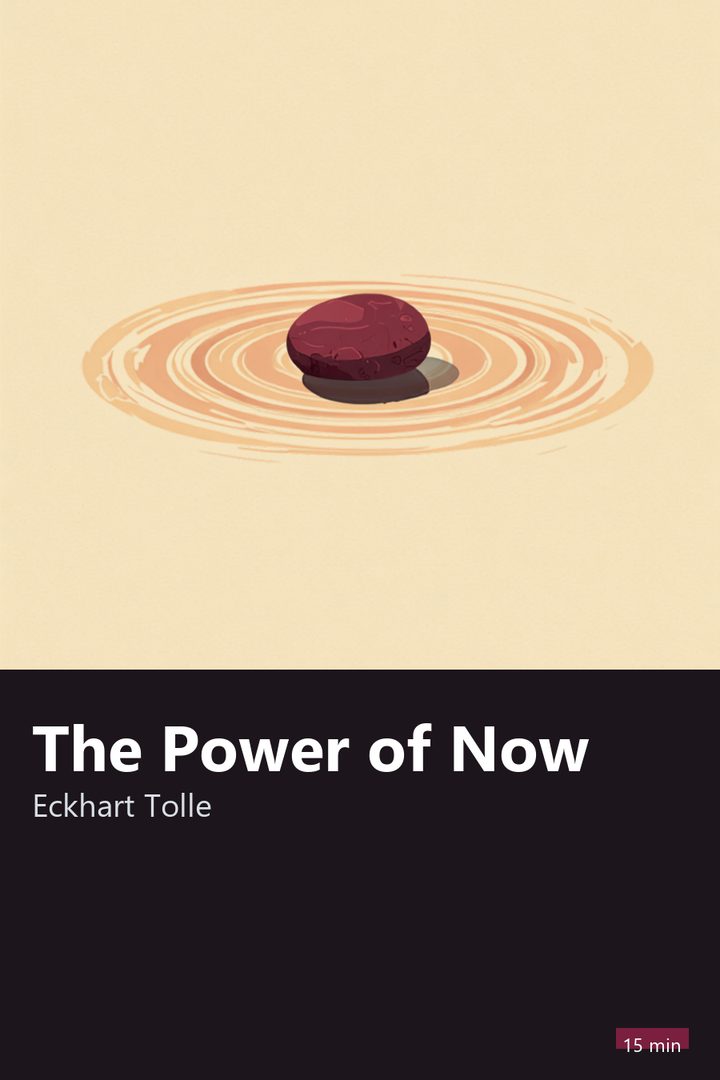
Cover of The Power of Now

Spirituality · 15 min

The Power of Now

Eckhart Tolle · 1997

Who it's for

For anyone whose head spins all day with repetitive thoughts, worry about the past, or anxiety about the future, and who wants to understand why it's so hard to simply settle down. It's also for people who have heard about living in the present but never really understood what that means in practice.

Read it in the app

⚡ Free to download • 🎁 One full book free every day

🎧 Audio coming soon in the app

Narration for the English summaries is on its way. Meanwhile you can read the full summary in the app.

3 ideas to take with you

1

The inner narrator that comments on everything you do all day is just a habit of the mind, not you.

2

An old hurt only stings again today because the mind replays its story, not because it's still happening.

3

Accepting the moment as it is doesn't mean giving up on changing anything. It means you stop wasting energy fighting a fact that already is the way it is.

“
The moment you notice you're thinking something, you've already opened a little space between you and that thought.
An idea from The Power of Now, in the words of 15 Minutes

Preview

Start reading now

A book born from a crisis, not from a thesis

Eckhart Tolle wasn't a spirituality teacher or a monk when he wrote this book. He was a university researcher in England, living through years of deep anguish, until an inner shift on an ordinary night, with no spectacular outside event, which he describes as the starting point of everything that came after.

That explains a lot about the book's tone. It almost never cites research or technical data, and it speaks mostly in the first person, like someone describing something felt firsthand, not studied from the outside. For people who like academic grounding, that can sound flimsy. For people looking for something else, a different way of looking at their own mind, the personal tone is part of what works for so many readers.

It's worth reading with that in mind: it's an account of experience, later shaped into teaching, not a study with method and controls. That doesn't invalidate the central idea, but it helps you understand what kind of reading you're doing before you demand a rigor from the book that it never promised to have.

The clock you use and the burden you carry in your head

The book separates two things we tend to mix up without noticing: clock time, useful for scheduling an appointment or catching the bus, and psychological time, that mental weight of chewing over the past or drowning in anxiety about the future.

The first kind of time is practical and necessary. Nobody gets by without it, because setting a time, planning a trip, and organizing the month all depend on thinking about before and after. The second kind drains energy without bringing any benefit, because it relives a pain that's already over or anticipates a problem that may never happen.

A simple example: thinking about your dentist appointment tomorrow is clock time, and it's useful. Spending the whole afternoon with a knot in your stomach, imagining every bad thing that could happen at the appointment, is psychological time, and it steals a whole day of peace over something that hasn't even arrived.

The voice that comments on your life nonstop

One of the central ideas is that almost everyone lives with a kind of inner narrator, a voice that comments, judges, and repeats thoughts about everything that happens, from bad traffic to a coworker's badly interpreted sentence.

That voice rarely stops. It comments on the past, takes a stab at predicting the future, and revisits the same worry several times in the same day, without offering any new solution, just repeating the discomfort in a slightly different way each time.

The book's invitation isn't to silence that voice by force, because that rarely works. It's simply to notice that it's talking, the way you'd notice a radio playing in the background of a room. That act of noticing alone creates a distance that wasn't there before.

12 more sections and the quiz

Continue in the app

Read the whole summary, finish with the The Power of Now quiz and follow the guided Journeys. No ads in the app.

About Eckhart Tolle

Eckhart Tolle was born in Germany in 1948 and spent part of his adult life as a researcher at the University of Cambridge in England before devoting himself fully to writing and giving talks on practical spirituality. The Power of Now was originally published in 1997 and became one of the best-selling spirituality books in the world, boosted years later by a public endorsement from Oprah Winfrey. Tolle doesn't follow any specific organized religion and often says he draws on ideas found in several spiritual traditions at once. He now lives in Canada and continues to lead retreats and give talks on presence and awareness.

Explore

Category:
Spirituality