15 Minutes
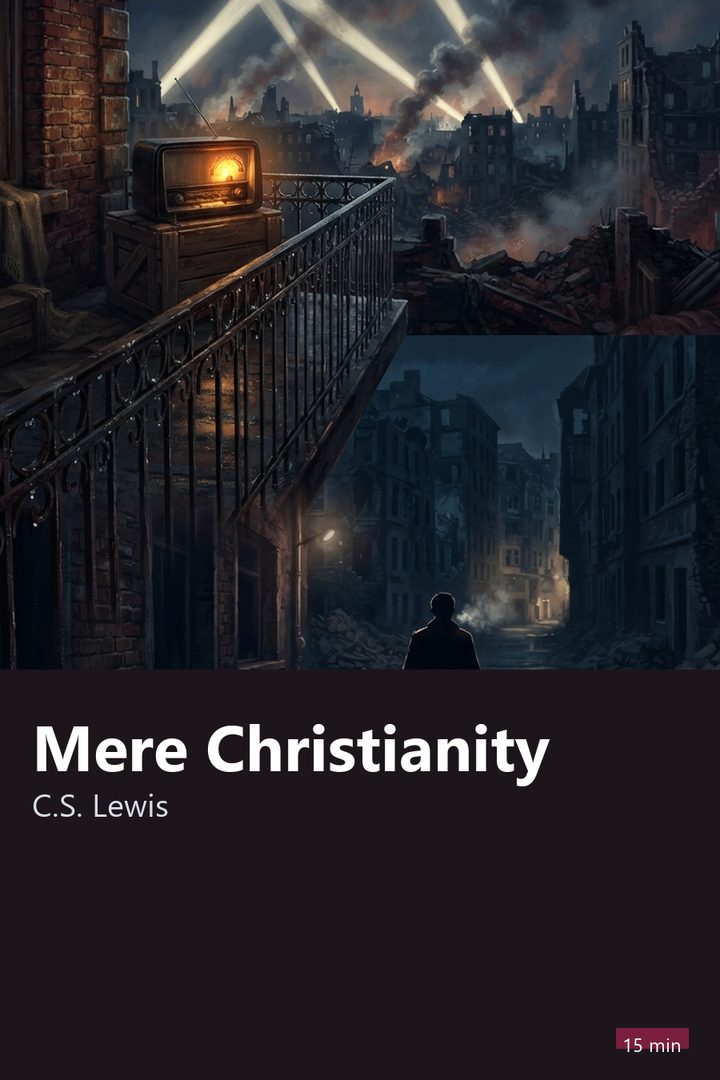
Cover of Mere Christianity

Spirituality · 16 min

Mere Christianity

C.S. Lewis · 1952

Who it's for

For anyone who has heard of Christianity, from inside or outside the faith, and wants to understand the arguments behind it without opening the Bible. It works both for believers who want to organize what they think and for non-believers who want to understand the argument before dismissing it.

Read it in the app

⚡ Free to download • 🎁 One full book free every day

🎧 Audio coming soon in the app

Narration for the English summaries is on its way. Meanwhile you can read the full summary in the app.

3 ideas to take with you

1

For Lewis, accepting your own diagnosis before looking for any relief is what separates real change from a burst of motivation that cools off in a week.

2

Forgiveness works less like a click that settles things for good and more like a decision a person has to repeat every time the resentment resurfaces.

3

For Lewis, deliberately acting like the patient or generous person you want to be, even when you don't feel like it that day, is training that can change who you are inside, not hypocrisy.

“
For Lewis, demanding from a neighbor a standard you don't meet yourself is a sign that there is a moral yardstick bigger than your personal taste.
An idea from Mere Christianity, in the words of 15 Minutes

Preview

Start reading now

An Oxford professor on wartime radio

In 1941, in the middle of World War II, the BBC invited an Oxford literature professor to speak at night about a subject that seemed out of place during the bombings: right and wrong. C.S. Lewis accepted, and the talks aired between 1941 and 1944. Years later he gathered and revised that material into a single book, published in 1952 under the name Mere Christianity.

Lewis's plan was strange by the standards of the time: he didn't start by quoting the Bible or asking listeners for faith. He started by asking why even people who have never opened a sacred book argue using phrases like that's not fair or you promised. This way of defending the faith with logic and everyday examples is what we now call apologetics.

The book has four parts, like steps: the moral law as a clue to something behind the universe, what Christians claim about that something, how it would change everyday behavior, and finally the Christian idea of God as Trinity. This summary follows the same steps, and marks when an idea is the author's interpretation.


The clue nobody can erase: the moral law

Lewis observes something simple: in any everyday quarrel, whether on a packed bus or in an argument over who pays for the round at the bar, people appeal to a standard they expect the other person to recognize. Nobody says only I don't like that, they say that's not done, as if there were a yardstick common to both sides.

Comparing different peoples across history, Lewis notes that the content of that yardstick varies less than you would think: almost everywhere values courage, honesty and care for family. To him, this suggests a human moral law, not just a personal taste of each culture.

The most uncomfortable part comes next: everybody recognizes this yardstick and, at the same time, almost nobody lives up to it. The person who demands honesty from a neighbor is the same one who cheats his own boss on the payroll when he can get away with it. That contrast is the real clue, more revealing than the law itself.

Not herd behavior, and not just habit

Lewis anticipates two objections. The first says the moral law is just herd instinct, like the instinct to protect offspring. He answers that instincts push in one direction only, but morality sometimes asks for the opposite of the strongest instinct: someone can feel like running from danger and still feel they ought to help a person who is drowning.

The second says morality is just social convention, changing with no criterion at all. Lewis pushes back by asking: if morality were only local taste, how can anyone say one country's morality is worse than another's? Every comparison of that kind already presupposes a standard above both.

The argument doesn't yet prove the existence of God, and Lewis himself is honest about that: it only shows that reducing morality to custom explains less than it seems to at first glance.

12 more sections and the quiz

Continue in the app

Read the whole summary, finish with the Mere Christianity quiz and follow the guided Journeys. No ads in the app.

About C.S. Lewis

Clive Staples Lewis was born in Belfast in 1898 and spent much of his academic life as a professor of medieval and Renaissance literature at Oxford, and later at Cambridge. He was an atheist in his youth and converted to Christianity as an adult, in 1931, an experience he described in other books. Besides works of Christian apologetics like this one, he wrote the children's series The Chronicles of Narnia. He died in 1963, on the same day as the death of American President Kennedy, which reduced the initial press coverage of the news.

Explore

Category:
Spirituality
Part of the Journeys:
Great Texts of Faith