15 Minutes
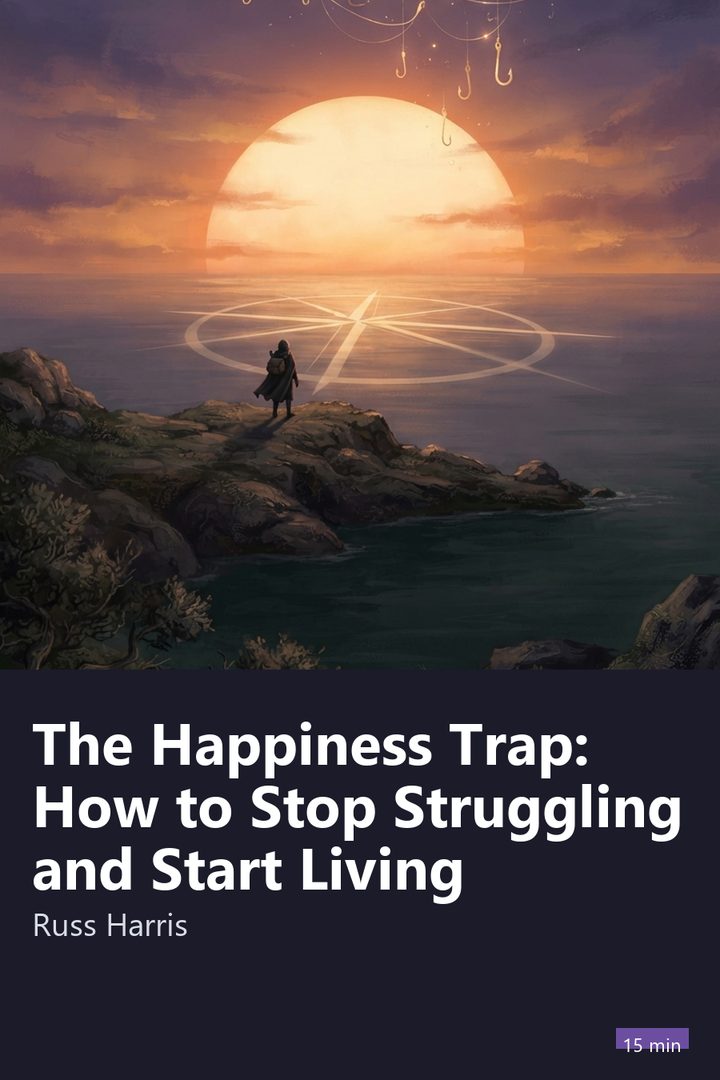
Cover of The Happiness Trap: How to Stop Struggling and Start Living

Psychology · 14 min

The Happiness Trap: How to Stop Struggling and Start Living

Russ Harris · 2007

Who it's for

For anyone who spends their life chasing good feelings all the time and only ends up more anxious because of it. It is an accessible introduction to acceptance and commitment therapy, great for laypeople and the curious alike.

Read it in the app

⚡ Free to download • 🎁 One full book free every day

🎧 Audio coming soon in the app

Narration for the English summaries is on its way. Meanwhile you can read the full summary in the app.

3 ideas to take with you

1

According to the book, fighting anxiety usually wastes energy and, in many cases, prolongs the discomfort.

2

For Harris, seeing a thought as just a thought rather than a fact creates the distance needed to choose what to do.

3

The difference between values and goals is helpful: values remain available even when a goal takes a long time or fails.

“
The happiness sold in advertising is a store window, and comparing yourself to it usually hurts.
An idea from The Happiness Trap: How to Stop Struggling and Start Living, in the words of 15 Minutes

Preview

Start reading now

The paradox of pursuing happiness

Russ Harris begins with a provocative idea: the harder we try to avoid bad feelings and guarantee good ones, the more unhappy we tend to become. Published in 2007, the book introduces acceptance and commitment therapy, or ACT, to a broad audience.

The central thesis is that much of our suffering comes from fighting our own internal experience. Struggling with anxiety, sadness, or self-critical thoughts consumes energy and often makes things worse, like someone thrashing around in quicksand.

The proposal is not to give up on feeling good, but to change your relationship with what you feel, so you can live a meaningful life even when your mood is low.

A very common example is spending Sunday night trying to push away the dread of Monday morning. The harder you push the feeling away, the bigger it grows, and you end up exhausted before the week even begins. The book proposes a different path for moments like these.


The myths about happiness

The author describes four myths that feed the trap. The first is that happiness is the natural state for human beings. The second is that if you are not happy, something is wrong with you. The third is that you must eliminate negative feelings in order to be happy. The fourth is that you should control your thoughts and feelings to build a good life.

These myths are reinforced by advertising, social media, and self-help culture, which sell the image of a constantly smiling life. Anyone scrolling through the feeds of friends and acquaintances gets the impression that only their own life has ups and downs.

Harris proposes a more realistic view. Pain, loss, fear, and disappointment are part of a normal human life, and trying to erase them usually comes at a high price.

The fourth myth is worth noting. Controlling what happens on the outside, like organizing your schedule or spending less, works well. Controlling your inner world of thoughts and emotions, however, is far less reliable. Confusing these two areas is a frequent source of frustration.

Why fighting feelings doesn't work

Everyday experience shows the problem. Anyone who tries not to think about something ends up thinking about it more. Anyone who forces themselves to relax gets tense. Anyone who tries to fall asleep quickly may end up wide awake. The effort to stay in control turns the feeling into an enemy and makes it even more present.

The author uses metaphors to illustrate this. One of them is a tug-of-war with a monster: pulling the rope with all your might only increases the tension, and the way out is to drop the rope. Another is quicksand, which requires spreading your body out and stopping the struggle instead of fighting.

None of this means resignation. It is about recognizing that when it comes to internal feelings, the tactic of combat is less effective than openness, and that the energy you save can go toward actions that truly matter.

10 more sections and the quiz

Continue in the app

Read the whole summary, finish with the The Happiness Trap: How to Stop Struggling and Start Living quiz and follow the guided Journeys. No ads in the app.

About Russ Harris

Russ Harris is an Australian physician who became a therapist and trainer in acceptance and commitment therapy, known by the acronym ACT. He has written books for both the general public and professionals, such as ACT Made Simple, and teaches courses in several countries. This book, published in 2007, is his most famous title. He became well known for explaining ACT through simple metaphors and exercises.

Explore

Category:
Psychology
Part of the Journeys:
The Science of Happiness