15 Minutes
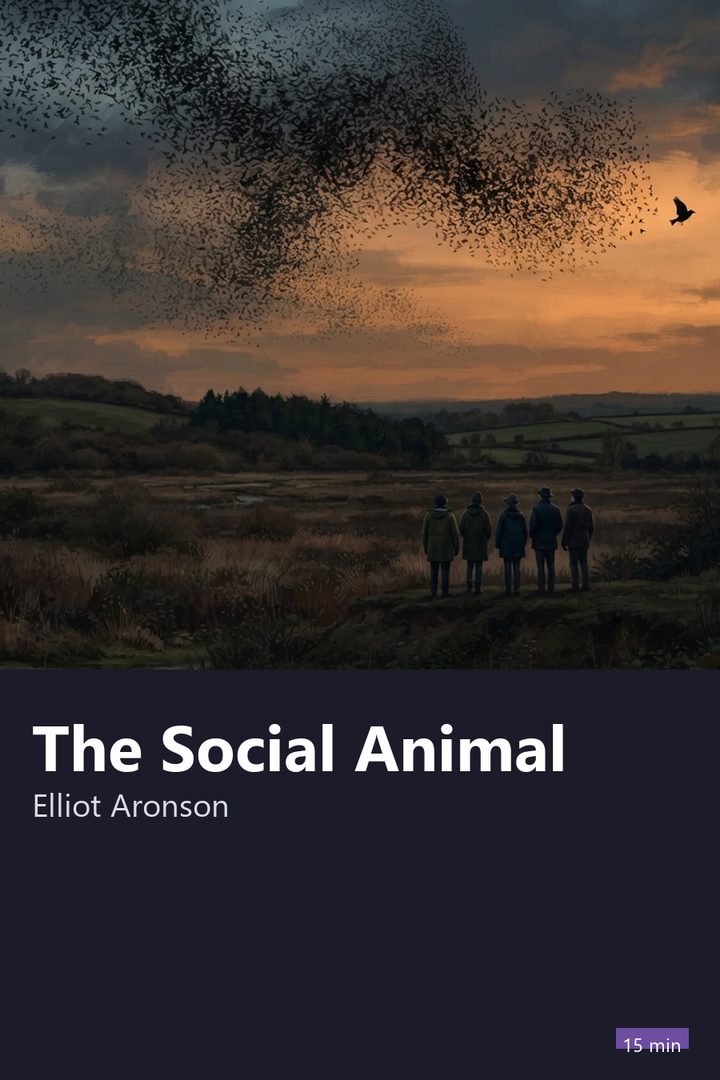
Cover of The Social Animal

Psychology · 14 min

The Social Animal

Elliot Aronson · 1972

Who it's for

For anyone who wonders why people, including you, act so differently in groups than they do alone. It's for students, people who work with teams, or anyone who just wants to understand their own excuses better.

Read it in the app

⚡ Free to download • 🎁 One full book free every day

🎧 Audio coming soon in the app

Narration for the English summaries is on its way. Meanwhile you can read the full summary in the app.

3 ideas to take with you

1

A small reward for defending something you don't believe can change your beliefs more than a large reward, because you don't have an external excuse.

2

When each student depends on a classmate's contribution to learn the whole lesson, rivalry gives way to cooperation.

3

The more people witness a call for help, the less responsible each person feels, because everyone expects someone else to act.

“
Before going along with the majority in a meeting, check whether you genuinely agree or just don't want to be the first to disagree.
An idea from The Social Animal, in the words of 15 Minutes

Preview

Start reading now

The Animal That Lives in Groups

The Social Animal is one of the best-known textbooks in social psychology, the field that studies how we think, feel, and act in the real or imagined presence of other people. Elliot Aronson wrote it to be an easy read, with plenty of cases and experiments, and it has gone through many editions over the decades.

Its underlying argument is that we aren't rational machines processing information alone, but animals that live in groups, need acceptance, justify their actions, and are shaped by their surroundings. The question is how that works and what we can do with that knowledge.

Rather than following a single sequence, the book explores several themes: conformity, self-justification, persuasion, attraction, prejudice, aggression, and helping. This summary follows that order and covers the most famous experiments.

Following the Crowd Against Your Own Eyes

The most widely cited experiment on conformity is Solomon Asch's. A group of people must identify which of three lines matches the length of a reference line. The answer is obvious. But everyone except one person is a confederate working with the researcher, and they all give the same wrong answer aloud before the volunteer responds.

Many volunteers went along with the majority in at least one round, even though they could see otherwise. Some doubted their own eyes; others didn't want to be the difficult one in the group. When one confederate gave the right answer, the pressure dropped considerably.

The book points out that conforming isn't simply weakness: it's often a rational way of handling uncertainty, since the group usually knows something. Trouble arises when the group is wrong and the discomfort of standing out matters more than the truth.

Dissonance: When Things Don't Add Up in Your Head

The central idea for Aronson, a student of Leon Festinger, is cognitive dissonance. It arises when we hold two conflicting ideas, such as 'I'm an intelligent person' and 'I did something stupid.' The discomfort is real, and it motivates us to reduce it.

The easiest way out is rarely to change our behavior. It's usually to change the explanation: 'It wasn't that bad,' 'Everyone does it,' 'I had no choice.' Smokers who know the risks but keep smoking offer an everyday example: 'My grandfather smoked his whole life and lived to ninety.'

For Aronson, dissonance is stronger when our self-concept is threatened: when a mistake clashes with our image of ourselves. That's why people who consider themselves honest feel more distressed when they realize they've lied.

12 more sections and the quiz

Continue in the app

Read the whole summary, finish with the The Social Animal quiz and follow the guided Journeys. No ads in the app.

About Elliot Aronson

Elliot Aronson is an American social psychologist, born in Massachusetts in 1932. He earned his doctorate at Stanford, where he studied under Leon Festinger, and taught at Harvard, the University of Texas, and the University of California, Santa Cruz. He developed the jigsaw classroom technique, used to reduce conflict between groups in schools. He is the author of The Social Animal, first published in 1972, and several other books.

Explore

Category:
Psychology
Part of the Journeys:
Why We Act This Way