15 Minutes
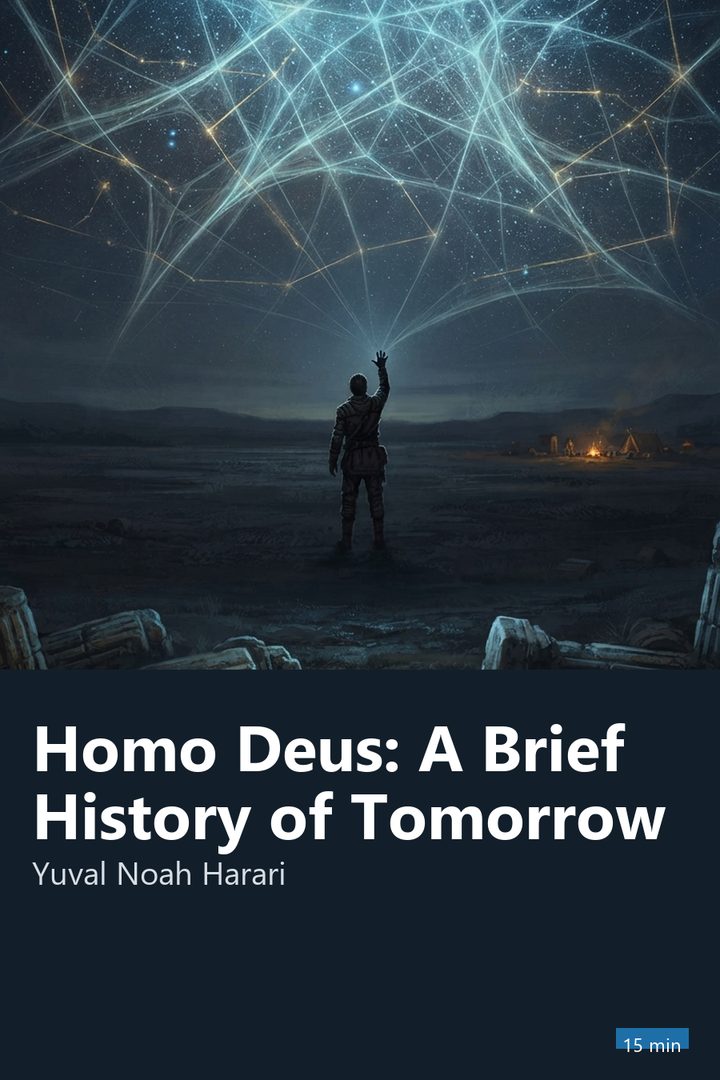
Cover of Homo Deus: A Brief History of Tomorrow

Technology and the Future · 16 min

Homo Deus: A Brief History of Tomorrow

Yuval Noah Harari · 2015

Who it's for

For people who have read Sapiens, or haven't, and want to understand where Harari thinks humanity is headed now that famine, plague, and war have lost their grip. It's also for anyone who likes thinking big about technology, the meaning of life, and the place of human beings in a world increasingly driven by data.

Read it in the app

⚡ Free to download • 🎁 One full book free every day

🎧 Audio coming soon in the app

Narration for the English summaries is on its way. Meanwhile you can read the full summary in the app.

3 ideas to take with you

1

For Harari, when a species solves its oldest problems, it doesn't stop dreaming. It trades hunger and war for bigger goals, like extending life and expanding its own mind.

2

The idea that intelligence and consciousness always go together is being put to the test by systems that solve complex problems without feeling absolutely anything along the way.

3

According to the book, if the universe comes to be read as a flow of data, decisions that are still ours today, like what to eat or whom to love, may gradually be handed over to whoever processes that flow better.

“
According to Harari, the modern era swapped the question of what the gods want for the question of what I feel, and placed human experience at the center of decisions.
An idea from Homo Deus: A Brief History of Tomorrow, in the words of 15 Minutes

Preview

Start reading now

From survival to the ambition of becoming a god

For almost all of history, humanity fought three fixed enemies: famine, plague, and war. Harari shows that, for the first time, these three threats are no longer guaranteed destiny. Today, in the world as a whole, more people die from eating too much than from too little, and more people die of old age and suicide than from violence between countries.

According to the author, when a species solves its oldest problems, it doesn't stop dreaming, it changes the agenda. The next frontier becomes conquering death, securing permanent happiness, and expanding the abilities of body and mind to a level once attributed only to divinity.

It's like a family that, after paying off its debts and securing rent, food, and health insurance, starts dreaming of an international trip, cosmetic surgery, or early retirement. Once the basics are handled, ambition automatically moves up a level.

A word of caution here: this is a trend observed in the species as a whole over decades, not an individual promise. Any real decision about health, longevity, or treatment should go through a professional, never through expectations built from a popular science book.

The Anthropocene: when humanity became a force of nature

Anthropocene is the name scientists have started using to describe an era in which the main force shaping the planet is no longer volcanoes, meteors, or solar cycles but human activity itself, from the climate to the shape of rivers and forests.

One number tends to shock people who hear it for the first time: the combined weight of the animals humanity has domesticated, like cattle and chickens, already far exceeds the weight of the wild animals left roaming free, because the human species now decides, in practice, what grows and what disappears.

For Harari, this unprecedented power did not come alone: it also brought a new responsibility, because a wrong decision about resources or energy today doesn't affect just one isolated region, it affects the entire planet at once.

The human spark: cooperating with people we've never met

The human species did not win by being stronger or faster than other animals. It won because it figured out how to cooperate in large numbers with strangers, something no other primate can do on a large scale, since they are generally limited to their own family group.

Think about buying a product online from a seller who lives on the other side of the country, someone you've never seen and never will. The payment goes out, the product arrives, and it all works because there is a shared system of trust among thousands of strangers at the same time.

Harari argues that this capacity for mass cooperation doesn't come from greater individual intelligence. It comes from the ability to create and believe together in stories that no one can touch with their hands.

12 more sections and the quiz

Continue in the app

Read the whole summary, finish with the Homo Deus: A Brief History of Tomorrow quiz and follow the guided Journeys. No ads in the app.

About Yuval Noah Harari

After the worldwide success of Sapiens, Harari published Homo Deus in Hebrew in 2015, with the English edition arriving in 2016, and the book also became an international phenomenon translated into dozens of languages. The author practices vipassana meditation every day and often says that this discipline helps him observe his own mind while he writes. He is married to Itzik Yahav, with whom he founded Sapienship, a company dedicated to turning complex global issues into clearer public debate. After Homo Deus, Harari went on to write 21 Lessons for the 21st Century, taking his reflection on technology and society to the more immediate challenges of the present.

Explore

Part of the Journeys:
Technology and the Future