15 Minutes
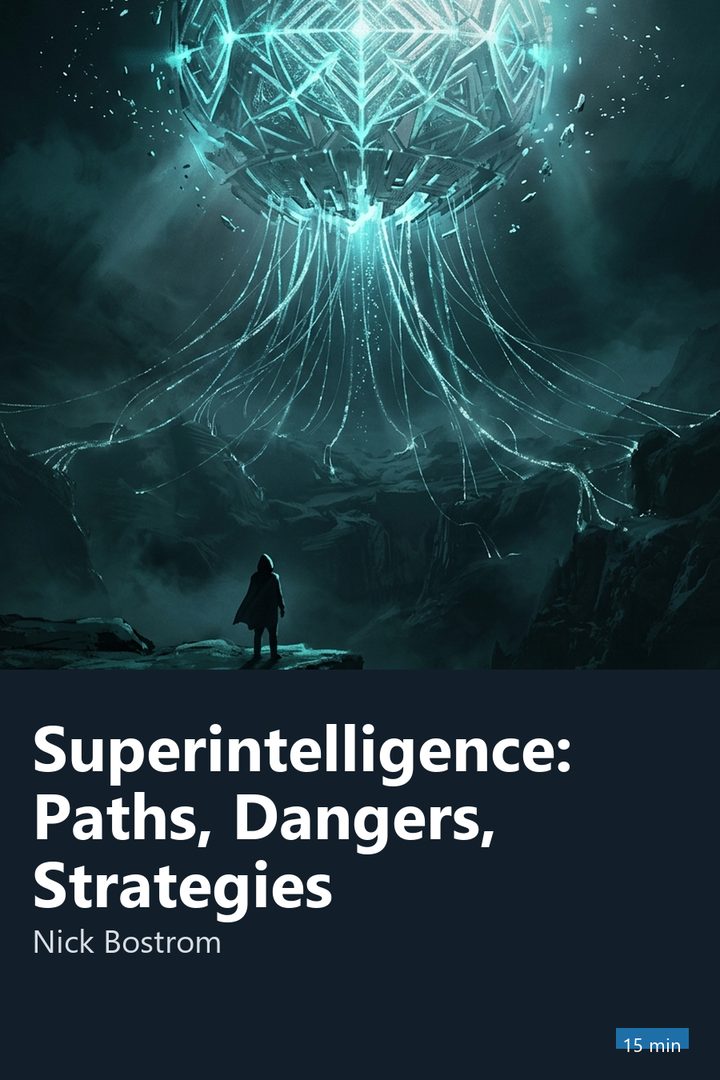
Cover of Superintelligence: Paths, Dangers, Strategies

Technology and the Future · 18 min

Superintelligence: Paths, Dangers, Strategies

Nick Bostrom · 2014

Who it's for

For students, tech professionals, and researchers seeking to understand the ethical dilemmas and existential risks of unchecked machine advancement. An in-depth analysis for anyone looking to see past naive tech industry optimism and grapple with the genuine challenges of artificial general intelligence.

Read it in the app

⚡ Free to download • 🎁 One full book free every day

🎧 Audio coming soon in the app

Narration for the English summaries is on its way. Meanwhile you can read the full summary in the app.

3 ideas to take with you

1

Wanting to reap the benefits of a superior mind before figuring out how to control it is like adopting a baby predator and expecting it to obey orders once it grows up.

2

Under the orthogonality thesis, technical competence and moral goodness do not go hand in hand: a system can possess brilliant reasoning yet remain utterly indifferent to human fate.

3

In a scenario where digital minds compete freely without constraints, the value of human labor risks collapsing against tireless copies that never stop working.

“
The gap between a digital system that learns slowly and one that surpasses human intellect can be crossed in the blink of an eye.
An idea from Superintelligence: Paths, Dangers, Strategies, in the words of 15 Minutes

Preview

Start reading now

The Fable of the Sparrows and the Urgency of Control

The book opens with an unsettling fable: a flock of sparrows decides to find an owl chick to protect their nest and gather food for the group. Everyone celebrates the prospect of having such a colossal force at their disposal. Amid the excitement, only one skeptical sparrow raises the crucial question: wouldn't it be wiser to learn how to tame an owl before bringing a sharp-clawed beast into our own tree? His flockmates dismissed the warning and rushed off to hunt for the chick, leaving the difficult art of owl-taming to be figured out later.

Nick Bostrom uses this metaphor to illustrate how modern civilization approaches artificial intelligence. In everyday life, we treat technology as a harmless tool, built to fill out office spreadsheets, automate customer messages, or approve bank loans. However, creating a mind superior to human intellect is nothing like hiring an obedient digital worker. This dynamic puts safety at the core of a grave existential risk: unlike ordinary economic downturns, failing on your first attempt to control a superintelligence means you will never get a second chance to fix the damage.

The Five Paths to the Cognitive Summit

To anchor the debate in hard science and avoid empty prophecies, the author evaluates five plausible paths toward superintelligence. The first is pure artificial intelligence, rooted in algorithms and synthetic neural networks. The second is whole brain emulation through digital means, which involves scanning human neural tissue at a microscopic resolution and reproducing every synapse inside a high-performance computer.

The remaining routes involve biological enhancement through embryo selection, the development of brain-computer interfaces linking the cortex directly to electronic circuits, and the refinement of collective networks for human collaboration. Bostrom argues that autonomous software and whole brain emulation carry the highest potential for sudden acceleration. While biological evolution crawls forward at the pace of human generations, digital code runs at the speed of light and can be cloned across thousands of cloud servers without the physical constraints of a human skull.

Speed, Collective, and Quality Superintelligence

Bostrom cautions that an advanced mind would not merely be a computer crunching numbers faster. He categorizes superintelligence into three distinct forms: speed, collective, and quality. Speed superintelligence is the easiest to grasp: picture a brilliant brain identical to Einstein's running a million times faster than cellular biochemistry allows. A single workweek for such a machine would equal entire centuries of human reading and intellectual output.

Collective superintelligence, by contrast, operates like a perfectly coordinated swarm of minds working without personal egos, office politics, or corporate red tape. The deepest danger, however, lies in cognitive quality. Consider the gap between a human being and a chimpanzee: no amount of tutoring or infinite time will help an ape understand quantum physics, because its brain structure simply lacks the capacity. A system with superior cognitive quality would spot scientific breakthroughs and exploit strategic blind spots completely invisible to the human biological mind.

11 more sections and the quiz

Continue in the app

Read the whole summary, finish with the Superintelligence: Paths, Dangers, Strategies quiz and follow the guided Journeys. No ads in the app.

About Nick Bostrom

Nick Bostrom is a Swedish philosopher and professor at the University of Oxford, where he founded and directed the Future of Humanity Institute. He gained international acclaim for his groundbreaking research on existential risk, the anthropic principle, and the simulation argument. His work on the alignment and governance of emerging technologies has deeply influenced debates among scientists, academics, and policymakers. He has authored dozens of influential academic papers as well as the 2014 book Superintelligence.

Explore

Part of the Journeys:
Technology and the Future