15 Minutes
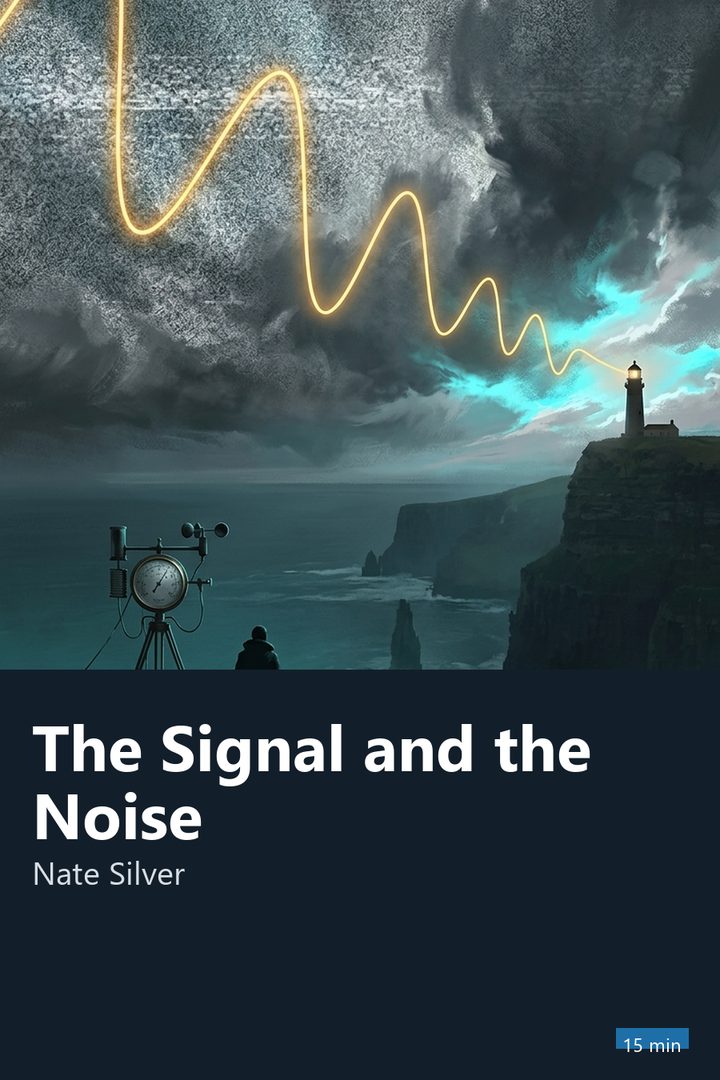
Cover of The Signal and the Noise

Technology and the Future · 18 min

The Signal and the Noise

Nate Silver · 2012

Who it's for

For anyone who makes data-driven decisions, follows the news with a critical eye, and wants to learn to separate relevant facts from the daily whirlwind of rumors and guesswork. The Signal and the Noise is a clearheaded guide to probability, intellectual humility, and prediction in the real world.

Read it in the app

⚡ Free to download • 🎁 One full book free every day

🎧 Audio coming soon in the app

Narration for the English summaries is on its way. Meanwhile you can read the full summary in the app.

3 ideas to take with you

1

Amassing an enormous volume of information does not guarantee better decisions if you cannot filter out what actually has practical relevance.

2

Acknowledging uncertainty in an estimate demonstrates technical rigor and prevents unpleasant surprises caused by inflexible promises.

3

Changing your mind when new facts emerge is a sign of practical intelligence that keeps you from stubbornly sticking with outdated strategies.

“
People who speak with absolute certainty on television or online usually attract a larger audience than those who analyze scenarios cautiously.
An idea from The Signal and the Noise, in the words of 15 Minutes

Preview

Start reading now

The illusion that more data means more wisdom

Ever since Gutenberg invented the movable-type printing press in the fifteenth century, humanity has learned that every revolution in the circulation of data brings a flood of misinformation before it delivers any wisdom. Back then, pamphlets about witchcraft and apocalyptic sects circulated much faster than scientific treatises. Today we face a similar upheaval: the internet has put trillions of pieces of information within reach, but the human brain still has the same biological limits it always had.

This disparity creates the central dilemma Nate Silver explores: the amount of useful information grows slowly, while the volume of irrelevant data explodes. The author defines signal as the hidden truth we are trying to find, while noise represents the excess of rumors and guesses that steer us away from that goal. When you open your building's group chat or check social media first thing in the morning, you do not get clarity, but a whirlwind of noise that produces only anxiety and false patterns.

The greatest danger of this avalanche is not just mental exhaustion, but a false sense of control. People with access to colorful charts and endless spreadsheets often believe they can see the future clearly, forgetting that indiscriminately collected data produces nothing but flawed conclusions dressed up in technical language. Learning to filter for what actually moves the needle is the defining skill of our time.


The financial collapse of 2008 and the failure of mathematical models

The global financial crisis of 2008 showed how blind faith in statistical formulas can bring down the world economy. At the time, credit rating agencies and major banks used sophisticated equations to evaluate high-risk mortgage securities. Their basic assumption was that U.S. home prices would never fall simultaneously across the entire country, treating defaults as isolated events.

This mistake ignored the systemic correlation among those contracts: when the bubble burst, entire neighborhoods defaulted at the same time. Agencies stamped their highest safety ratings on toxic bundles, misled by spreadsheets that looked only at recent years of prosperity. The case serves as a warning for anyone saving part of their paycheck: avoid promises of guaranteed returns, always consult certified professionals, and never entrust your family's wealth to formulas that sell predictability in uncertain markets.

In a country where stories of pyramid schemes and promises of easy money recur again and again, the lesson of 2008 is indispensable. Any model that guarantees high returns without the risk of fluctuations is, in practice, leaving out variables that will exact their price sooner or later. Protecting your wealth requires skepticism toward magical certainties and an understanding that markets do not forgive excessive arrogance.

Foxes versus hedgehogs in the public arena

Investigating why television pundits get so much wrong, Silver draws on Philip Tetlock's distinction between the fox and the hedgehog. The hedgehog sees the world through a single central idea, trying to force every fact into a favorite theory. If reality contradicts a partisan belief, the hedgehog blames the world but never acknowledges a flaw in the premise.

The fox, by contrast, takes a flexible approach, recognizing that reality is too chaotic for any single playbook. Foxes consult varied sources and adjust their projections using cautious probabilities. The trouble with social media and barroom debates is that audiences reward the noisy hedgehog, who speaks with false certainty, while the prudent fox sounds indecisive to anyone looking for easy answers.

11 more sections and the quiz

Continue in the app

Read the whole summary, finish with the The Signal and the Noise quiz and follow the guided Journeys. No ads in the app.

About Nate Silver

Nate Silver is an American statistician, writer, and journalist who founded FiveThirtyEight. He gained international recognition in 2008 and 2012 by predicting the results of U.S. presidential elections state by state with almost perfect accuracy. Before working in data journalism and politics, Silver developed PECOTA, a statistical system for projecting baseball performance, and played online poker professionally. He holds a degree in economics from the University of Chicago.

Explore

Part of the Journeys:
Think Better