15 Minutes
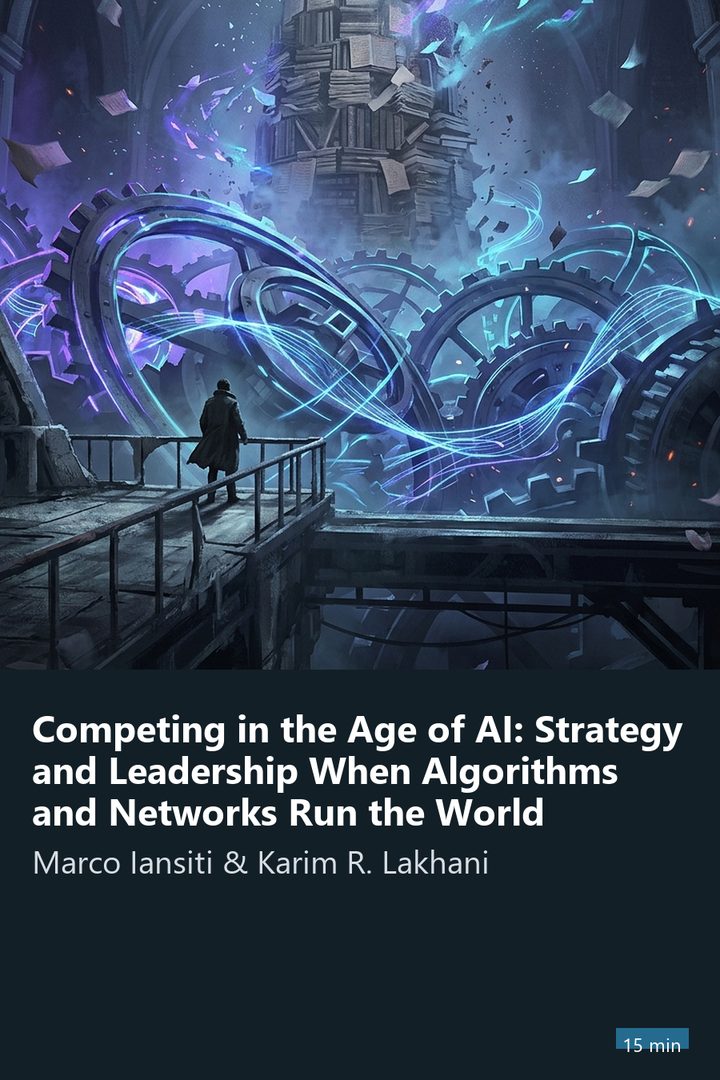
Cover of Competing in the Age of AI: Strategy and Leadership When Algorithms and Networks Run the World

Technology and the Future · 15 min

Competing in the Age of AI: Strategy and Leadership When Algorithms and Networks Run the World

Marco Iansiti & Karim R. Lakhani · 2020

Who it's for

For executives, entrepreneurs, consultants, and leaders who need to redesign traditional business models and understand how algorithms are redefining global competition.

Read it in the app

⚡ Free to download • 🎁 One full book free every day

🎧 Audio coming soon in the app

Narration for the English summaries is on its way. Meanwhile you can read the full summary in the app.

3 ideas to take with you

1

Artificial intelligence is not just an office automation tool, but a new operating engine that replaces human bureaucracy at the core of the company.

2

Algorithm-driven companies break the historic trade-off between scale, product variety, and speed of learning.

3

Modern strategic leadership requires rigorous data and algorithm governance to prevent discriminatory biases and catastrophic ethical risks.

“
Artificial intelligence transforms companies by replacing the bottlenecks of human bureaucracy with a scalable digital factory for fast decisions.
An idea from Competing in the Age of AI: Strategy and Leadership When Algorithms and Networks Run the World, in the words of 15 Minutes

Preview

Start reading now

The great collision between two corporate worlds

For more than a century, successful companies were built around a predictable operating model: hiring talented managers, dividing tasks across specialized departments, and relying on bureaucratic chains of command and control. However, this traditional organizational architecture has hit its physical limits of productivity, unable to compete with the speed of contemporary digital networks.

Harvard professors Marco Iansiti and Karim Lakhani describe the current moment as a historic collision between the traditional firm, supported by the work of human brains, and the digital firm, governed by algorithms at its operational core. What is at stake is not the simple digitization of paper forms, but a complete reinvention of how organizations create, deliver, and capture value.

In this new economy, companies that have learned to structure data and automate daily decisions outperform century-old competitors in just a few years, forcing leaders across every economic sector to rethink their survival strategies in the face of the artificial intelligence revolution.


The beating heart of the new firm: the AI Factory

At the center of every successful digital-native company lies what the authors call the AI Factory. Far from being an abstract metaphor, it is a scalable computational system made up of four essential, integrated components: the data pipeline, predictive algorithms, the experimentation platform, and the software infrastructure.

The data pipeline is responsible for continuously collecting, cleaning, and integrating information from millions of user interactions in real time. Algorithms process this ocean of raw data to generate accurate predictions about buying behavior, credit risks, or inventory demands.

The experimentation platform makes it possible to run thousands of controlled tests simultaneously to validate business hypotheses, while cloud infrastructure ensures that the software runs without interruption even during brutal traffic spikes. This algorithmic machine runs in a perpetual cycle, improving its own decisions with every new click recorded in the system.

Breaking the traditional limits of scale and scope

Classical economic theory teaches that every traditional company faces diminishing returns to scale: as an organization grows, internal bureaucracy multiplies, communication between departments slows down, and administrative costs begin to eat up additional profits.

AI-powered companies have achieved the unprecedented feat of breaking this historic barrier. By removing human decision-making from routine operational processes and handing it over to software, organizations like Amazon, Ant Financial, and Netflix can serve hundreds of millions of simultaneous customers without the marginal cost of service increasing proportionally.

Beyond infinite scale, these corporations break the scope dilemma, proving capable of expanding their product lines into microscopic niches and personalizing the experience of each individual consumer, combining mass volume with tailored service in real time.

10 more sections and the quiz

Continue in the app

Read the whole summary, finish with the Competing in the Age of AI: Strategy and Leadership When Algorithms and Networks Run the World quiz and follow the guided Journeys. No ads in the app.

About Marco Iansiti & Karim R. Lakhani

Marco Iansiti is a professor of business administration at Harvard Business School, where he heads the Technology and Operations Management unit. He has advised tech giants such as Microsoft and Amazon on strategic digital transformations. Karim Lakhani is a professor of innovation and founder of the Laboratory for Innovation Science at the same institution. Together, the two authors are global authorities on data- and AI-driven operating models.

Explore