15 Minutes
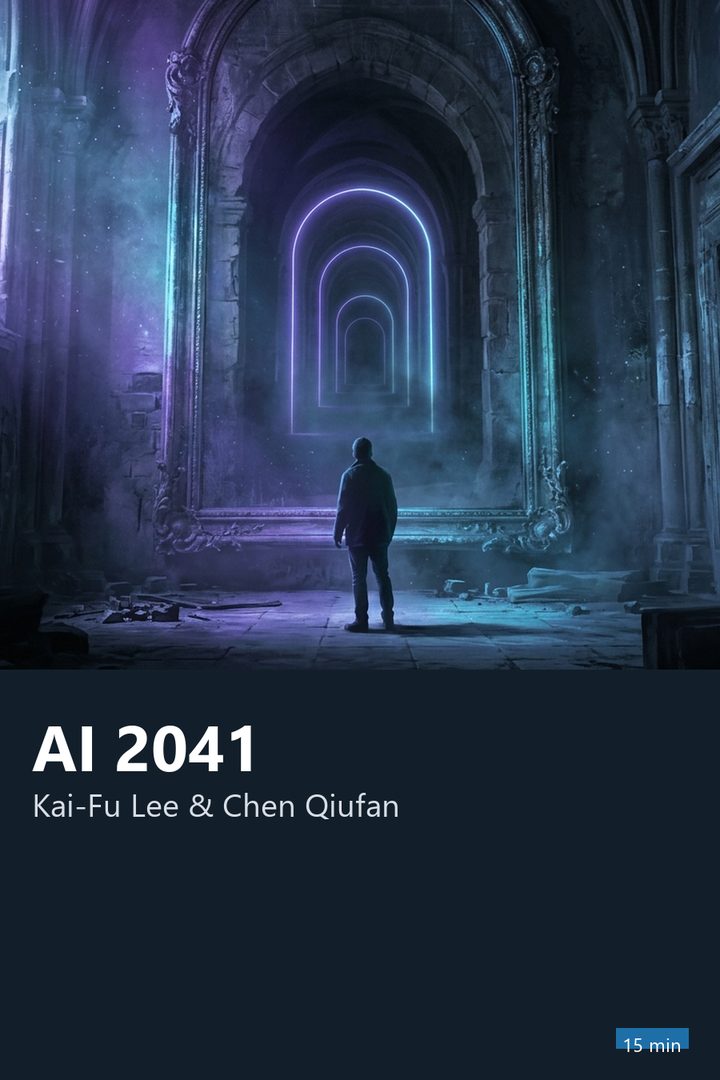
Cover of AI 2041

Technology and the Future · 16 min

AI 2041

Kai-Fu Lee & Chen Qiufan · 2021

Who it's for

For anyone who hears about artificial intelligence every day, yet struggles to separate reality from hype. This book is for readers who enjoy learning through stories and want to imagine how technology will shake up jobs, privacy, and human relationships.

Read it in the app

⚡ Free to download • 🎁 One full book free every day

🎧 Audio coming soon in the app

Narration for the English summaries is on its way. Meanwhile you can read the full summary in the app.

3 ideas to take with you

1

A system that learns from past data can repeat the injustices of that past, only now wearing a mask of mathematical neutrality.

2

When any video can be fabricated, the challenge is no longer spotting the lie, but rebuilding trust in the sources.

3

If machines take over a large share of our work, the central question stops being technical and becomes a question about what gives life meaning.

“
A system that is good at a narrow task does not understand the world; it only recognizes patterns, and it is wise to remember that before trusting it.
An idea from AI 2041, in the words of 15 Minutes

Preview

Start reading now

Ten stories, ten possible futures

AI 2041 blends fiction and technical explanation in an unusual way. It features ten short stories set twenty years from now in different countries, and each one is followed by an essay that explains the technology behind the story and how much of it already exists today.

The goal is for the reader to feel the future before understanding it. A story about life insurance or a driverless car sticks in your memory much better than a chart about research investment, and the essay that follows brings your feet back to the ground.

Kai-Fu Lee handles the technical side, while Chen Qiufan, a science fiction writer, handles the plots. Together, they try to answer a simple question: what will it be like to live with intelligent machines in 2041, and what can we decide right now so that this future turns out well?
Why a book that is half story, half essay

The format serves a practical purpose. Technical texts about artificial intelligence usually push away people outside the field, while fiction tends to exaggerate without any commitment to reality. The book tries to stay right in the middle, offering plausible stories and explanations that do not require a degree.

The authors make it clear that they are not making exact predictions. They call the results visions, scenarios extrapolated from trends that are already showing up in labs and companies. Their bet is that most of the technologies described will be available by 2041, even if not in the exact way the plots portray them.

This caution matters for the reader. Instead of accepting everything as prophecy, you are invited to look at each story as an exercise in imagination, discuss what seems likely and what feels forced, and then check the technical text to see how well each idea holds up.

Deep learning in plain words

The foundation of almost everything in the book is deep learning, a technique in which a program learns patterns from massive amounts of examples instead of following rules written by a person. That is how your phone recognizes your face or how an app translates a sentence.

The main point is that the system does not understand the world the way we do. It finds statistical relationships between inputs and outputs. Show it millions of cat photos, and it learns to recognize cats. Show it millions of customer histories, and it learns to predict who will pay their bill on time.

The authors explain that this method works very well for specific, narrow tasks, yet it is fragile outside of them. A system that is great at playing chess knows nothing about cooking. Understanding this limitation helps us neither fear nor overestimate what machines do today.

11 more sections and the quiz

Continue in the app

Read the whole summary, finish with the AI 2041 quiz and follow the guided Journeys. No ads in the app.

About Kai-Fu Lee & Chen Qiufan

Kai-Fu Lee is a Taiwanese computer scientist and businessman who holds a PhD from Carnegie Mellon and previously worked at Apple, Microsoft, and Google in China. He founded Sinovation Ventures, a fund that invests in tech companies, and previously wrote the book AI Superpowers. Chen Qiufan, also known as Stanley Chan, is a Chinese science fiction writer and author of the novel Waste Tide. Together, the two co-authored this work, published in 2021.

Explore