15 Minutes
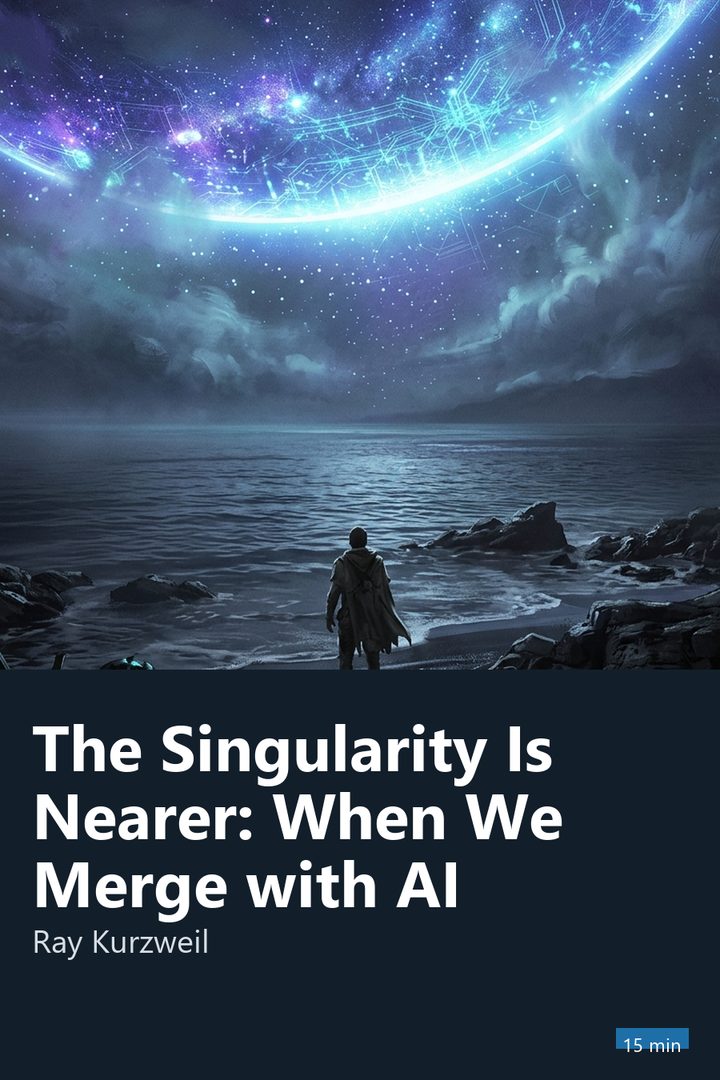
Cover of The Singularity Is Nearer: When We Merge with AI

Technology and the Future · 17 min

The Singularity Is Nearer: When We Merge with AI

Ray Kurzweil · 2024

Who it's for

For anyone who wants to understand, in plain language, why so many people say artificial intelligence will reshape work, health, and identity in the coming years. It is ideal for anyone curious about technology and anyone who wants to debate the future with solid arguments.

Read it in the app

⚡ Free to download • 🎁 One full book free every day

🎧 Audio coming soon in the app

Narration for the English summaries is on its way. Meanwhile you can read the full summary in the app.

3 ideas to take with you

1

In the book's timeline, each leap in history arrived faster than the one before because it built on what the previous stage left ready.

2

For Kurzweil, health and medicine are becoming information problems, which means they could accelerate just like computing.

3

Discussing technology requires looking at the benefits and the risks at the same time, without cheerleading or panic.

“
Anyone who treats the future like a straight line usually gets the math wrong: some things double, and doubling changes everything.
An idea from The Singularity Is Nearer: When We Merge with AI, in the words of 15 Minutes

Preview

Start reading now

A Bet with a Set Date

Few authors are willing to put a specific year on their own predictions. Ray Kurzweil is. In The Singularity Is Nearer, he argues that around 2029 an artificial intelligence will match a human being in general language and reasoning tasks, and that around 2045 the merging of the human mind and machine will multiply our intelligence in ways that are hard to imagine.

That second moment is what he calls the singularity: the point from which progress becomes so fast and so deep that life as we know it stops serving as a yardstick for predicting what comes next. The word comes from physics and mathematics, where it describes a point at which standard calculations stop working.

The book is the sequel to an earlier work by the same author from 2005, and it serves as an accounting of sorts: what panned out, what is still missing, and why he is still placing his bets. It is worth reading as a thesis to be evaluated rather than a prophecy to be accepted.
The Yardstick That Doubles

The idea holding everything together is exponential growth. When something grows linearly, you add the same amount at every step. When it grows exponentially, it multiplies. Thirty linear steps take you about thirty yards. Thirty doublings take you past a billion. Our intuition was trained for the first kind of math, which is why the second always catches us off guard.

Kurzweil calls this pattern the law of accelerating returns: technologies that can be measured in information, such as computing, gene sequencing, and data storage, improve quickly and get cheaper, and each breakthrough helps build the next. The famous Moore's law, about microchips, is just one chapter in a much longer story that started before transistors.

Think about a budget smartphone that plenty of people buy on a monthly payment plan. It has more computing power than machines that once filled entire rooms and cost a fortune. For the author, this drop in price per unit of computation is the invisible engine that makes almost everything else he describes in the book possible.

Six Epochs, from Physics to the Expanded Mind

To give the discussion scale, the author organizes history into six epochs. In the first, there are only physics and chemistry. In the second, life emerges and stores information in DNA. In the third, animals develop brains capable of processing the world. In the fourth, humans create tools and digital technology that store and expand what the brain does.

The fifth epoch, which he believes we are now entering, is the merger of biological intelligence and artificial intelligence. The sixth, far more speculative, would see the entire universe saturated with intelligence, something the text treats as a distant horizon rather than a dated forecast.

The value of this ladder is how it shows that each leap happened faster than the last and used what the previous one produced. It also makes the book's style of argument clear: it is not a list of gadgets, but an attempt to see a long curve and ask where it will likely go next.

10 more sections and the quiz

Continue in the app

Read the whole summary, finish with the The Singularity Is Nearer: When We Merge with AI quiz and follow the guided Journeys. No ads in the app.

About Ray Kurzweil

Ray Kurzweil was born in 1948 in New York and is an inventor, author, and futurist. He created pioneering technologies in optical character recognition, speech synthesis, and electronic musical instruments, and he received the U.S. National Medal of Technology in 1999. Since 2012, he has worked at Google as a director of engineering. His previous books include The Age of Spiritual Machines, The Singularity Is Near, and How to Create a Mind.

Explore