15 Minutes
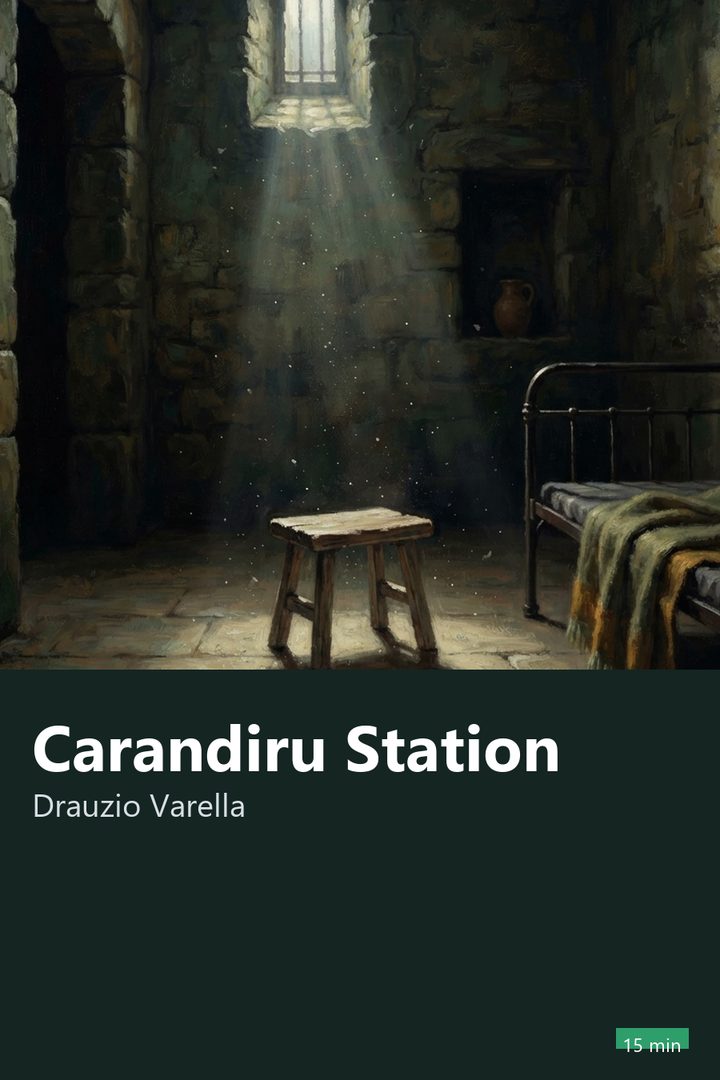
Cover of Carandiru Station

Health · 16 min

Carandiru Station

Drauzio Varella · 1999

Who it's for

Original title (Portuguese): Estação Carandiru. For you if you want to understand the Brazilian prison system beyond the newspaper headline, through the account of someone who went inside for years as a volunteer doctor. Carandiru Station is a read for people who can look straight at violence, disease, and the failure of the state without walking away convinced they already knew everything.

Read it in the app

⚡ Free to download • 🎁 One full book free every day

🎧 Audio coming soon in the app

Narration for the English summaries is on its way. Meanwhile you can read the full summary in the app.

3 ideas to take with you

1

Preventing disease inside a prison depends less on pamphlets and more on trust built one visit at a time.

2

A prison sentence also punishes the people waiting on the outside, in the visiting line and in a household budget that has to balance on one income.

3

Decades after Carandiru closed, prison overcrowding in Brazil is still the same structural problem the book already described.

“
Prison makes its own law when the state cannot guarantee even the basics inside.
An idea from Carandiru Station, in the words of 15 Minutes

Preview

Start reading now

A doctor who became a regular visitor to the prison

Drauzio Varella is an oncologist, trained at the University of São Paulo, known for decades of work fighting cancer. In 1989 he began going into the São Paulo House of Detention, Carandiru, as a volunteer, trying to slow an AIDS epidemic that was spreading fast among the inmates, at a time when the disease still killed almost everyone who caught it.

The original plan was to stay a short while, give a talk, put together a pamphlet, and go back to his usual office. That is not what happened: he ended up returning every week for more than a decade, until he became a kind of trusted doctor in a place that trusted no outsider.

This summary tells what he saw and heard in those years inside the cell block, without romanticizing or demonizing the people locked up there. It is the account of a middle-class man trying to understand a reality that most Brazilians only see from a distance, through the bars of a newspaper headline.


A whole city squeezed behind a wall

Carandiru was designed to hold about four thousand inmates and at one point had more than double that living within its walls. Each cell block worked almost like its own neighborhood, with its own daily schedule and its own way of organizing the line for showers and meals.

This overcrowding was not a background detail, it was the problem running through everything: cells meant for four inmates holding twice that, mattresses on the floor, lines for everything. The book shows that much of the tension inside the prison came straight from that math that never added up.

Even so, there was a recognizable routine: work in workshops, classes, visits on set days, lockdown time. In official documents, each inmate was recorded by the term "reeducando" (a bureaucratic label for someone serving a sentence), a language that contrasts with the informal way they talked to each other inside the cell block.

The rules nobody wrote down but everybody follows

Inside the cell block there was a code of conduct that appeared in no official regulation, and that the inmates themselves enforced among each other. Debts incurred inside the prison had to be paid, informants were treated with contempt, and crimes against children or rape drew internal punishment much harsher than most other offenses.

This code worked as a kind of parallel law, created because the state, in there, could barely guarantee basic safety. Those who understood and respected the informal hierarchy among the inmates had a better chance of getting through their sentence without serious trouble; those who ignored the prison's rules ran a real risk.

The book does not treat this code as something nice or fair, but as a fact: with the state almost entirely absent inside the cells, the inmates built their own system of order, with rewards and punishments defined by themselves, not by the law outside the wall.

13 more sections and the quiz

Continue in the app

Read the whole summary, finish with the Carandiru Station quiz and follow the guided Journeys. No ads in the app.

About Drauzio Varella

Drauzio Varella is a Brazilian oncologist, trained at the University of São Paulo School of Medicine, with decades of work in cancer treatment and research. Starting in 1989, he began volunteering at the São Paulo House of Detention, known as Carandiru, on AIDS prevention efforts. Besides Carandiru Station, he has published other books about medicine and about his experience in the prison system, and he remains active as a columnist and health educator.

Explore

Category:
Health
Part of the Journeys:
Witnesses to History