15 Minutes
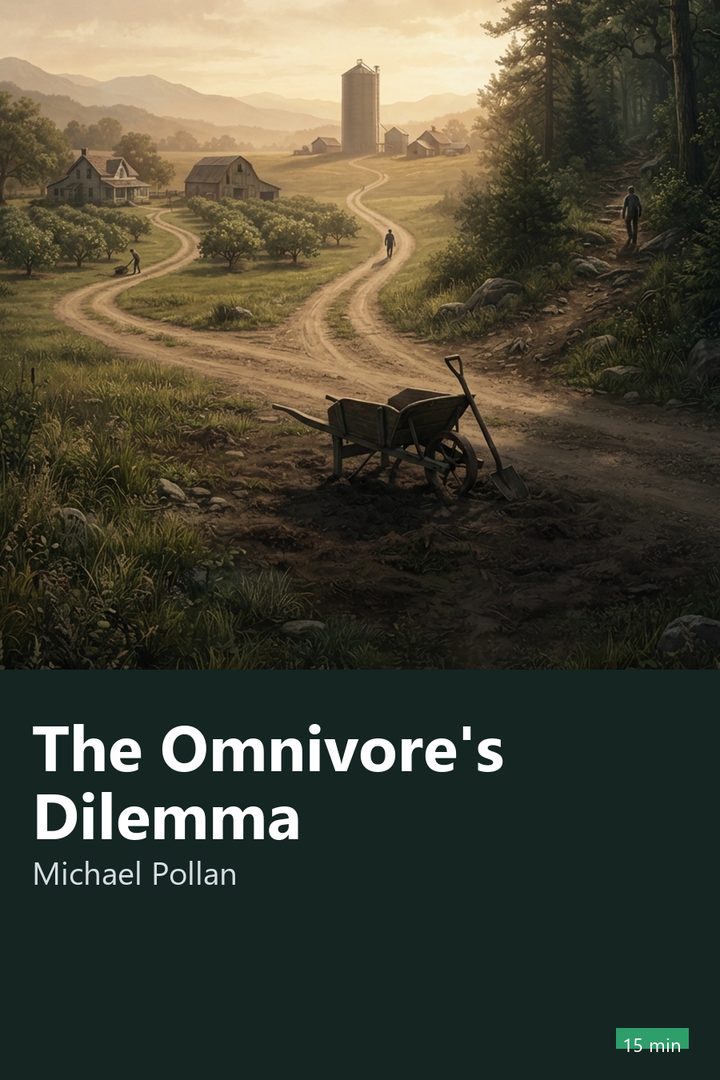
Cover of The Omnivore's Dilemma

Health · 16 min

The Omnivore's Dilemma

Michael Pollan · 2006

Who it's for

For anyone who has ever wondered what exactly is on their plate and where it came from before it got there. It is also for those who feel that labels like organic, natural, or homemade promise more than they explain.

Read it in the app

⚡ Free to download • 🎁 One full book free every day

🎧 Audio coming soon in the app

Narration for the English summaries is on its way. Meanwhile you can read the full summary in the app.

3 ideas to take with you

1

A meal that seems to have dozens of different ingredients can, at its source, come almost entirely from the same cornfield, disguised under different names.

2

A label guarantees that a rule was followed. It does not, on its own, guarantee that the food is local, small-scale, or fairer to the people who produced it.

3

On the farm Pollan visits, one animal helps solve another's problem, with no medicine or extra feed, and that shows a different way of thinking about production.

“
When incentives push everyone to plant more of the same, the one left poor at the end of the day is often the very person who planted.
An idea from The Omnivore's Dilemma, in the words of 15 Minutes

Preview

Start reading now

An animal that can eat almost anything

The starting point of the book is a simple question: what am I going to eat today? A koala never has to ask itself that, because it only eats eucalyptus leaves. Humans can digest meat, vegetables, grains, and dairy all at once, and all that freedom becomes a problem: every meal demands a new choice.

Pollan calls this the omnivore's dilemma. Anyone who can eat everything has to decide what is worth eating, and today that decision runs through a system full of labels, advertising, and contradictory information, very different from the days when family tradition made the choice for you.

To understand this maze, the author decides to trace four meals back to their origins: one from a fast-food restaurant, one bought at an organic supermarket, one from a small farm he visits, and one he hunts, gathers, and grows himself. The idea is to follow each plate backward until reaching the soil, the animal, or the plant that gave rise to it.

The industrial chain: corn becomes king

The first chain the book follows starts in a cornfield in the American Midwest. Pollan shows how this plant became the hidden foundation of almost everything people eat there: it is not just popcorn or cornmeal, it is syrup for soda, feed for cattle and chickens, and a disguised ingredient inside processed products.

The problem is one of scale. The United States produces too much corn, year after year, because farm incentives push growers to plant more and more, even when prices are low. That surplus needs somewhere to go, and industry takes advantage of this cheap leftover to fatten animals and sweeten drinks on an industrial scale.

The average consumer cannot see this dependence on the label. A soda, a chicken nugget, a cookie, all of them carry a piece of corn under some other chemical name. Pollan treats this not as a conspiracy but as the consequence of a crooked farm incentive that industry knew how to exploit.

Steer 534: from pasture to feedlot

To make the system concrete, Pollan buys a calf identified as steer 534 and follows its life. The animal is born on a pasture, nursing on its mother's milk, but is soon moved to a feedlot, a crowded yard holding thousands of head of cattle where the diet changes to large amounts of ground corn.

The problem is that a steer is a herbivore adapted to digest grass, not grain. A corn-heavy diet fattens the animal much faster, which suits industry, but it also makes the steer's rumen more acidic, opening the door to disease and requiring a constant dose of antibiotics just to keep the animal on its feet until slaughter.

Pollan describes the feedlot soberly: it is not a scene of gratuitous horror, it is an efficient production line designed to deliver cheap meat in large volume. The price of that efficiency shows up hidden: in the heavy use of drugs, in the smell, in the risk of contamination by resistant bacteria.

12 more sections and the quiz

Continue in the app

Read the whole summary, finish with the The Omnivore's Dilemma quiz and follow the guided Journeys. No ads in the app.

About Michael Pollan

Michael Pollan is an American journalist and professor, born in 1955, known for decades of reporting on food, agriculture, and nature for The New York Times Magazine. He holds a chair in science and environmental journalism at the University of California, Berkeley. The Omnivore's Dilemma, published in 2006, was the book that made him a national name and won awards such as the James Beard Award. After it, Pollan wrote other books on food and health, including In Defense of Food and Cooked.

Explore

Category:
Health
Part of the Journeys:
Eat Better