15 Minutes
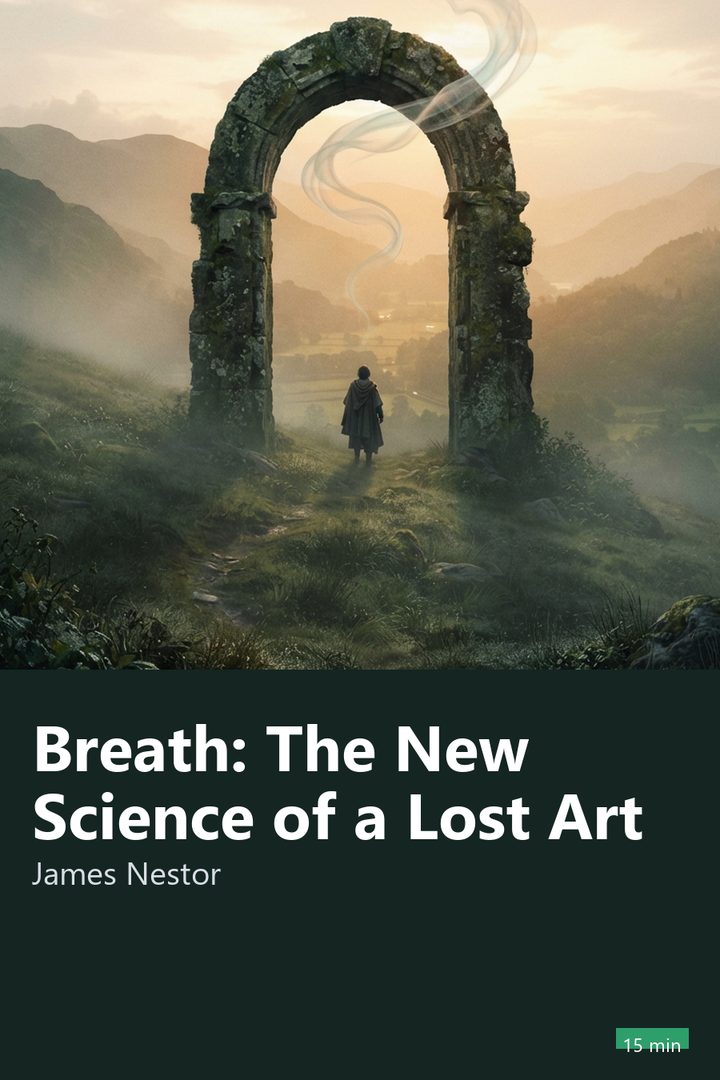
Cover of Breath: The New Science of a Lost Art

Health · 17 min

Breath: The New Science of a Lost Art

James Nestor · 2020

Who it's for

For anyone who has always breathed without thinking about it and keeps feeling tired, stuffed up, or sleeping badly without knowing why. Breath is for people who want to understand why the way you pull in air can matter as much as the food on your plate or a good night's sleep.

Read it in the app

⚡ Free to download • 🎁 One full book free every day

🎧 Audio coming soon in the app

Narration for the English summaries is on its way. Meanwhile you can read the full summary in the app.

3 ideas to take with you

1

The sinuses release a meaningful amount of nitric oxide only when air passes through the nose, and this gas helps widen blood vessels and get oxygen circulating better.

2

Emptying your lungs well before taking the next breath swaps more old air for fresh air on every cycle, which usually matters more than simply breathing in deeply.

3

According to the studies cited in the book, breathing in and out for about five and a half seconds each is the rhythm that comes closest to a measurable state of calm in the body.

“
Ten days of breathing only through the mouth were enough for blood pressure to rise, sleep to get worse, and snoring to appear, according to the experiment Nestor ran on himself with another volunteer.
An idea from Breath: The New Science of a Lost Art, in the words of 15 Minutes

Preview

Start reading now

A breathless journalist decides to investigate breathing

James Nestor is neither a doctor nor a scientist: he is a journalist who, after his previous book on freediving, realized he was constantly out of breath, catching colds often, and tired for no apparent reason. In a breathing class he took out of curiosity, an instructor told him that almost nobody breathes the right way, and he left intrigued.

The question that drives the whole book is simple: if breathing is the most basic thing a body does, why does nobody learn to do it properly? Doctors treat the lungs, nose, and throat separately, but they rarely look at breathing as a habit that can be learned and corrected, the way you learn to eat better.

To answer it, Nestor tracked down researchers at Stanford, dug into archives of ancient skulls, visited practitioners of age-old techniques, and tested a good share of the findings on his own body, including the most uncomfortable experiment in the book, the one that opens the story.


Ten days with a plugged nose: the Stanford experiment

The starting point of the book is a real experiment, carried out with researcher Jayakar Nayak of Stanford University. Nestor and another volunteer had their nostrils blocked with silicone and tape, spending ten days breathing exclusively through the mouth, day and night, while devices measured blood pressure, sleep, and blood gas levels.

The results of those first ten days were bad for both of them. Blood pressure went up, sleep got worse, snoring showed up with a vengeance, and the overall feeling was one of exhaustion, even without any new illness. Breathing only through the mouth, which many people do without noticing while they sleep, showed a measurable cost in just a few days.

In the next phase, with the nose unblocked, the two switched to breathing exclusively through the nose, including specific techniques for rhythm and air volume. The measurements began to improve: lower blood pressure, steadier sleep, less snoring. The experiment becomes the book's common thread because it shows, in numbers, a difference most people have never stopped to feel.

It is worth noting that this experiment involved only two people, Nestor himself and one volunteer. It is a vivid personal account, useful for illustrating the book's argument, but it does not replace a study with hundreds of participants, something the critique section of this summary returns to later.

The nose is not just for smelling

The nose filters particles, warms, and humidifies air before it reaches the lungs, a job the mouth does not do. Breathing through the mouth sends dry, dirty air straight to the throat, which irritates the airways and makes infection easier.

A lesser-known detail is that the sinuses produce nitric oxide, a gas that helps widen blood vessels and improves how oxygen reaches the body. This gas only enters the body in meaningful amounts when air passes through the nose, not the mouth.

Putting the two effects together, filtering and nitric oxide, the book argues that breathing through the nose, even during exercise, tends to deliver more usable oxygen with less effort than breathing through the mouth, even if opening your mouth seems easier when you are short of breath.

12 more sections and the quiz

Continue in the app

Read the whole summary, finish with the Breath: The New Science of a Lost Art quiz and follow the guided Journeys. No ads in the app.

About James Nestor

James Nestor is an American journalist whose work has appeared in outlets like The New York Times, Outside, and Scientific American. Before Breath, he wrote Deep, a 2014 book about freediving and the limits of the human body underwater. For Breath, published in 2020, he spent years interviewing researchers, testing techniques on himself, and weaving recent science together with ancient breathing practices. The book became an international best-seller and helped popularize breathing as a trainable habit.

Explore

Category:
Health
Part of the Journeys:
Truly Rest