15 Minutes
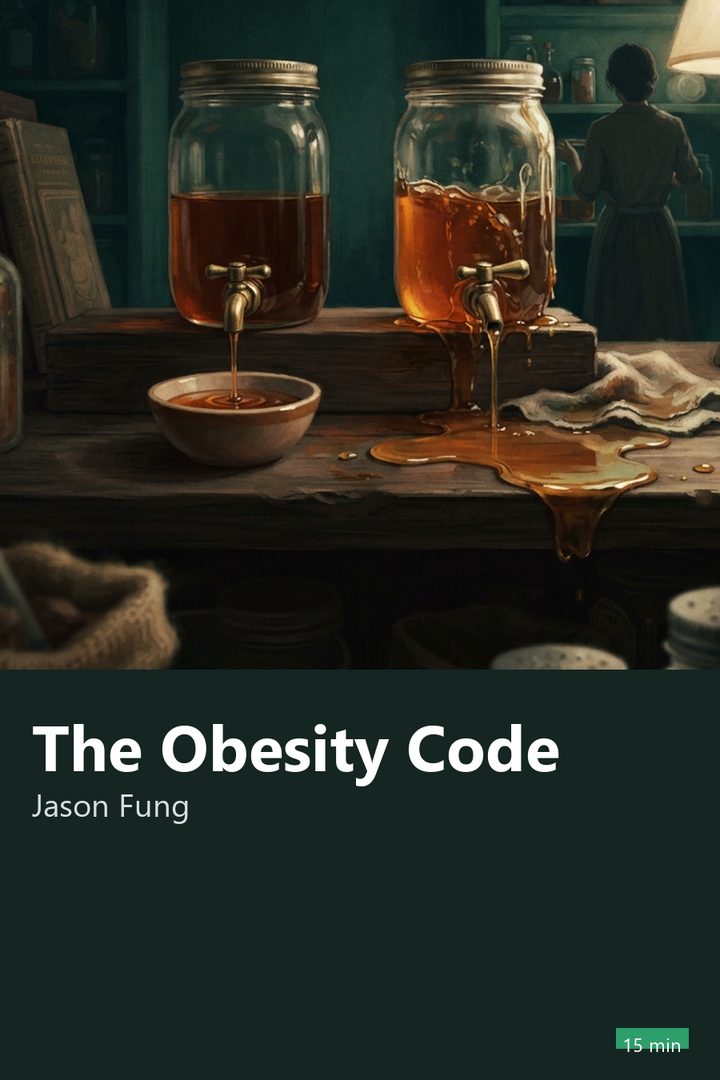
Cover of The Obesity Code

Health · 16 min

The Obesity Code

Jason Fung · 2016

Who it's for

For you if you've tried to lose weight by counting calories, succeeded for a while, then watched the weight come back, and you want to understand why your body sometimes seems to row against your own diet.

Read it in the app

⚡ Free to download • 🎁 One full book free every day

🎧 Audio coming soon in the app

Narration for the English summaries is on its way. Meanwhile you can read the full summary in the app.

3 ideas to take with you

1

For Fung, treating obesity as a hormonal disease rather than a character flaw changes the entire target of treatment: the problem stops being willpower and becomes how the body is regulated.

2

Poor sleep scrambles the hormones of hunger and fullness, so people who sleep badly wake up craving junk food the next day, and that has nothing to do with discipline.

3

Swapping refined flour and ultraprocessed food for food with its original fiber, like beans, lentils and brown rice, softens the insulin spike of a meal without requiring any radical carb cutting.

“
For Fung, the body reacts to eating less by slowing the metabolism, which explains why the same diet that worked in month one can stop working in month six.
An idea from The Obesity Code, in the words of 15 Minutes

Preview

Start reading now

An epidemic that no diet has solved

Over the past forty years the number of obese people has multiplied almost everywhere in the world, right in the period when more people than ever were counting calories, buying light products and following medical advice to eat less and move more. If the math were that simple, the result should have been the opposite.

Jason Fung writes as a doctor who saw this contradiction every day: a Canadian nephrologist, he treated the kidneys of diabetic and obese patients and noticed that the standard advice, eat less and burn more, rarely held up after a few months. People would lose a little weight, and then it would come back, almost always with interest.

The book is born from this practical frustration: if the treatment doesn't work for almost anyone in the long run, maybe the diagnosis of the cause has been wrong from the start. That question drives the rest of the argument.


The myth of just counting calories

The logic seems unquestionable: if you take in less energy than you burn, you lose weight; if you take in more, you gain. It's the foundation of every diet app. The problem, according to Fung, is treating the body like a passive calculator that just stores the surplus without reacting to anything.

For Fung, the body is a system that adjusts: when you cut back on food for weeks in a row, your metabolism slows down and your hunger rises, so the same restriction that made you lose weight in month one stops working in month six. He argues that calorie math describes the result but doesn't explain why the body chooses to store fat instead of burning it.

You can see this in anyone who has tried: you shrink your lunch at work, white-knuckle the afternoon hungry, get home and snack on double the amount at dinner without noticing. A month later, the scale is the same or worse, and the blame falls on willpower, when the body was simply reacting the way bodies react.

Obesity as a hormonal disease, not a character flaw

The central proposal of the book is to change the question. Instead of asking why a person eats too much, Fung asks why their body decides to store so much fat, even when they eat little. To him, obesity looks more like a hormonal disease than a simple lack of willpower.

This switch changes the entire target of treatment: if the problem is hormonal, simply recommending discipline helps very little, because the hormone sends an order that discipline alone can't easily override. Fung uses this to argue that blaming obese patients for lack of effort is unfair and clinically inaccurate.

A common example in the doctor's office: someone who goes to the gym three times a week, cuts soda, controls portions on the plate and still doesn't lose weight at the speed that effort would suggest. For those who follow the hormonal model, the explanation isn't hidden laziness, it's that the body's internal machinery is set to store, not to release.

11 more sections and the quiz

Continue in the app

Read the whole summary, finish with the The Obesity Code quiz and follow the guided Journeys. No ads in the app.

About Jason Fung

Jason Fung is a Canadian nephrologist based in Toronto who specializes in kidney disease. He became known for advocating intermittent fasting in the treatment of obesity and type 2 diabetes, based on his own clinical experience with diabetic patients. He is the author of other books on the same subject, including The Diabetes Code. The Obesity Code was originally published in 2016.

Explore

Category:
Health
Part of the Journeys:
Eat Better