15 Minutes
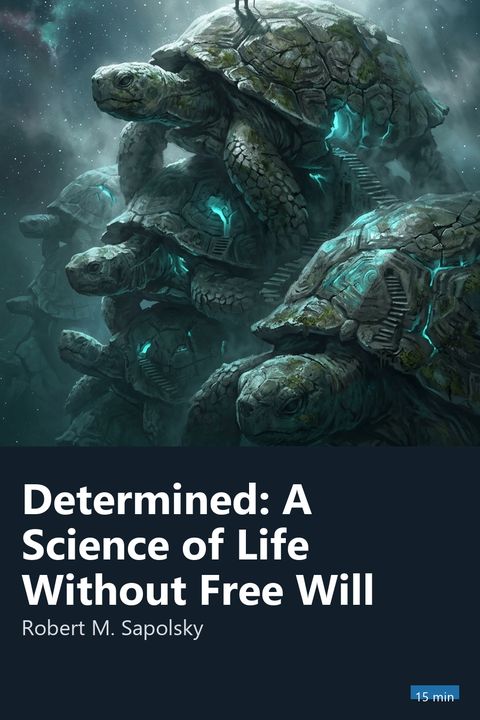
Cover of Determined: A Science of Life Without Free Will

Science · 15 min

Determined: A Science of Life Without Free Will

Robert M. Sapolsky · 2023

Who it's for

For anyone interested in neuroscience, philosophy, and justice who's willing to consider an argument that challenges common assumptions about blame and merit.

Read it in the app

⚡ Free to download • 🎁 One full book free every day

🎧 Listen to this summary in the app

Every summary has audio narration. Open the app to read it or listen to it.

3 ideas to take with you

1

In the book's view, discipline and self-control also depend on factors no one chose, such as sleep, nutrition, and childhood.

2

If punishment stops being about revenge, the focus of justice shifts toward protecting society and preventing future crimes.

3

Accepting that causes shape behavior doesn't stop us from acting, because our present actions are part of what causes the future.

“
When someone makes a mistake, asking what explains the act changes the tone of the conversation.
An idea from Determined: A Science of Life Without Free Will, in the words of 15 Minutes

Preview

Start reading now

A Radical Argument in the Language of the Lab

Robert Sapolsky, a neuroscientist and primatologist, has written a book defending an idea many people find offensive: free will does not exist. Everything we do, think, and choose, he argues, results from biological and environmental factors over which we have never had control.

He presents this argument not as a philosopher's opinion, but as the conclusion of decades of research on the brain, hormones, genes, and development. According to him, the further science advances, the less room remains for an autonomous self that makes decisions above it all. A freely chosen act, ultimately, would be a persuasive illusion.

The book doesn't deny that we make decisions, weigh options, and feel that we're choosing. What it denies is that these choices originate in anything independent of prior causes. That leads to consequences for justice, morality, and everyday life, which occupy much of the book's final pages.
The Case of the Shooter with a Tumor

The starting point is a dramatic story. In 1966, a young American named Charles Whitman shot and killed several people from a university tower in Texas. Beforehand, he had written that he was experiencing violent thoughts and asked that his brain be examined after his death.

The autopsy revealed a tumor near the amygdala, a region associated with fear and aggression. For many people, this changes the moral judgment: he wouldn't be entirely responsible, because something in his brain pushed him. Sapolsky uses the case to ask an uncomfortable question.

The question is: why does the tumor move us while other causes don't? If a visible change in the brain reduces blame, why wouldn't an invisible change, caused by genes, a difficult childhood, or hormones, do the same? The distinction between a diseased brain and a normal brain, he says, is arbitrary.

The Chain of Causes, All the Way Back

The central reasoning is an investigation that works backward. Faced with a behavior, ask what happened one second earlier: activity in certain neurons. One minute earlier: what the person saw or heard. Hours earlier: hormone levels, sleep, hunger. Days, months, years earlier: accumulated experience.

Keep going, and we reach adolescence, when the brain is still developing, then childhood, the environment in the womb, and inherited genes. Further back lie the culture of our ancestors and the evolution of our species. The author's image is of turtles stacked one on top of another, all the way down.

At no step on this ladder is there a moment when a self breaks free of causes and chooses out of nowhere. Every explanation moves the question backward, but never finds the point where someone originated the act. For him, that absence is what makes free will untenable.

10 more sections and the quiz

Continue in the app

Read the whole summary, finish with the Determined: A Science of Life Without Free Will quiz and follow the guided Journeys. No ads in the app.

About Robert M. Sapolsky

Robert Sapolsky is a professor of biology and neurology at Stanford University and spent decades studying baboons in Kenya. He received a MacArthur Fellowship, known as the genius grant, in 1987. He wrote Behave and other books about stress and behavior. Determined was published in 2023.

Explore

Category:
Science