15 Minutes
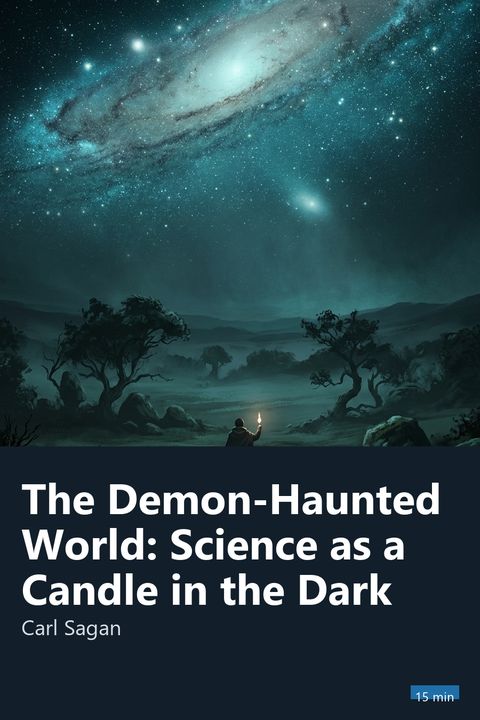
Cover of The Demon-Haunted World: Science as a Candle in the Dark

Science · 15 min

The Demon-Haunted World: Science as a Candle in the Dark

Carl Sagan · 1995

Who it's for

For you if you receive startling messages every day and want to know how to separate fact from nonsense. This is a classic guide to critical thinking, written with a passion for science.

Read it in the app

⚡ Free to download • 🎁 One full book free every day

🎧 Listen to this summary in the app

Every summary has audio narration. Open the app to read it or listen to it.

3 ideas to take with you

1

For the author, the hallmark of science is its ability to self-correct, so changing a conclusion shows that the method is working.

2

The catalog of reasoning errors helps you recognize tricks in advertising, speeches, and chain messages.

3

According to the book, the persecution of witches shows the cost of accepting accusations without proof, a useful lesson for the social media age.

“
An idea that no test can disprove cannot prove anything either.
An idea from The Demon-Haunted World: Science as a Candle in the Dark, in the words of 15 Minutes

Preview

Start reading now

A Candle Burning in the Dark

Carl Sagan wrote this book, published in 1995, out of a concern that still feels relevant: well-meaning people accept strange ideas without examining them, while science, which could help distinguish truth from falsehood, is seen as something for specialists. The original edition's subtitle compares science to a candle burning in the dark, small but capable of driving back shadows.

The haunted world of the title is one where ghosts, witches, demons, flying saucers, and miracle cures fill people's imaginations. Sagan doesn't ridicule those who believe in these things. He tries to understand why such beliefs attract so many people and what we lose when we stop checking what we hear.

His aim is twofold: to defend scientific thinking as a tool for everyone, not just scientists, and to show that skepticism and wonder go together. Someone who examines things with rigor can also marvel at what they discover.


Science Is a Way of Thinking

For the author, science is less a body of knowledge than a method for avoiding being fooled. It proposes hypotheses, tests them, accepts that it can be wrong, and changes course when contradictory evidence emerges. This capacity for self-correction is what distinguishes it from other belief systems.

This matters because many people think science is synonymous with certainty. In fact, it's the opposite: an organized way of dealing with uncertainty. When a study changes its conclusion, that doesn't mean failure. It means the method is working.

This way of thinking is within anyone's reach. If you compare prices before buying, test whether a home remedy really works, or check a news story against more than one source, you're already using the spirit of science in everyday life.

There's also an element of humility: no scientist, however famous, is above criticism. An appeal to authority, where something is true simply because someone important said it, carries little weight in this method. What counts is supporting evidence, which anyone can examine and discuss.

The Allure of Strange Ideas

Sagan devotes much of the book to beliefs that spread despite a lack of proof. He discusses faces in photographs of other planets' surfaces, reports of contact with beings from other worlds, apparitions, and supernatural powers. This isn't always a matter of dishonesty: many people genuinely believe what they saw.

He explains that the human brain is good at recognizing patterns, which helped us survive, but also leads us to see faces in clouds, intentions in noises, and meaning in coincidences. The same quality that protected us can mislead us when rigorous testing is missing.

Understanding this mechanism helps you be kinder to believers and more careful with yourself. The question shifts from who is gullible to how we can avoid falling for errors that affect all of us.

10 more sections and the quiz

Continue in the app

Read the whole summary, finish with the The Demon-Haunted World: Science as a Candle in the Dark quiz and follow the guided Journeys. No ads in the app.

About Carl Sagan

Carl Sagan was an American astronomer and science communicator who taught at Cornell University. He participated in NASA space missions and became famous for the 1980 television series Cosmos. He wrote several books, including Contact, which became a movie. He died in 1996, shortly after publishing this book.

Explore

Category:
Science